You check your plants and notice clusters of tiny insects along the stems and new growth. Leaves may look curled or distorted, and there’s often a sticky residue forming.
That’s aphids—and they can spread faster than almost any other garden pest.
If you’re not completely sure what pest you’re dealing with, start with the Garden Pest Identification Guide.
For a full system to treat and prevent problems across your garden, see the Garden Pest Control Guide.
For natural treatment options, use the Organic Garden Pest Control guide.
Quick Answer
Aphids are soft-bodied, sap-feeding insects that reproduce rapidly and cluster on new plant growth. The most effective control is a combination of removal, repeated treatment, and improving plant conditions to prevent reinfestation.
What Aphids Are (and Why They Spread So Easily)
Aphids are small insects that feed by piercing plant tissue and extracting sap. They tend to gather in dense groups, especially on tender new growth.
What makes aphids difficult is how quickly they multiply:
- females can reproduce without mating
- populations grow exponentially in warm conditions
- colonies form before damage is obvious
They also produce honeydew, a sticky substance that attracts ants and promotes mold growth.
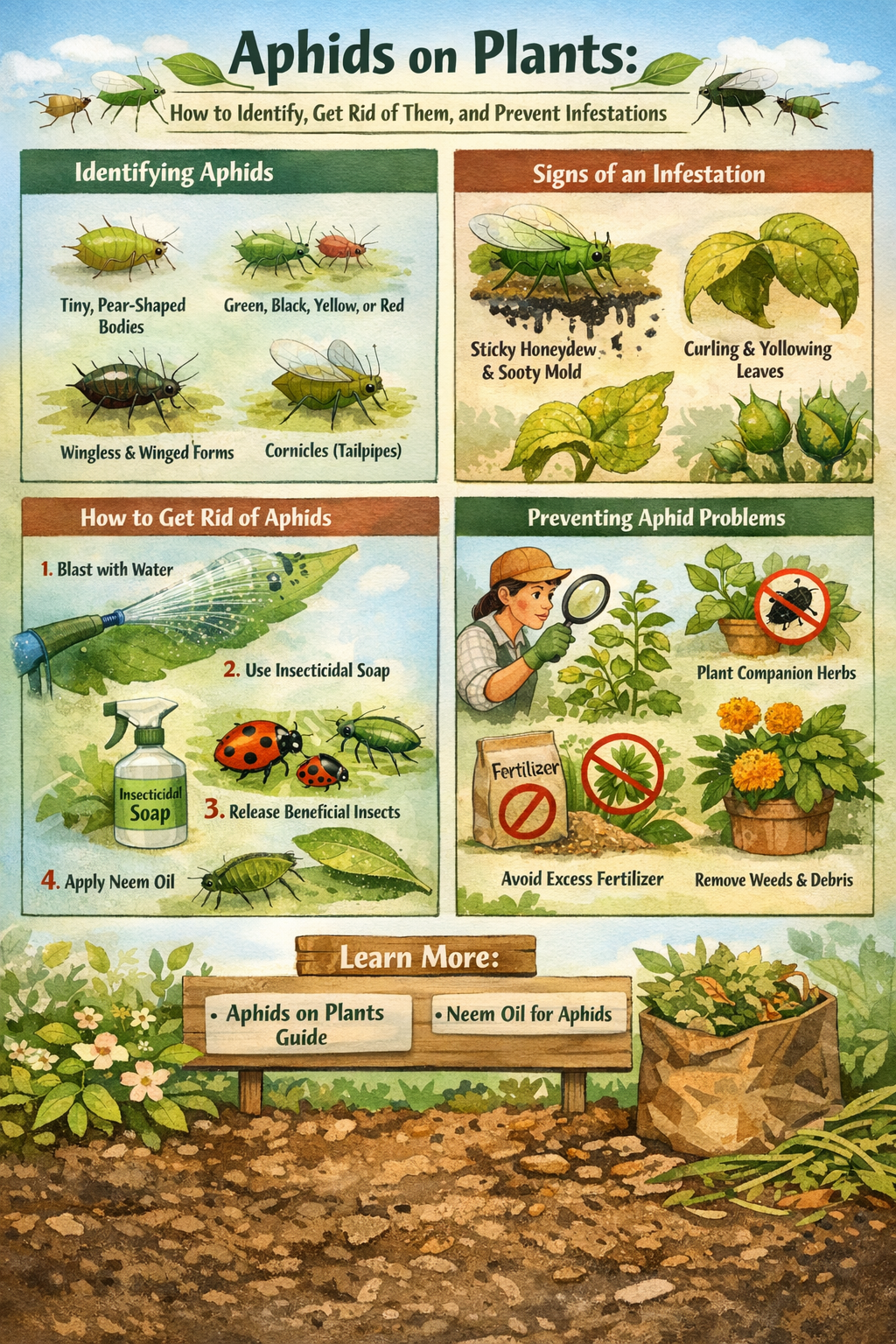
Signs of an Aphid Infestation
Aphids are usually easy to spot once you know what to look for.
- clusters of small insects on stems and leaf undersides
- curled or distorted new growth
- sticky residue on leaves (honeydew)
- increased ant activity
- black sooty mold developing on leaves
If your symptoms don’t fully match, compare with:
Why Aphids Become a Problem So Fast
Aphids don’t just reproduce quickly—they reproduce continuously.
This creates:
- overlapping generations
- constant population growth
- rapid spread across plants
Even a small colony can become a full infestation in days if not addressed.
How to Get Rid of Aphids (Step-by-Step)
The goal is not just removal—it’s breaking the cycle.
1. Spray with Water
A strong stream of water can remove large numbers of aphids quickly.
- focus on stems and leaf undersides
- repeat regularly
2. Remove Heavily Infested Growth
If certain areas are covered, prune them off.
This:
- removes entire colonies
- slows reproduction immediately
3. Apply Insecticidal Soap
Insecticidal soap is highly effective on aphids.
- works on contact
- requires full coverage
- repeat every few days
4. Use Neem Oil
Neem oil helps disrupt feeding and reproduction.
Best used:
- as a follow-up treatment
- as part of a repeated cycle
5. Control Ant Activity
Ants protect aphids because they feed on honeydew.
If ants are present:
👉 aphid populations often persist longer
What Actually Works (and What Doesn’t)
What works:
- consistent treatment cycles
- early intervention
- removing clusters directly
What doesn’t:
- waiting too long
- treating once and stopping
- ignoring ants
How to Prevent Aphids
Prevention focuses on plant health and monitoring.
- inspect plants regularly
- avoid excess nitrogen (promotes soft growth)
- encourage airflow
- watch for early clustering
Strong plants are less vulnerable. Improve overall structure with the Vegetable Gardening Guide.
Common Mistakes
- letting small colonies grow
- missing early signs on new growth
- relying on one-time treatment
- ignoring environmental factors
Where to Go Next
For related issues, see:
For disease-related problems, review Fungal Diseases in the Garden.
For hands-on work, use durable protection from Best Garden Gloves.
Conclusion
Aphids are one of the most common garden pests—but also one of the easiest to control when handled early.
The key is consistency. Once you interrupt their reproduction cycle, the infestation collapses quickly.