
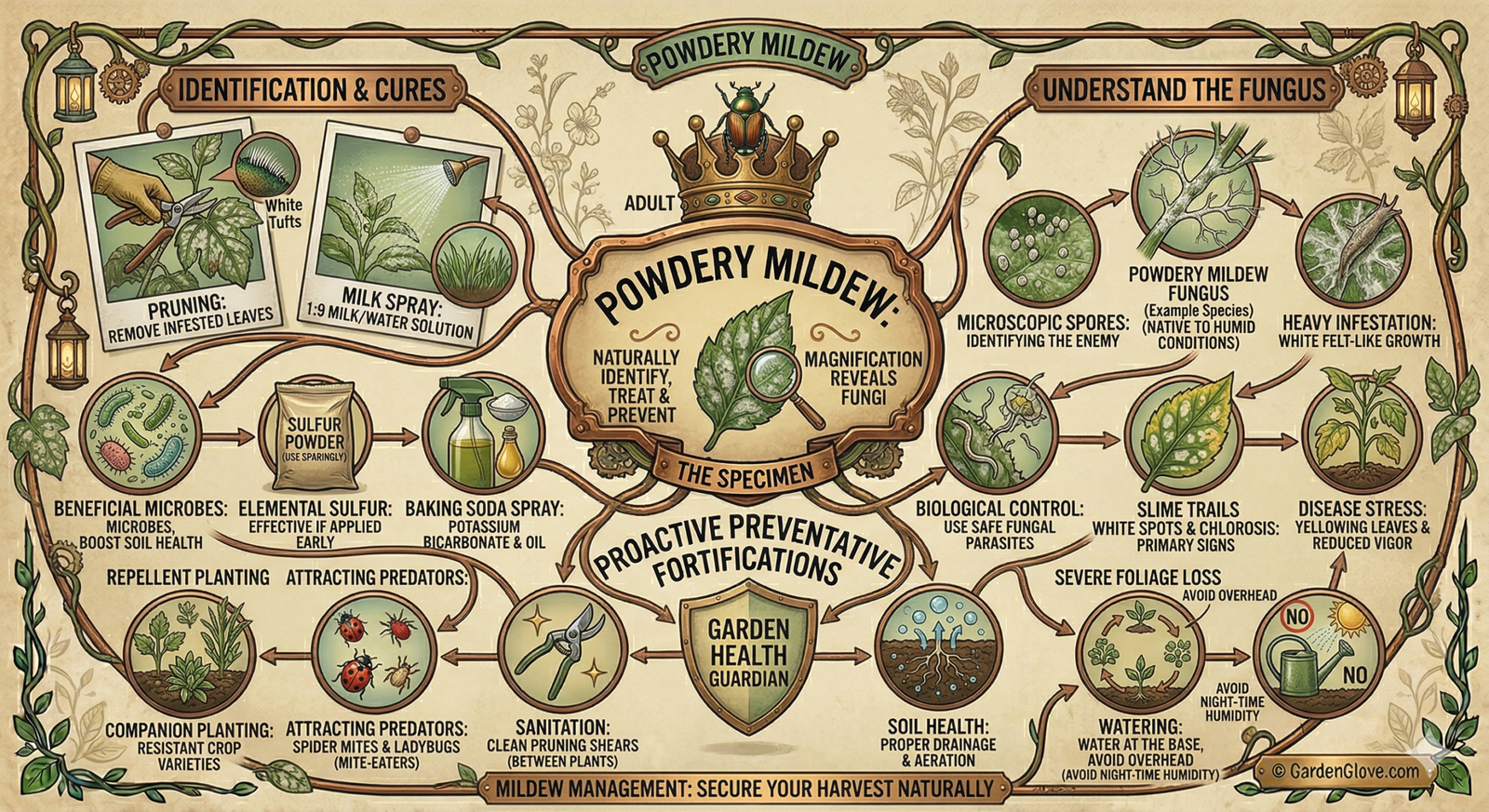
You walk out to the garden and notice the zucchini leaves look like someone dusted them with flour. A few days later it’s on the cucumbers. Then the beans. The white powder spreads fast, and once it’s established it doesn’t go away on its own. That’s powdery mildew — one of the most common fungal diseases in vegetable gardens, and one that rewards early action more than almost any other garden problem.
The good news is that powdery mildew is rarely fatal, and in most cases it’s manageable with organic treatments you can make at home. The key is catching it early, treating consistently, and changing the conditions that let it establish in the first place. For the bigger picture on diagnosing pests and plant problems naturally, see Garden Pest Control: Identify, Treat, and Prevent Common Garden Pests Naturally.
What Powdery Mildew Is
Powdery mildew is a fungal disease caused by several different species of fungi. Each species targets a specific range of plant families — the powdery mildew on your squash is not the same species as the mildew on your roses or beans. This matters because it means the disease doesn’t typically jump between unrelated crops. If your cucumbers have powdery mildew and your tomatoes don’t, the tomatoes are unlikely to catch it from the cucumbers.
All powdery mildew fungi share the same visible symptom: a white or gray powdery coating made up of fungal spores and mycelium, most often on the upper surfaces of leaves. The coating starts as small circular spots and spreads to cover increasing portions of the leaf.
Unlike many fungal diseases that require wet conditions to spread, powdery mildew is unusual because it does not need standing water to thrive. It does best in warm conditions, usually around 60–80°F, with relatively high humidity around the plant. The classic setup is warm days, cool nights, and still air in late summer or early fall. Dense plantings, shady locations, and crowded beds are the most common pressure zones.
Identification: What to Look For
Plants infected with powdery mildew look as if they have been dusted with flour. Powdery mildew usually starts as circular, powdery white spots, which can appear on leaves, stems, and sometimes fruit. It typically shows up on the upper surface of leaves first.
As infection progresses:
- Circular white spots merge into larger patches covering more of the leaf surface
- Leaves may yellow, curl, or distort around infected areas
- Severely infected leaves turn brown and die
- New growth — shoots, buds, and young leaves — is most susceptible
- In heavy infections, stems, flowers, and developing fruit may be affected
When powdery mildew coats a significant portion of the foliage, it reduces photosynthesis. That weakens the plant over time and can lower fruit quality because the plant is producing fewer sugars. This is why managing powdery mildew on cucumbers and squash matters even when the plant does not look close to death.
Powdery mildew vs. downy mildew
These are different diseases and they do not follow the same pattern. Powdery mildew appears as a white powder on upper leaf surfaces in warm, relatively dry conditions. Downy mildew appears as a grayish-purple fuzz on the undersides of leaves in cool, humid conditions. If the coating is primarily under the leaf and the weather has been wet and cool, you are likely dealing with downy mildew rather than powdery mildew.
Plants Most Susceptible
Powdery mildew affects a wide range of garden plants. In the vegetable garden, the most commonly affected crops are:
- Cucurbits — cucumbers, squash, zucchini, pumpkins, and melons
- Nightshades — tomatoes, eggplant, and peppers, though often less severely
- Legumes — beans and peas
- Brassicas in crowded or low-airflow conditions
Ornamental plants commonly affected include roses, zinnias, bee balm, lilacs, phlox, and dahlias.
The Lifecycle: Why Early Action Matters
Powdery mildew spores primarily live on plants, but they can also survive or overwinter in mulch, compost, soil, and plant debris. Spores spread from plant to plant by wind, insects, splashing water, or direct contact with infected foliage.
New plant growth is the most susceptible to infection. As conditions become favorable in late spring and summer, spores germinate on leaf surfaces and begin spreading fungal growth across the tissue. Each infected leaf then produces thousands of new spores, which means a small infection can become a canopy-wide problem fast.
The practical takeaway is simple: an infection caught at the first two or three spots can often be managed. One that has already spread through most of the plant is much harder to slow down. Check susceptible crops weekly during warm weather and begin treatment at the first sign.
Treatment: How to Get Rid of Powdery Mildew
Step 1: Remove infected material
Start by removing infected leaves, branches, and flowers. Carefully cut off infected foliage and dispose of it in the trash — do not compost it. This slows the spread and improves airflow through the plant.
Disinfect your pruning tools between cuts with rubbing alcohol or a 1:10 bleach solution so you do not transfer spores to healthy growth. For a plant that has already lost most of its productive canopy, removing the entire plant may protect the rest of the garden more effectively than repeated treatment.
Step 2: Use baking soda spray
Baking soda spray is the easiest home treatment for powdery mildew. It works by making the leaf surface slightly alkaline, which creates an environment the fungus struggles to colonize. It is best used as a preventive or very early-intervention spray.
A strong version often recommended for active management is:
- 1 tablespoon baking soda
- 2.5 tablespoons horticultural oil
- 1 gallon water
Apply to all leaf surfaces, including the undersides. The oil helps the mixture stick and adds some antifungal value. For lighter infections, a simpler mix of 1 teaspoon baking soda per 1 quart of water can work.
Always test on a small area first and wait 24 hours. Some plants are sensitive, especially in hot weather. Do not spray in direct sun or high temperatures.
Step 3: Try milk spray
Milk spray has shown surprisingly good results in trials, especially on cucumbers and squash. It appears to work both as a mild preventive and as a plant-defense booster.
Mix 1 part milk to 9 parts water for prevention, or a stronger ratio of 1 part milk to 2 parts water for active infections. Apply weekly to all leaf surfaces. Diluted milk is easier to work with than full-strength milk, which can smell unpleasant as it dries.
Step 4: Apply neem oil
Neem oil for plants is one of the better organic options for established powdery mildew infections because it disrupts spore production rather than only changing surface conditions. That makes it more useful once mildew is already spreading.
Mix neem at about 2 tablespoons per gallon of water with a small amount of dish soap as an emulsifier. Apply in the early morning or evening to reduce leaf-burn risk and avoid pollinator activity. Repeat weekly for prevention or every 5 days during active infection. For full mixing ratios, timing, and safety details, see Neem Oil for Plants: How to Use It Safely and Effectively for Pest Control.
Step 5: Use potassium bicarbonate
Potassium bicarbonate works similarly to baking soda but is generally stronger. It does more than create an unfavorable surface pH — it can damage the fungal cells directly. That makes it one of the better organic choices when the infection is active and already spreading.
Apply according to label directions, typically around 1 tablespoon per gallon, depending on the product. It works both as a preventive and as a stop-spread tool.
Step 6: Use sulfur fungicide for tougher cases
For persistent or advanced infections, sulfur-based fungicides are usually the strongest organic option. They work well as both preventive treatments and active-disease suppressants.
The main caution is timing. Sulfur can injure plants in hot weather, especially above 90°F, and should not be used within about two weeks of applying horticultural oil. Never stack sulfur and oil too closely together.
What Not to Do
Do not compost infected material. Home compost piles usually do not get hot enough to kill powdery mildew spores reliably.
Do not water foliage in the evening. If you wash spores off with water, do it early in the morning only. Wet foliage overnight increases humidity around the plant and can worsen disease pressure.
Do not ignore early spots. Powdery mildew spreads quickly. A small infection this week can become a major canopy problem by next week.
If you want the broader low-toxicity framework for deciding when to prune, spray, or change the environment first, see Organic Garden Pest Control: Natural Methods That Actually Work.
Prevention
Spacing and airflow
Proper spacing is the single most effective preventive step. Crowded plants, poor airflow, and shaded conditions create the humid microclimate powdery mildew prefers. In beds with a history of mildew, increase spacing beyond the minimum recommendation.
Sun exposure
Powdery mildew is usually worse in shade than in full sun. Place susceptible crops in the sunniest part of the garden that fits their needs. If neighboring plants are blocking airflow and light, thin or prune them back.
Watering method and timing
Use drip irrigation or soaker hoses whenever possible so foliage stays dry. If overhead watering is unavoidable, do it early in the morning so leaves dry quickly.
Avoid excess nitrogen
Heavy nitrogen feeding creates soft, tender new growth, and that is exactly the tissue powdery mildew colonizes most easily. Use steady, moderate fertility rather than aggressive feeding that causes rapid flushes of vulnerable growth.
Choose resistant varieties
Many mildew-resistant cucumber and squash varieties now exist. When seed catalogs list a variety as powdery mildew resistant, that is often one of the highest-value prevention decisions you can make. Resistant genetics reduce treatment burden before the season even starts.
End-of-season cleanup
Remove infected debris from the bed at the end of the season and discard it rather than composting it. Clean tools thoroughly before storage. Do not leave badly infected annual crops in place over winter.
Planting strategy and support crops
Because dense beds and still air make mildew worse, planting structure matters. Wider spacing, cleaner trellising, and thoughtful crop placement often do more than sprays alone. For broader crop-pairing and layout ideas, see our Companion Planting Chart.
Quick Reference
| Symptom | What It Means | First Response |
|---|---|---|
| White powder on upper leaf surface | Early powdery mildew infection | Remove affected leaves; use baking soda spray |
| Spreading white patches across canopy | Active infection spreading | Apply neem oil or potassium bicarbonate; improve airflow |
| Yellowing leaves with powder | More advanced infection | Remove affected growth; assess whether plant is worth saving |
| New growth distorted and white-coated | Heavy infection on tender tissue | Remove infected tips; reduce crowding |
| Mildew on squash but not tomatoes | Normal disease pattern | Treat the affected crop; monitor others separately |
More Garden Pest and Treatment Guides
- Garden Pest Control: Identify, Treat, and Prevent Common Garden Pests Naturally
- Neem Oil for Plants: How to Use It Safely and Effectively for Pest Control
- Organic Garden Pest Control: Natural Methods That Actually Work
- Companion Planting Chart
Anchor strategy used
I placed the links where the user’s intent naturally shifts:
- Garden Pest Control in the intro for readers who need the full framework
- Neem Oil for Plants directly inside the treatment section where it is genuinely relevant
- Organic Garden Pest Control in the “what not to do” / treatment-logic section
- Companion Planting Chart in prevention, where planting structure and airflow strategy make it feel natural
Structural fix made
I converted the raw absolute links into cleaner internal links:
/neem-oil-for-plants//organic-garden-pest-control//garden-pest-control/