
You brush past a tomato plant and a cloud of tiny white insects lifts into the air. They settle back underneath the leaves, and suddenly you notice the foliage feels sticky and slightly yellow.
That’s whiteflies—and by the time you see them flying, the infestation is already established.
If you’re not completely sure what pest you’re dealing with, start with the Garden Pest Identification Guide.
For a full system to treat and prevent problems across your garden, see the Garden Pest Control Guide.
For natural treatment options, use the Organic Garden Pest Control guide.
Quick Answer
Whiteflies are fast-reproducing sap-feeding insects that weaken plants and spread quickly in warm conditions. Control requires repeated treatment—removing adults alone is not enough. You must interrupt their life cycle.
What Whiteflies Are (and Why They’re Hard to Control)
Whiteflies are closely related to aphids and feed by piercing plant tissue and extracting sap. Both adults and immature stages (nymphs) damage plants.
The challenge is that most of the population lives on the underside of leaves, where they’re easy to miss and harder to reach with treatments.
They reproduce quickly in warm weather, which means:
- a small infestation becomes a large one in days
- inconsistent treatment allows rapid rebound
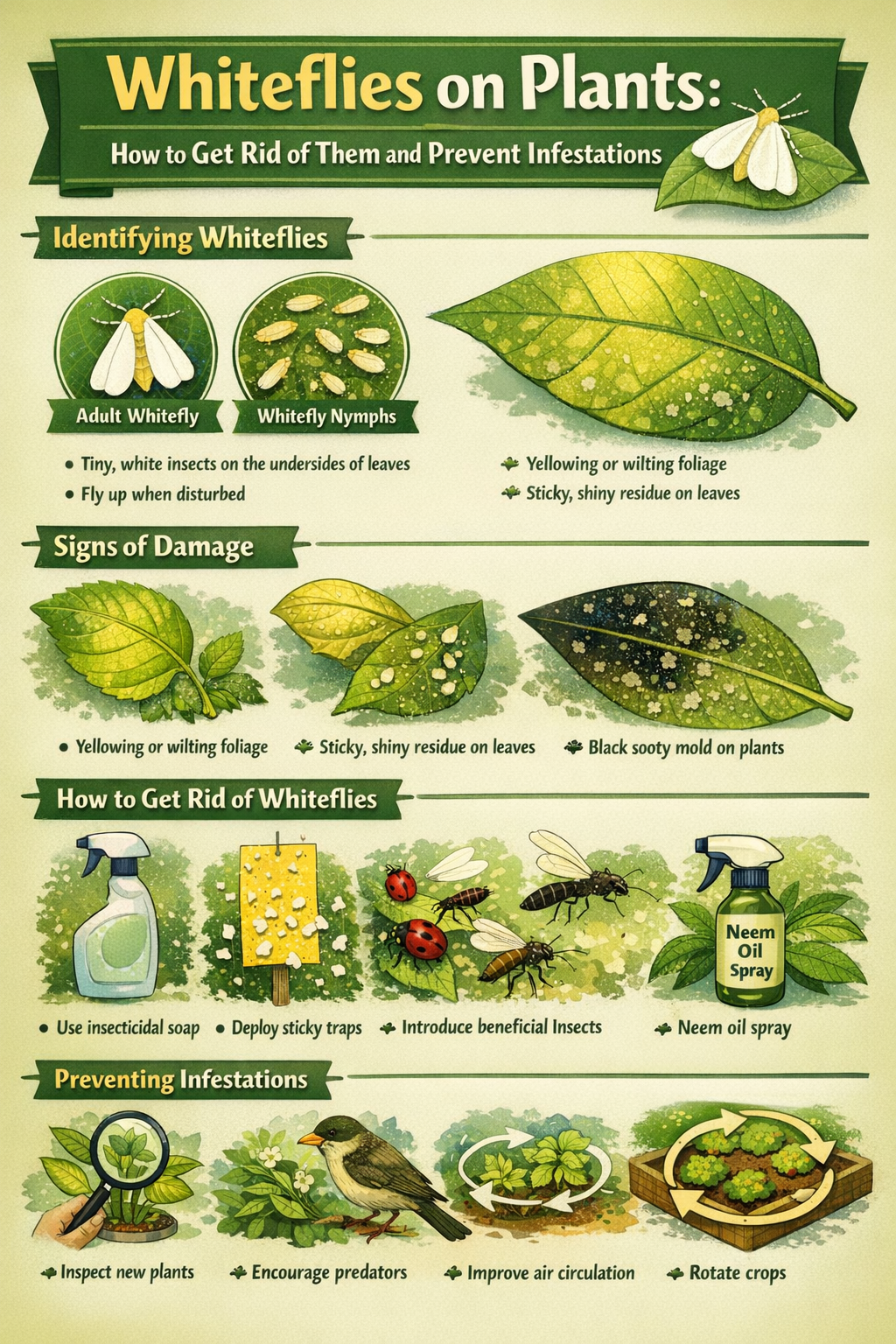
Signs of a Whitefly Infestation
Whiteflies are usually identified by behavior and plant damage, not by spotting individuals first.
- cloud of insects when plants are disturbed
- sticky leaves from honeydew
- yellowing or weakening foliage
- black sooty mold forming on residue
- tiny pale nymphs on leaf undersides
If your symptoms don’t fully match, compare with:
Why Whiteflies Spread So Quickly
Each female lays hundreds of eggs, and in warm conditions a full generation can develop in just a few weeks.
This creates overlapping populations, meaning:
- eggs, nymphs, and adults are present at the same time
- single treatments rarely work
Control depends on consistency, not intensity.
How to Get Rid of Whiteflies (Step-by-Step)
Work through these methods in order. Skipping steps usually leads to incomplete control.
1. Remove Heavily Infested Leaves
Prune and discard leaves with dense nymph populations. This removes a large portion of the infestation immediately.
2. Spray with Water
A strong stream of water knocks adults, eggs, and nymphs off the plant. Focus on the underside of leaves and repeat regularly.
3. Apply Insecticidal Soap
Insecticidal soap works on contact and is highly effective against soft-bodied pests. Coverage is critical.
4. Use Neem Oil
Neem oil disrupts feeding and reproduction. It’s most effective when used repeatedly over time rather than as a one-time treatment.
5. Repeat Every Few Days
This is where most people fail. Whiteflies require repeated treatment to break their life cycle.
What Actually Works (and What Doesn’t)
What works:
- consistent treatment cycles
- targeting leaf undersides
- combining removal + spray + follow-up
What doesn’t:
- one-time treatments
- spraying only the top of leaves
- waiting until infestation is severe
How to Prevent Whiteflies
Prevention is significantly easier than control.
- inspect plants before bringing them home
- avoid overcrowding
- maintain airflow
- avoid excessive nitrogen (soft growth attracts pests)
Strong plants are less vulnerable. Improve overall health with the Vegetable Gardening Guide.
Common Mistakes
- stopping treatment too early
- missing early signs
- focusing only on visible adults
- ignoring plant stress conditions
Where to Go Next
For related issues, see:
For hands-on work, use durable protection from Best Garden Gloves.
Conclusion
Whiteflies are not difficult to control—but they are easy to underestimate. The difference between success and failure is consistency.
If you act early and follow through, you can eliminate them before they spread across your garden.
You brush past a tomato plant and a cloud of tiny white insects lifts into the air. They settle back underneath the leaves, and suddenly you notice the foliage feels sticky and looks slightly yellow.
That’s whiteflies—and by the time you see them flying, the population is already established.
If you’re not completely sure what pest you’re dealing with, start with the Garden Pest Identification Guide.
For a full system to treat and prevent problems across your garden, see the Garden Pest Control Guide.
For natural treatment options, use the Organic Garden Pest Control guide.
—Quick Answer
Whiteflies are fast-reproducing sap-feeding insects that weaken plants and spread quickly in warm conditions. Control requires repeated treatment—removing adults alone is not enough. You must interrupt their life cycle.
—What Whiteflies Are (and Why They’re Hard to Control)
Whiteflies are closely related to aphids and feed by piercing plant tissue and extracting sap. Both adults and immature stages (nymphs) damage plants.
The challenge is that most of the population lives on the underside of leaves, where they’re easy to miss and harder to reach with treatments.
They reproduce quickly in warm weather, which means:
- a small infestation becomes a large one in days
- inconsistent treatment allows rapid rebound
Signs of a Whitefly Infestation
Whiteflies are usually identified by behavior and plant damage, not by spotting individuals first.
- cloud of insects when plants are disturbed
- sticky leaves from honeydew
- yellowing or weakening foliage
- black sooty mold forming on residue
- tiny pale nymphs on leaf undersides
If your symptoms don’t fully match, compare with:
—Why Whiteflies Spread So Quickly
Each female lays hundreds of eggs, and in warm conditions a full generation can develop in just a few weeks.
This creates overlapping populations, meaning:
- eggs, nymphs, and adults are present at the same time
- single treatments rarely work
Control depends on consistency, not intensity.
—How to Get Rid of Whiteflies (Step-by-Step)
Work through these methods in order. Skipping steps usually leads to incomplete control.
1. Remove Heavily Infested Leaves
Prune and discard leaves with dense nymph populations. This removes a large portion of the infestation immediately.
2. Spray with Water
A strong stream of water knocks adults, eggs, and nymphs off the plant. Focus on the underside of leaves and repeat regularly.
3. Apply Insecticidal Soap
Insecticidal soap works on contact and is highly effective against soft-bodied pests. Coverage is critical.
4. Use Neem Oil
Neem oil disrupts feeding and reproduction. It’s most effective when used repeatedly over time rather than as a one-time treatment.
5. Repeat Every Few Days
This is where most people fail. Whiteflies require repeated treatment to break their life cycle.
—What Actually Works (and What Doesn’t)
What works:
- consistent treatment cycles
- targeting leaf undersides
- combining removal + spray + follow-up
What doesn’t:
- one-time treatments
- spraying only the top of leaves
- waiting until infestation is severe
How to Prevent Whiteflies
Prevention is significantly easier than control.
- inspect plants before bringing them home
- avoid overcrowding
- maintain airflow
- avoid excessive nitrogen (soft growth attracts pests)
Strong plants are less vulnerable. Improve overall health with the Vegetable Gardening Guide.
—Common Mistakes
- stopping treatment too early
- missing early signs
- focusing only on visible adults
- ignoring plant stress conditions
Where to Go Next
For related issues, see:
For hands-on work, use durable protection from Categories Garden Pest Control Guides