
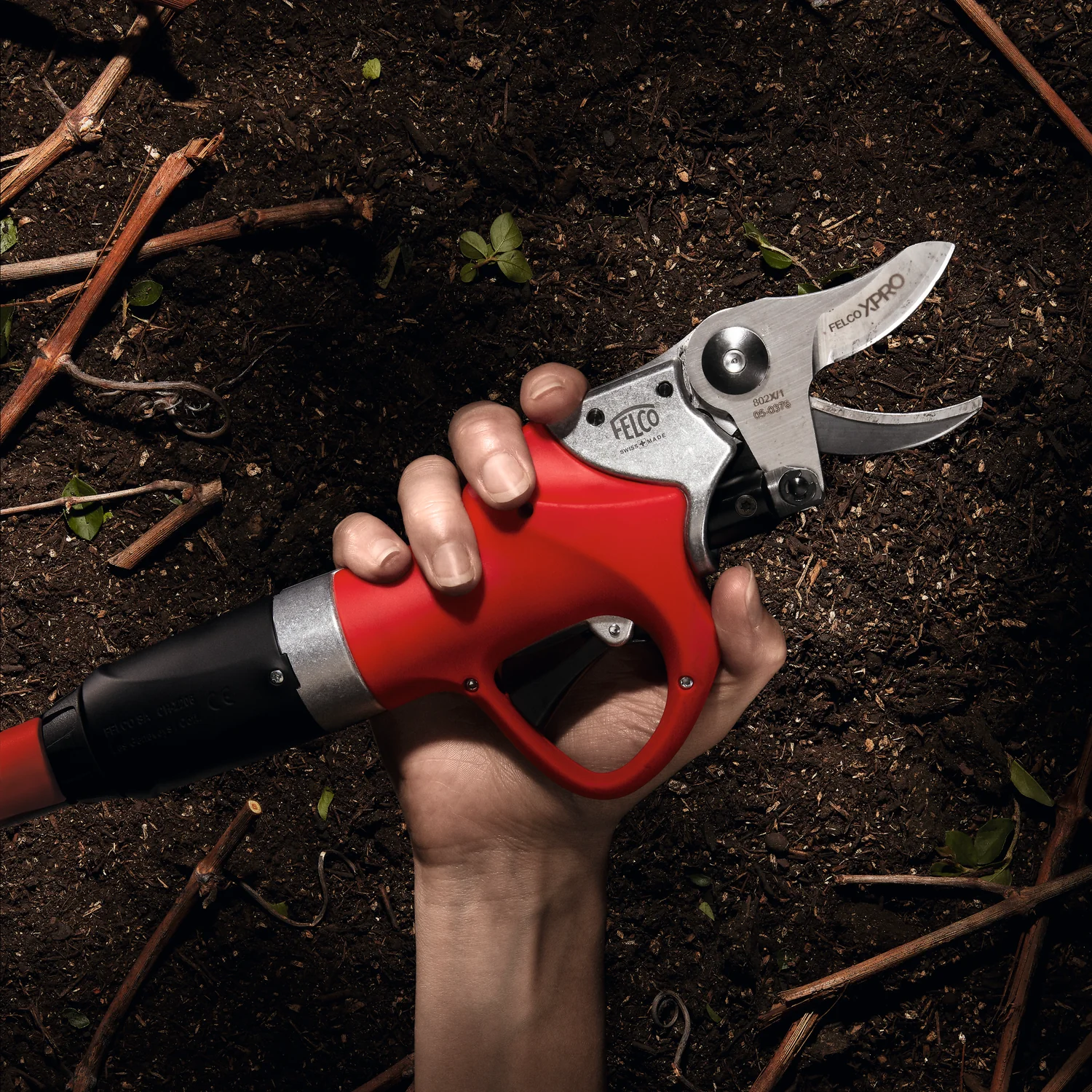
If you’ve spent any time shopping for electric pruning shears, you’ve probably run into the same wall I did: a flood of no-name brands on Amazon with suspiciously similar specs, mixed in with a few well-known tool names that cost twice as much. It’s hard to know what you actually need, and whether spending more gets you anything real.
Here’s the honest answer: for light trimming around flowers and thin stems, almost anything works. But if you’re tackling thick rose canes, fruit trees, overgrown shrubs, or a property that demands real pruning season after season, the tool you pick makes a significant difference. This guide cuts through the noise and helps you land on the right one.
What Actually Matters When Buying Electric Pruning Shears
Cutting Capacity — and What It Really Means
Manufacturers list a maximum cutting diameter, usually between 3/4 inch and 1.5 inches. That number matters, but it doesn’t tell the whole story.
A tool rated for 1.5 inches will slice cleanly through dry, light wood at that diameter. Wet wood, green wood, and dense hardwood like apple or oak are harder. If you’re working fruit trees or old rose canes, I’d recommend buying a shear rated for at least 1/4 inch more than the thickest branch you expect to cut regularly. That buffer makes a real difference in how clean the cut is and how hard the motor has to work.
Brushless vs. Brushed Motors
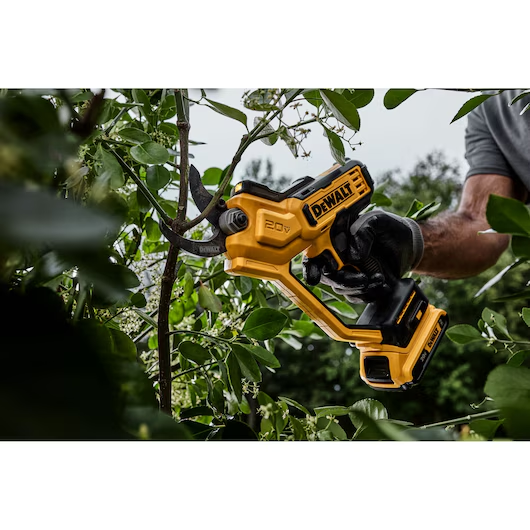
This distinction matters more than most buyers realize. A brushed motor works fine for occasional use but generates more heat and wears down faster. A brushless motor runs cooler, lasts significantly longer, and is more efficient — meaning more cuts per charge. If you’re pruning more than a few times a season, pay the extra for brushless.
Battery Platform Compatibility
If you already own Craftsman, DeWalt, Ryobi, or Milwaukee power tools, this is your biggest money-saver. Buying a bare tool (no battery or charger included) in your existing platform can save $50–$80 right away, and you’ll already know how the battery performs. The no-name brands use proprietary batteries, which means you’re stuck buying their replacement packs.
Weight and How Long You’ll Actually Be Holding It
Most electric pruners run 2.5 to 3.5 pounds with a battery. That doesn’t sound like much — until you’ve been working overhead or reaching into a dense shrub for an hour. Look for something that balances well in your dominant hand and has a soft grip. Lighter tools matter more than they get credit for.
Safety Mechanisms
Every decent electric pruner has a two-step activation — usually a safety button you hold first, then a trigger. This is important. These tools are fast and powerful enough to cause real injury if they fire accidentally. Don’t skip this feature, and don’t get annoyed by it. It becomes second nature quickly.
Blade Quality and Replaceability
Cheap blades dull fast and can chip on hard wood. SK5 high-carbon steel is the standard worth looking for. High-speed steel (HSS), used by Craftsman, holds up well too. More importantly, check whether the blades are easy to replace. Some models require tools and are a hassle; others pop out in seconds. Over the life of the tool, this matters.
The Best Electric Pruning Shears
1. Craftsman V20 Cordless Pruner (CMCPR320C1)
Best Overall | ~$129 kit with 1.5Ah battery
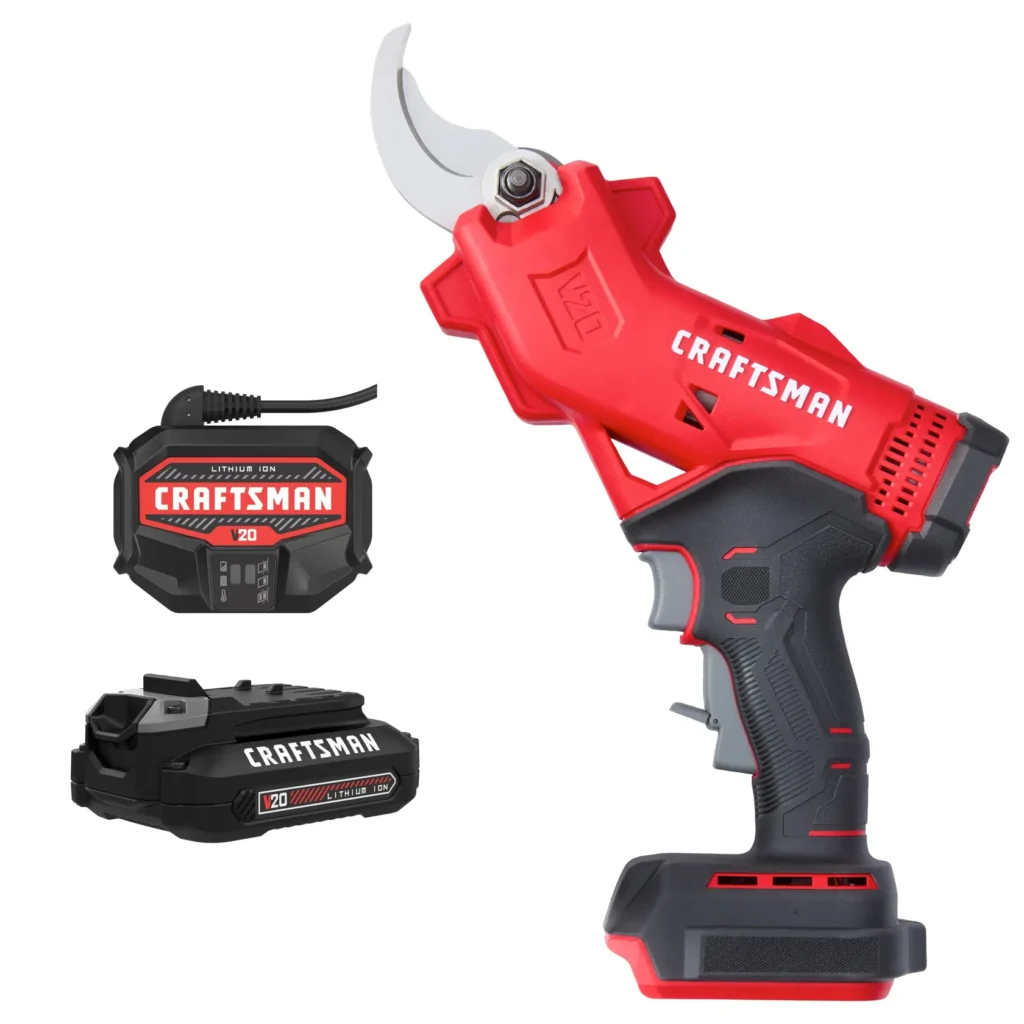
The Craftsman V20 is the most well-rounded option at this price point, and it consistently tops real-world reviews for a reason. It handles branches up to 1-1/4 inches, cuts at roughly one stroke per second, and delivers around 900 cuts per charge on the 1.5Ah battery. It’s also the lightest of the larger-format electric pruners, which you’ll appreciate after the first long session.
The blades are high-speed steel, and blade changes require no tools — a genuinely useful feature when you’re in the middle of a job. The safety mechanism is intuitive, and the grip is comfortable for extended use.
The trade-off: the 1.5Ah battery is on the small side. If you have a large property or dense material, you’ll want a spare or to upgrade to a 2Ah pack. Also, 1-1/4 inches is the cap — it won’t be your tool for thicker ornamental branches without multiple bites.
It uses the Craftsman V20 platform, compatible with their full line of outdoor tools. For anyone who doesn’t already own a battery ecosystem, this kit is the easiest entry point.
Best for: Homeowners with medium-sized gardens, rose beds, hedges, and light tree work.
2. DeWalt 20V MAX Cordless Pruner (DCPR320B)
Best for DeWalt Users | ~$129 bare tool
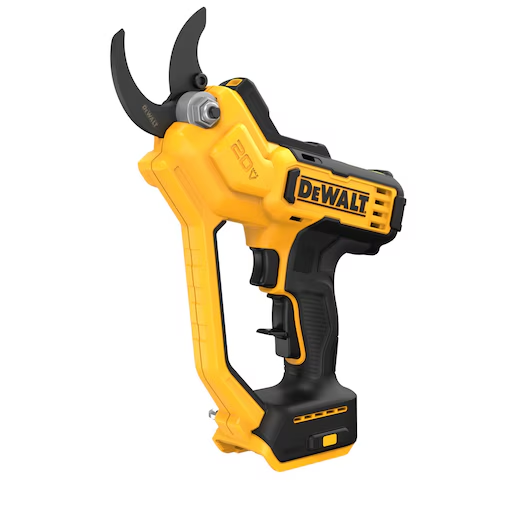
The DeWalt edges out the Craftsman on cutting capacity, handling branches up to 1-1/2 inches — that extra quarter inch makes a real difference on older rose canes or young fruit tree branches. It delivers up to 1,100 cuts per charge and weighs 3 pounds without the battery. The non-stick blade coating helps it move cleanly through sappy or wet wood without binding.
One useful feature is the built-in LED work light, which sounds like a gimmick until you’re working under a dense canopy or trimming near a fence on an overcast afternoon. It’s a small thing that earns its keep.
The honest downside: it comes bare-tool only at that price, so you need a 20V MAX battery already in hand. If you’re a DeWalt household, that’s no issue. If you’re starting fresh, factor in the cost of a battery and charger, which can push the total to $180–$200.
Reviews are mostly strong, but some users report that the brushed motor (not brushless at this price) runs warm on extended use. For occasional pruning sessions, it’s a non-issue. For daily heavy work, consider stepping up.
Best for: DeWalt tool owners who want more cutting capacity without a major investment.
3. Milwaukee M12 Brushless Pruning Shears (2534-20)
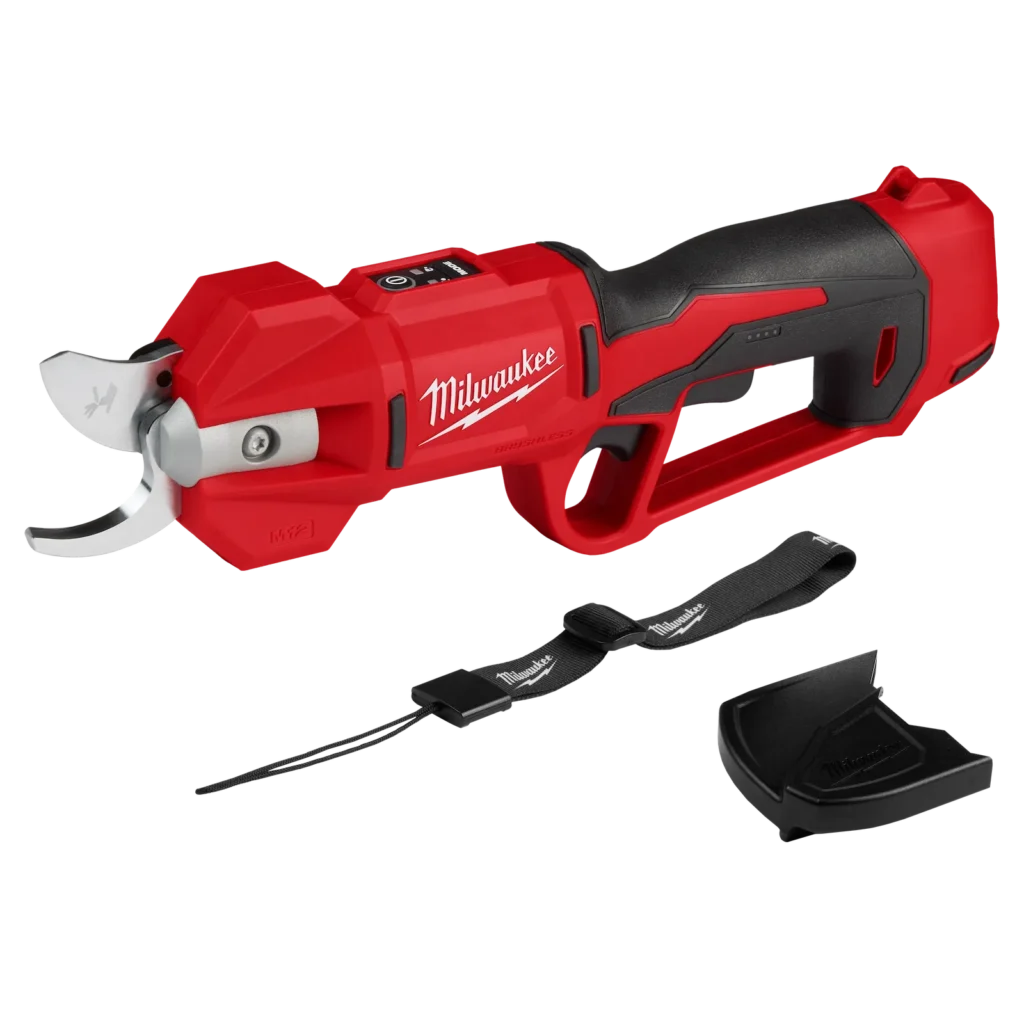
Best Control and Features | ~$199 bare tool / ~$249 kit
The Milwaukee is a step up in both price and capability. The M12 brushless motor runs noticeably more efficiently than brushed competitors, and the “Active Blade Control” feature — where the blade movement follows the trigger in real time — gives you more precise control over each cut than a standard on/off action. That matters when you’re trimming around delicate growth or making precise cuts on a specimen tree.
It also has a mode selector that locks the blade opening to half capacity, which speeds up cutting on thin growth by about 40% according to Milwaukee. In practice, this means you can blast through a dense hedge without the blade cycling all the way open and closed each time. Clever engineering.
Cutting capacity is 1-1/4 inches, matching the Craftsman. The inline grip design is compact and maneuverable — easier to get into tight spaces than the bulkier DeWalt or Craftsman form factor.
The trade-off is price. At $249 for the kit, you’re spending significantly more. And replacement blades are Milwaukee-specific — no mixing and matching with other brands. If you’re already a Milwaukee M12 user, this is the obvious choice. If you’re buying into a new platform just for this tool, the value calculation gets harder.
Best for: Serious gardeners, orchardists, and anyone who wants professional-grade control on a residential budget.
4. Ryobi 18V ONE+ HP Brushless Pruner (P2505BTL)
Best for Ryobi Owners | ~$179 bare tool / ~$209 kit
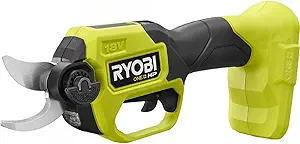
Ryobi made a smart move with the brushless upgrade on their 18V ONE+ pruner. The brushless motor delivers noticeably faster cutting than the older brushed model — about 1.5x faster by Ryobi’s own testing — and the cut capacity bumped up from 3/4 inch to 1 inch in the upgrade.
The blade removal system stands out: it’s tool-free and simple, making field sharpening and replacement faster than on the DeWalt or Milwaukee. The LED work light and soft grip handle round out a comfortable package.
The trade-off is that 1-inch capacity puts it behind the Craftsman and DeWalt on heavy branches. If your pruning is mostly hedges, perennials, and lighter shrub work, that’s more than enough. If you regularly encounter thick woody stems, it’ll struggle. The pricing is also a bit high relative to the Craftsman kit, which comes with a battery and handles larger branches for less.
For anyone already running the Ryobi 18V ONE+ ecosystem — one of the most popular battery platforms out there — this is the natural pick.
Best for: Ryobi tool owners doing regular light-to-medium pruning on hedges and ornamentals.
5. Black+Decker 20V MAX Cordless Pruner (BCPR320C1)
Best Budget Option | ~$130 kit with 1.5Ah battery
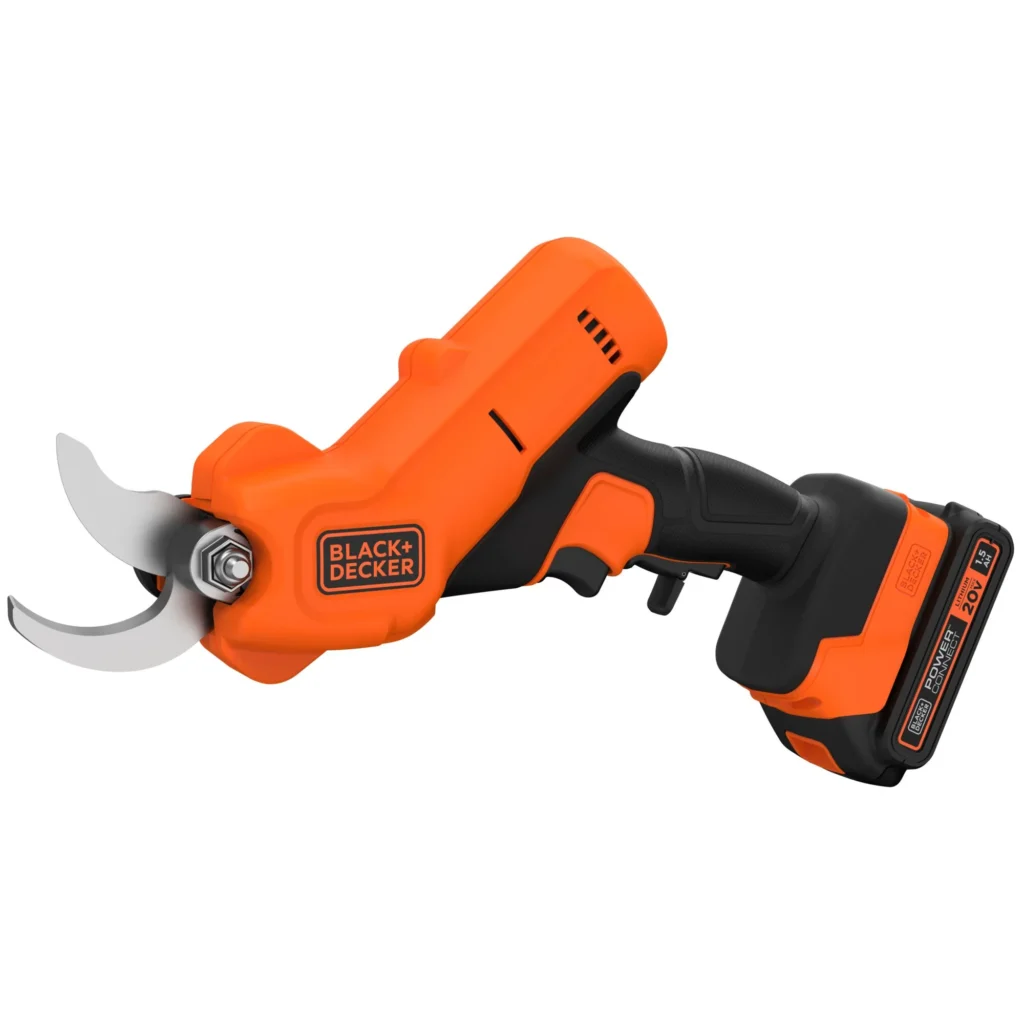
The Black+Decker is priced similarly to the Craftsman kit and delivers similar basic performance — 1-inch cut capacity and around 900 cuts per charge. It’s available widely, comes with a battery and charger, and is simple enough to hand off to anyone in the household.
The limitation here is the battery. Black+Decker batteries tend to get mixed reviews for longevity, and users in multiple reviews note the battery life can fall short on larger jobs. The tool itself also runs a brushed motor, which is fine for occasional use but less durable over time.
If you’re a light-duty pruner — deadheading, trimming a few hedges, keeping up with perennials — this does the job at a reasonable price. If you push it hard, you may outgrow it faster than you’d like.
Best for: Beginners, light-duty users, or anyone who needs a capable tool without a significant upfront cost.
Quick Comparison
| Tool | Cut Capacity | Motor | Battery Included | Price (approx.) |
|---|---|---|---|---|
| Craftsman V20 (CMCPR320C1) | 1-1/4 in. | Brushed | Yes (1.5Ah) | ~$129 kit |
| DeWalt 20V MAX (DCPR320B) | 1-1/2 in. | Brushed | No (bare tool) | ~$129 bare |
| Milwaukee M12 (2534-20) | 1-1/4 in. | Brushless | No (bare tool) | ~$199 bare |
| Ryobi 18V HP (P2505BTL) | 1 in. | Brushless | No (bare tool) | ~$179 bare |
| Black+Decker 20V (BCPR320C1) | 1 in. | Brushed | Yes (1.5Ah) | ~$130 kit |
Best Choice by Use Case
If you’re a beginner: Go with the Craftsman V20 kit. You get a battery, charger, and a capable tool in one purchase. It handles most home garden tasks without overwhelming you, and the no-tool blade change makes maintenance simple.
If you do heavy pruning — fruit trees, old roses, thick ornamental shrubs — pick the DeWalt 20V MAX. That 1-1/2 inch capacity gives you real headroom when wood gets dense, and if you already own DeWalt batteries, the value is excellent.
If you want the best control and features: The Milwaukee M12 brushless is the most sophisticated option here. Active Blade Control, a brushless motor, and mode selection make it genuinely better in intricate applications. Worth the premium if you prune frequently or care about precision.
If you’re already in a battery ecosystem: Buy the bare tool in your platform. A Ryobi household buys the Ryobi. A Milwaukee household buys the Milwaukee. The savings on the battery and charger are real, and you get the convenience of one shared charging system.
If you’re on a tight budget: The Black+Decker gets the job done for light work. Just go in knowing its limitations — and keep an eye on that battery.
A Few Things to Know Before You Buy
Electric pruning shears aren’t loppers. They’re designed for bypass-style cuts on branches you could manage (with effort) with a good manual pruner. If you’re regularly cutting branches over 1.5 inches, you’re in lopper or pruning saw territory — no electric pruner will do that work cleanly. Using any of these tools outside their rated capacity wears the motor and blades faster.
Blade maintenance matters more than people expect. Even good SK5 or HSS blades dull with use. A quick wipe down after each session, occasional oiling, and blade sharpening once a season keeps them cutting cleanly and extends the life of the tool significantly.
And finally: always engage the safety before setting one down. These things cycle fast.