Depth is the one raised bed decision most gardeners make too quickly. You find a kit, pick a lumber width, or go with what looks right — and only after the bed is filled and planted do you discover that the carrots are forking, the tomatoes are struggling, or the soil dries out faster than you can water it.
The depth of a raised bed determines what you can grow, how often you water, and how much the bed costs to fill. Get it right at the start and everything else is easier. Build too shallow and you’ll spend seasons working around the limitation (this connects directly to how raised beds function as a system: /raised-bed-gardening-guide/).
This guide gives you the real numbers — not just crop depths, but the reasoning behind them — so you can make a decision that fits your plants, your budget, and how you actually garden.
Why Depth Matters More Than Most Gardeners Expect
It’s tempting to think of bed depth as a simple root-clearance question. But depth does several things at once.
Root room.
Moisture buffering.
Temperature stability.
Cost and weight.
These factors combine to determine plant performance.
Deeper beds also reduce how frequently you need to water, especially in summer heat (this becomes critical as plants establish: /vegetable-garden-watering-guide/).
The Native Soil Factor
Whether your bed sits on native soil or a hard surface changes everything.
On native soil:
- roots extend downward
- effective depth increases
On hard surfaces:
- roots are confined
- depth must fully support crops
Loosening native soil improves root penetration and drainage (this is part of proper soil preparation: /vegetable-garden-soil-prep/).
Depth by the Numbers
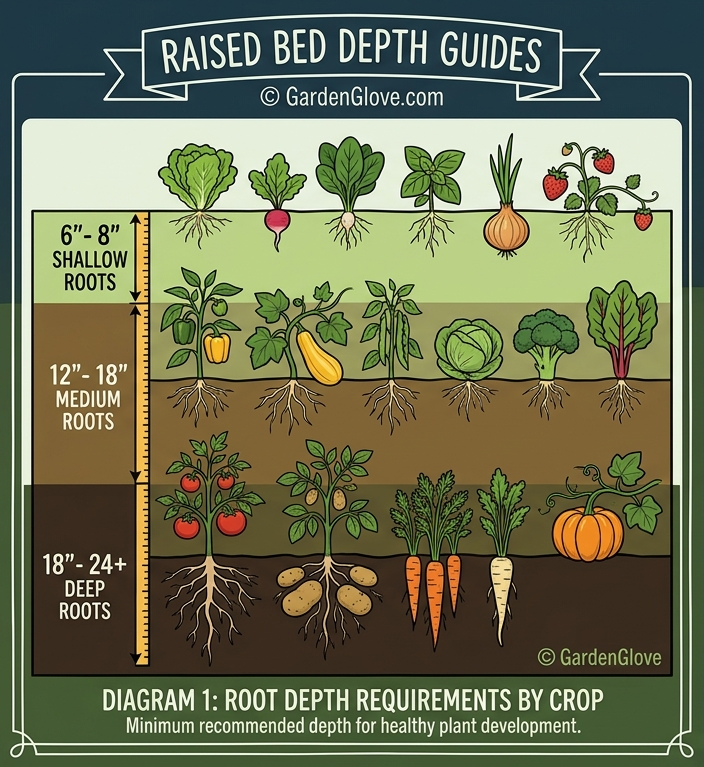
6 Inches — The Minimum
Only works for:
- greens
- herbs
- shallow crops
Not suitable for most vegetables.
10–12 Inches — The Sweet Spot
Handles:
- most vegetables
- balanced performance
- reasonable cost
This is the default recommendation for most home gardens.
15–18 Inches — High Performance
Supports:
- deep-rooted crops
- better moisture retention
- more stable growth
This depth pairs best with a properly built soil mix:
→ /raised-bed-soil-mix/
24–30 Inches — Accessibility
Not required for plants — built for the gardener.
Depth by Crop — A Practical Reference
(Keep your table exactly as written — no changes)
Mixed Beds: What Depth to Choose
Build for your deepest-rooted crop.
Shallow crops adapt. Deep crops do not.
If uncertain:
👉 12 inches (native soil) is the most versatile baseline.
Depth on Hard Surfaces vs. Native Soil
Use deeper beds when:
- no soil below
- drainage is limited
- roots are confined
The Single Most Common Depth Mistake
Building too shallow.
This leads to:
- poor yields
- constant watering
- restricted root growth
Most of these show up as broader garden problems rather than obvious depth issues:
→ /common-vegetable-garden-mistakes/
A Note on Drainage at Greater Depths
Depth doesn’t cause drainage issues — poor soil structure does.
A properly balanced mix drains at any depth (this is where soil fundamentals matter: /best-garden-soil/).
If drainage is poor:
- adjust mix
- increase aeration
- reduce compaction
Where to Go Next
If you’re building your first raised bed:
→ /raised-bed-gardening-guide/
If you need the correct soil mix:
→ /raised-bed-soil-mix/
If you’re preparing beds for planting:
→ /vegetable-garden-soil-prep/
If watering becomes difficult:
→ /vegetable-garden-watering-guide/
If you’re troubleshooting issues:
→ /common-vegetable-garden-mistakes/