Watering raised beds by hand is not a sustainable system for serious growing. A well-planted kitchen garden in summer needs water every one to two days in dry conditions — consistently, at soil level, in the right volume. Hand watering with a can or hose is inconsistent, wets foliage rather than roots, takes time that compounds quickly across multiple beds, and is the first thing that gets skipped when life is busy. I installed drip irrigation in my raised beds four seasons ago and the immediate improvement in plant health, harvest consistency, and time spent in the garden changed my approach to raised bed growing permanently. Raised bed irrigation done correctly is the single best investment in productive kitchen garden infrastructure.
Why Raised Beds Need More Irrigation Than In-Ground Growing
Three characteristics of raised beds increase irrigation requirements:
Higher drainage rate — the loose, well-amended soil of a raised bed drains faster than compacted in-ground soil. The drainage that prevents root suffocation also means the bed dries out faster between watering events.
Greater soil surface area to volume ratio — raised beds have more exposed surface per unit of soil volume than in-ground growing. Evaporation from the surface is proportionally higher.
Higher planting density — raised beds are planted more densely than traditional rows. More plants transpiring moisture from the same soil volume increases total water demand.
Mulching reduces all three effects significantly — see: Raised Bed Mulching
Irrigation Methods for Raised Beds
Drip Irrigation — The Recommended System
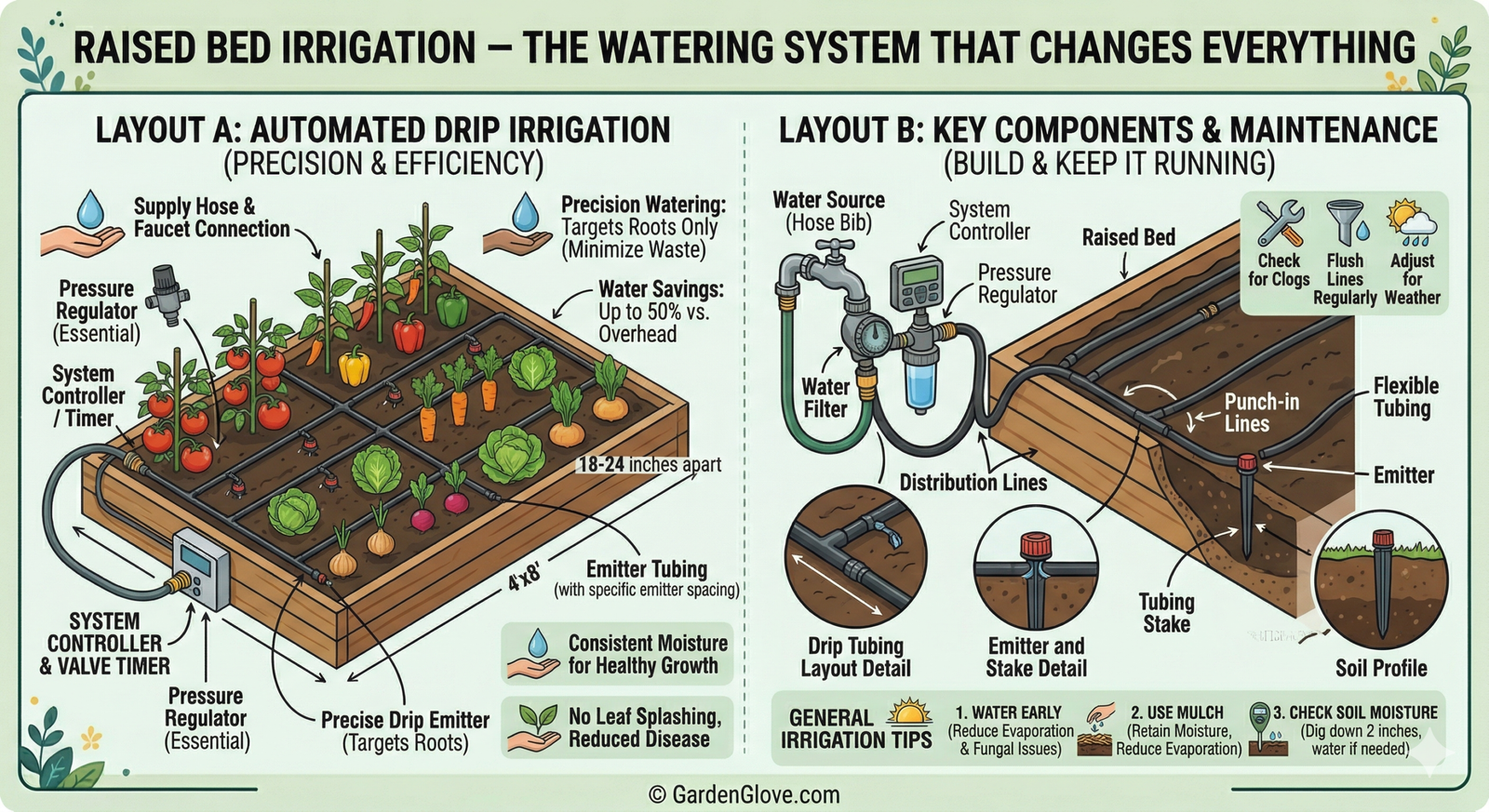
Drip irrigation delivers water slowly and directly to the root zone through emitters positioned at or just below soil surface. The key advantages:
Foliage stays dry — wet foliage is the primary environment for fungal disease development. Drip irrigation keeps water at the soil and away from leaves, stems, and fruit. The reduction in fungal pressure on drip-irrigated beds compared to overhead-watered beds is immediately visible in reduced blight, powdery mildew, and botrytis incidence.
Reduced evaporation — water delivered at soil level doesn’t travel through air to reach the ground. Overhead watering loses a significant proportion to evaporation before reaching soil — particularly in warm or windy conditions. Drip delivers essentially all water to the root zone.
Precise volume control — emitter flow rates are specified in litres per hour. Knowing the emitter output and run time gives exact water delivery volume — important for matching irrigation to crop water requirement.
Timer compatibility — drip systems connect to tap timers that automate watering entirely. The system runs at set times regardless of whether you’re in the garden, on holiday, or have forgotten. Consistent irrigation without the consistency dependency on human memory.
Soaker Hose
Porous rubber or recycled material hose that seeps water slowly along its full length. Simpler to install than individual emitter drip systems, and effective for beds with densely planted crops where individual emitters would be awkward.
Less precise than drip — water output per metre varies with water pressure and hose age. Works well for general vegetable beds; less suited to beds with widely spaced large plants where targeted emitter placement is more efficient.
Overhead Watering — When It’s Acceptable
Overhead irrigation — sprinklers, hand watering — is acceptable for seedling beds and germination stages where keeping the entire soil surface moist matters more than keeping foliage dry. Once plants are established, transitioning to ground-level water delivery reduces disease pressure.
Hand watering with a can or watering wand fitted with a rose produces gentler water delivery than a jet and is adequate for small bed collections where the time investment is manageable.
Designing a Drip System for Raised Beds
Components
Main supply line — 13–16mm polypipe running from the tap or water butt pump to the bed area. This is the distribution spine that feeds water to each bed.
Bed supply line — 13mm polypipe running along each bed, connected to the main supply line with a T-connector or elbow.
Drip emitters — inserted into the bed supply line at spacing appropriate for the crops. Standard emitters flow at 2–4 litres per hour. Adjustable emitters allow flow rate tuning.
End caps — seal the end of each bed supply line to maintain pressure along the full length.
Filter — a mesh filter at the tap connection prevents debris blocking emitters. Essential for systems fed from water butts.
Timer — battery-powered tap timers control watering automatically. Two-zone timers allow different beds to receive different schedules — high-water-demand crops more frequently, drought-tolerant crops less.
Emitter Spacing
The correct emitter spacing depends on soil type and crop. In the free-draining soil of a raised bed, water disperses less laterally than in heavier soils. Emitter spacing of 20–30cm ensures water reaches between plants without gaps.
For densely planted beds — carrots, salads, onions — a soaker hose running the length of the bed rather than individual emitters is more practical.
Pressure
Drip systems operate at lower pressure than mains supply. A pressure regulator at the connection point protects emitters from damage and ensures consistent flow rates across the system. Most drip kits specify the operating pressure range — typically 1–2 bar for standard emitters.
Water Butt Integration
Rainwater collected from roof surfaces is softer, unchlorinated, and free — preferable to mains water for most garden crops. A water butt irrigation system requires a small pump to maintain adequate pressure for drip emitters, or relies on gravity from an elevated butt.
Gravity-fed systems work at low flow rates — soaker hose is more compatible than individual emitters, which need higher pressure for reliable performance. A submersible pump rated for garden irrigation bridges the pressure gap and allows a full drip system to run from stored rainwater.
Irrigation Scheduling — How Much and How Often
Factors That Affect Water Requirement
Crop type — high-water-demand crops (courgettes, cucumbers, celery, brassicas) need more frequent irrigation than drought-tolerant crops (herbs, garlic, onions, root vegetables once established).
Growth stage — seedlings and transplants need consistent moisture. Established plants need deep, less frequent watering that encourages deep root development. Fruiting crops at the point of fruit development need consistent moisture to prevent blossom end rot in tomatoes and peppers.
Season and temperature — peak summer demand can be double spring or autumn demand. Adjust timer schedules seasonally rather than running the same programme year-round.
Mulch — mulched beds retain moisture longer and require less frequent irrigation. This is the most practical way to reduce irrigation frequency without reducing plant water availability. See: Raised Bed Mulching
A Practical Starting Point
In mid-summer conditions with no rainfall: run drip irrigation for 20–30 minutes daily on high-water-demand crops. For drought-tolerant crops: 20–30 minutes every two to three days.
Adjust based on observation — wilting in early morning indicates water deficit. Soil staying wet 5cm down for more than two days indicates overwatering.
Summary
Install drip irrigation before first planting — retrofitting through established crops is far more disruptive. Use a timer to remove the consistency dependency. Run emitters or soaker hose at soil level to keep foliage dry. Mulch the bed to reduce evaporation between watering events. Adjust schedules seasonally and by crop.
The infrastructure investment is modest. The improvement in plant health, harvest consistency, and time saved is immediate and permanent.
See also: Raised Bed Gardening Guide | Raised Bed Mulching | Best Soil for Raised Beds