A raised bed filled with good soil mix starts out productive. The first season is usually strong — plants grow well, yields are solid, and the bed seems to take care of itself. Then the second season is a little worse. By the third or fourth year, something is clearly off: smaller fruit, yellowing leaves mid-season, plants that look healthy but produce disappointingly.
What happened isn’t a mystery. Plants removed nutrients from the soil every season. Organic matter broke down and wasn’t fully replaced. The biological activity that makes nutrients available slowed. The bed is still structurally fine — but it’s running low on what plants need to perform.
Fertilizing a raised bed correctly prevents this from happening. It’s not complicated, but it requires understanding a few basics: what nutrients do, the difference between feeding soil and feeding plants, when to apply what, and how to read the signs when something is off. This guide covers all of it.
The Foundation: Feed the Soil, Not Just the Plant
The most important shift in thinking about raised bed fertilization is moving from feeding plants to feeding soil. A plant fed with synthetic fertilizer gets a direct nutrient hit — fast, measurable, effective in the short term. A soil fed with organic matter and slow-release amendments develops the microbial ecosystem that makes nutrients continuously available to plants at the rate they need them.
Organic fertilizers stimulate beneficial soil microorganisms and improve the structure of the soil. Soil microbes play an important role in converting organic fertilizers into soluble nutrients that can be absorbed by your plants.
The practical difference: synthetic fertilizers work immediately but do little for long-term soil health, and in raised beds the concentrated salt residues they leave behind accumulate faster than in open ground where they can disperse. Over time, those salts build up, creating a hostile environment for beneficial microbes and actually damaging plant roots — you’ll know it’s happening when you see leaf burn, stunted growth, and plants that look stressed even though you’re fertilizing regularly.
Organic fertilizers work more slowly but build the soil ecosystem that makes a raised bed more productive over time, not less. This is the approach most experienced raised bed gardeners settle on — and the one this guide is built around. That said, synthetic fertilizers have a legitimate role in specific situations, which we’ll cover.
NPK: What the Three Numbers Actually Mean
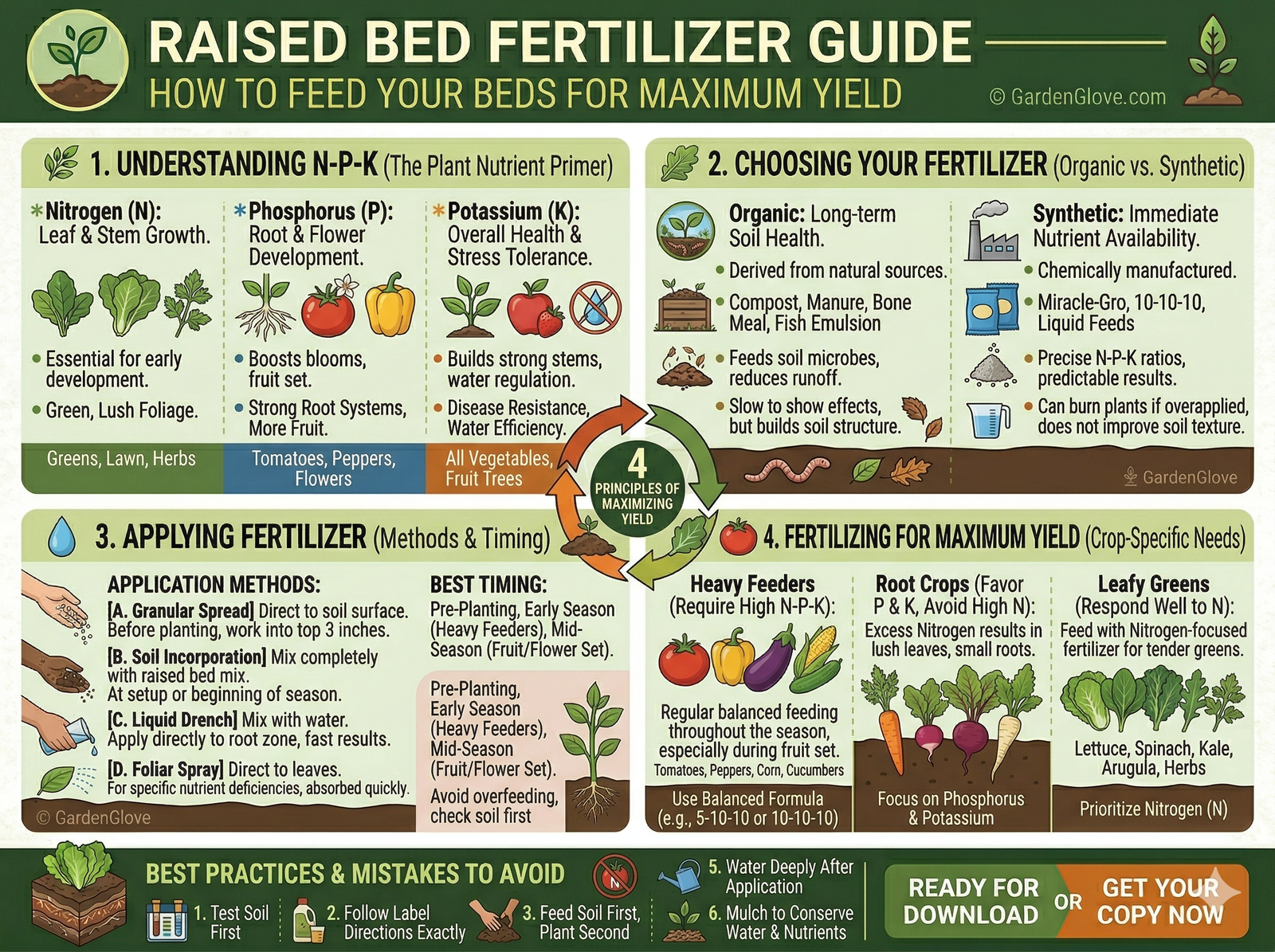
Every fertilizer bag lists three numbers — the NPK ratio. These represent the percentage by weight of nitrogen (N), phosphorus (P), and potassium (K) in the product. A 100-pound bag of 10-20-10 fertilizer contains 10 pounds of nitrogen, 20 pounds of phosphorus, and 10 pounds of potassium — 40 pounds of nutrients total. The rest is carrier material such as sand, perlite, or rice hulls.
Understanding what each nutrient does helps you choose the right product for the situation:
Nitrogen (N) — the growth driver. Nitrogen fuels leafy growth, stem development, and the green color in leaves. It’s the most consumed nutrient in a productive vegetable bed and the one most likely to be depleted first. Nitrogen-deficient plants show yellowing that starts with the oldest (lowest) leaves and progresses upward. Leafy crops like lettuce, spinach, and kale are the heaviest nitrogen consumers; root crops like carrots and beets need less.
Phosphorus (P) — root and fruit development. Phosphorus supports root establishment, flowering, and fruit set. It’s critical at transplant time and during early fruit development. Phosphorus deficiency shows as purplish coloration on the undersides of leaves. Importantly, phosphorus builds up in raised bed soil over time — adding too much year after year causes accumulation that can lock out other nutrients. Don’t add phosphorus-heavy amendments without a soil test indicating deficiency.
Potassium (K) — plant resilience. Potassium regulates water use, improves disease resistance, supports strong root systems, and enhances fruit quality. Deficiency shows as scorched or brown leaf edges starting with older leaves. Most balanced organic fertilizers supply adequate potassium alongside nitrogen and phosphorus.
Beyond NPK, plants also need calcium, magnesium, sulfur, and a range of micronutrients in smaller amounts. In most cases, organic fertilizers and compost will provide all the secondary and micronutrients your plants need — one of the practical advantages of organic over synthetic, which typically delivers only NPK.
Organic vs. Synthetic: The Honest Trade-Off
Neither type is universally better. They work differently and suit different situations.
Organic fertilizers — compost, worm castings, fish emulsion, blood meal, bone meal, kelp meal, alfalfa meal — release nutrients slowly as soil microbes break down the organic material. Most organic nutrients are slow-release, adding organic material to the soil so that you don’t need to apply nearly as often. They improve soil structure, feed microbial life, and provide trace elements that synthetics don’t. The NPK numbers look low compared to synthetics, but the ratio can only express nutrients that are immediately available — organic fertilizers contain slow-release nutrients that become available over time, along with many trace elements synthetic fertilizers lack entirely.
Synthetic fertilizers are water-soluble and plant-available almost immediately. They do have some advantages in early spring — because they are water-soluble, they are available to plants even when soil is still cold and soil microbes are inactive. This makes them useful as a quick corrective tool when plants show acute deficiency symptoms mid-season. The practical downside in raised beds is salt accumulation — synthetic fertilizers leave salt residues that build up faster in the confined soil volume of a raised bed than in open ground.
The practical approach for most raised bed gardeners: use organic slow-release amendments as the primary feeding strategy — applied at planting time and as top-dressings through the season — and keep a liquid organic fertilizer or diluted synthetic on hand for mid-season correction when heavy feeders show signs of deficiency.
The Main Organic Fertilizer Inputs
These are the materials worth knowing for raised bed gardening, what each contributes, and when to use them.
Compost. The foundation of raised bed fertility. Compost improves soil structure, feeds microbial life, and delivers a broad spectrum of nutrients in slow-release form. A 1–2 inch top-dressing of compost worked lightly into the surface before each planting season is the single most important fertilization practice. Compost from multiple sources — bagged, worm-based, aged manure — provides broader nutrient and microbial diversity than a single source.
Worm castings. One of the gentlest and most effective soil amendments available. Worm castings are rich in beneficial microbes, provide slowly available nutrients, and — unlike most other nitrogen sources — carry essentially no burn risk. They can be mixed into seed-starting media, worked into planting holes at transplant time, or top-dressed around heavy feeders mid-season. Expensive in volume but highly effective in targeted use.
Blood meal (NPK ~12-0-0). A fast-acting organic nitrogen source. Useful when nitrogen deficiency is showing (yellowing lower leaves) and you want a quicker response than compost provides. Apply sparingly — too much burns plants and can create nitrogen excess that promotes leafy growth at the expense of fruit.
Bone meal (NPK ~3-15-0). High in phosphorus. Most useful at transplant time to support root establishment. Because phosphorus accumulates in raised bed soil, use only when deficiency is confirmed or in a newly built bed that hasn’t had phosphorus amendment before.
Fish emulsion (NPK ~5-2-2). A balanced liquid organic fertilizer that delivers results within days. Smells unpleasant but works well as a mid-season foliar feed or root drench for plants that need a boost. Dilute to half strength for regular use; use full strength only for clearly deficient plants.
Kelp meal / seaweed extract. Low in NPK but rich in trace minerals, growth hormones, and compounds that improve stress tolerance and root development. Works best as a supplement to other fertilizers rather than a primary nutrient source. Liquid seaweed extract is one of the easiest mid-season amendments to apply.
Alfalfa meal or pellets (NPK ~3-1-2). A well-rounded organic fertilizer that also contains triacontanol, a natural growth stimulant. Particularly effective for roses and tomatoes. Can be brewed into a tea by steeping in water for a few days for a fast-acting liquid feed.
Balanced granular organic fertilizers (e.g., Jobe’s Organics, Dr. Earth, Espoma). Pre-mixed organic fertilizer blends formulated for vegetables. Convenient and reliable for gardeners who don’t want to manage individual inputs. Look for OMRI-listed products, which are certified organic. Apply according to label rates at planting and as side-dressings mid-season for heavy feeders.
When to Fertilize: A Seasonal Framework
Timing matters as much as what you apply. Here’s how to think through the season:
Before Planting — The Foundation Amendment
The most important fertilization window is before the season starts. Ideally, plan to add fertilizer a week or two prior to planting, giving it time to mellow out before the plants go in.
Work 1–2 inches of compost into the top few inches of soil. If using a granular organic fertilizer, broadcast it evenly across the bed and scratch it lightly into the surface. This feeds soil biology, restores nutrients depleted by the previous season, and raises the soil level back toward the rim of the bed.
For a new bed in its first season, the compost-rich soil mix you filled it with typically provides enough fertility to carry the first season without additional fertilizer — though a light application of a balanced organic granular at planting doesn’t hurt.
At Transplant Time — Starter Nutrients
When transplanting seedlings — tomatoes, peppers, squash, brassicas — a small amount of fertilizer in or near the planting hole helps root establishment. A handful of worm castings or compost in the planting hole is the gentlest approach. Bone meal scratched into the planting hole provides phosphorus for root development. Avoid concentrated synthetic fertilizers near transplant roots — young roots are sensitive and can be burned.
Mid-Season — Feeding Heavy Feeders
Most crops that started in well-amended soil don’t need mid-season feeding. The exception is heavy feeders — tomatoes, peppers, cucumbers, squash, corn, and kale — which actively consume nutrients through a long growing season and benefit from additional feeding as the season progresses.
Watch for signs that heavy feeders are running low: yellowing lower leaves (nitrogen), purple leaf undersides (phosphorus), or brown leaf margins (potassium). Apply a side-dressing of compost or granular organic fertilizer around the base of the plant and water in. Fish emulsion or diluted liquid seaweed works faster if plants are showing significant stress.
Once fruiting crops begin to flower and set fruit, switch to a fertilizer lower in nitrogen and higher in potassium — compost tea, dilute seaweed extract, alfalfa meal tea, or a side dressing of slow-release dry fertilizer all work well for this stage.
After Harvest — Replenishing for Next Season
After clearing spent plants, add a top-dressing of compost to restore organic matter and nutrients for the next planting. Incorporating 2–3 inches of compost into the top layer of soil or using a balanced 5-5-5 fertilizer can help maintain soil fertility and rebuild the soil’s nutrient base, promoting healthy soil biology and ensuring the bed is ready for the next growing season.
Don’t apply fertilizer to empty beds that will sit through winter — if you apply fertilizer in the fall and leave the beds empty all winter, rain will wash away much of the added nutrients. Time end-of-season amendments for when you’re about to plant, not months before.
Fertilizing by Crop Type
Not all crops need the same level of fertility. Applying the same feeding program to every crop wastes inputs and can cause problems — excess nitrogen on root crops, for example, promotes leaf growth at the expense of root development.
Heavy feeders: Tomatoes, peppers, eggplant, cucumbers, squash, corn, kale, broccoli, cabbage. These crops need the richest soil and benefit from mid-season side-dressing. Amend beds for these crops most generously before planting.
Moderate feeders: Beans, peas, beets, carrots, onions, garlic, Swiss chard, spinach. These crops do well in standard raised bed soil without additional mid-season feeding in most cases. Beans and peas fix their own nitrogen — don’t fertilize these with nitrogen-heavy inputs, as it suppresses their nitrogen-fixing activity.
Light feeders: Lettuce, arugula, radishes, herbs. These crops are fast-growing and shallow-rooted. A compost top-dressing before planting provides all the fertility they need. Additional fertilization is rarely required and can cause more harm than benefit on herbs, pushing rank leafy growth at the expense of flavor.
Reading Deficiency Signs
Plants that aren’t getting what they need show it. Knowing what to look for helps you correct quickly.
| Symptom | Likely Cause | Quick Fix |
|---|---|---|
| Yellowing starting on lowest (oldest) leaves | Nitrogen deficiency | Fish emulsion, blood meal, compost tea |
| Purple/red coloration on leaf undersides | Phosphorus deficiency | Bone meal, rock phosphate |
| Brown, scorched leaf edges | Potassium deficiency | Wood ash, kelp meal, balanced fertilizer |
| Yellow leaves with green veins (young leaves first) | Iron or magnesium deficiency | Foliar spray with chelated iron or Epsom salt |
| Stunted growth, dark green or blue-green leaves | Phosphorus excess or cold soil | Soil test; improve drainage; wait for soil to warm |
| Tip burn on lettuce or inner leaves of cabbage | Calcium deficiency or inconsistent watering | Consistent moisture; crushed eggshells; gypsum |
A soil test is the most reliable tool for confirming what’s actually in your soil. Conducted every two to three seasons, a basic soil test from a state extension lab costs $15–$25 and tells you exactly what nutrients are present, what’s deficient, and what the pH is. It removes guesswork and prevents the over-application of phosphorus and potassium that accumulates in long-running raised beds.
A Simple DIY Organic Fertilizer Mix for Raised Beds
For gardeners who want to blend their own general-purpose organic fertilizer rather than buy pre-mixed products, this is a well-regarded base recipe adapted from Edward C. Smith’s raised bed gardening work:
- 4 parts seed meal or alfalfa meal (nitrogen base)
- 1/4 part kelp meal (trace minerals, growth compounds)
- 1/4 part bone meal (phosphorus)
- 1/2 part greensand or Sul-Po-Mag (potassium and trace minerals)
- 1/2 part lime (calcium, pH adjustment)
Mix well and apply at 4–6 quarts per 100 square feet, worked lightly into the soil surface before planting. Adjust ratios based on your soil test results — if phosphorus is already high, reduce or eliminate bone meal. This blend provides a broad, balanced nutrient profile that covers most raised bed crops through a full season with a single application.
For related guides, see our Best Soil for Raised Beds, Raised Bed Crop Rotation, and Raised Bed Gardening Guide.