Most gardening problems trace back to the soil. Yellowing leaves, stunted growth, poor fruit set, disease that returns every season, plants that look fine but never quite thrive — these symptoms have different surface causes but often share the same root: soil that isn’t supporting the plants growing in it.
The good news is that soil is fixable. Unlike climate, aspect, or drainage that would require major infrastructure, soil quality responds to relatively straightforward interventions. Compost, organic matter, correct pH, and good structure — these are manageable inputs that produce measurable results within a single season and compounding improvements over time.
This guide explains what best garden soil actually is at a biological and physical level, how to identify what you’re working with, and how to build toward it regardless of what your starting point looks like (if you’re preparing soil specifically for vegetables, start here: /vegetable-garden-soil-prep/).
What Good Garden Soil Actually Is
Most people think of soil as the stuff plants grow in — a medium that holds roots and gets watered. That framing misses what makes soil productive. Soil is a lively interaction between structured solids, living microorganisms, and plant roots, as well as water, air, and nutrients. The hidden “magic” in healthy soil is the organisms — small animals, worms, insects and microbes — that flourish when the other soil elements are in balance.
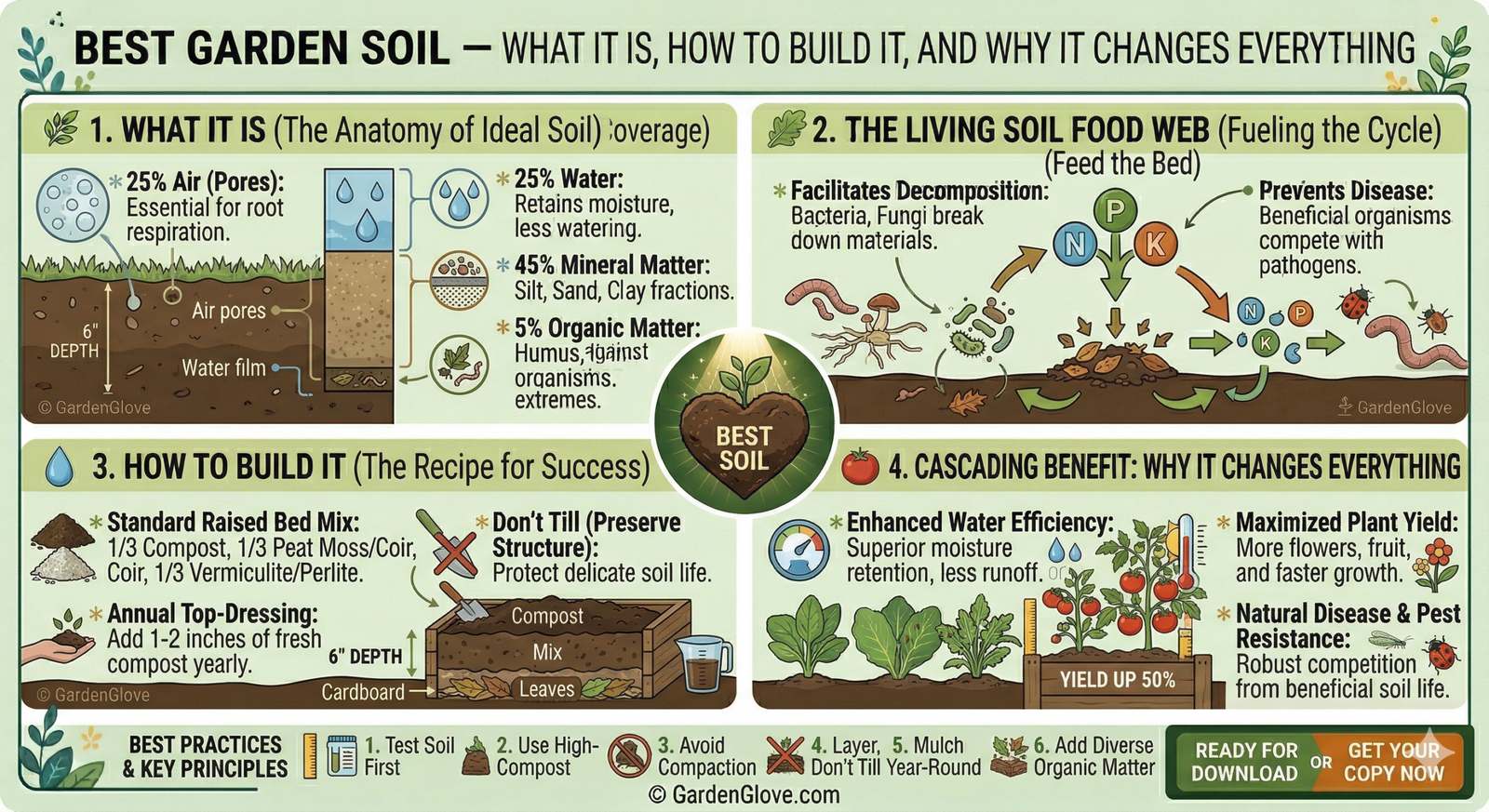
Ideal garden soil strikes a loamy balance: about 40% minerals for structure, 25% air for oxygen flow to roots, 25% water for hydration, and 10% organic matter to hold it all together (this balance is what defines loam: /loam-soil-explained/).
The Three Soil Types — And What Each Needs
Soil is made of approximately 45% weathered mineral particles from the parent rocks of the area. Sand is the largest-sized and coarsest mineral particle, silt is smaller, and clay is the smallest. The ratio of these three particle sizes determines your soil’s texture — and texture determines how it behaves.
Clay Soil
Clay particles are tiny, flat, and tightly packed. Clay holds water and nutrients exceptionally well — it has a high cation exchange capacity, meaning it binds positively charged nutrient ions and makes them available to plants.
The downside is what most gardeners know firsthand: clay drains slowly, compacts easily, becomes sticky when wet and rock-hard when dry, and suffocates roots in waterlogged conditions.
Clay-heavy soil forms a tight, slippery ball when wet. Clay soils compact easily and cause stunted root systems (full improvement process here: /clay-soil-improvement/).
The fix for clay is organic matter — not sand. Organic matter — compost, aged manure, shredded leaves — opens the clay structure by encouraging soil organisms that bind clay particles into aggregates, creating pore space.
Sandy Soil
Sandy soil is the opposite problem. Large particles mean large pore spaces — water drains straight through, carrying nutrients with it.
Sandy soil crumbles easily and feels gritty (how to improve sandy soil effectively: /sandy-soil-gardening/).
The fix is the same: organic matter. Compost fills gaps, improving retention.
Loam
Loam contains equal parts of sand, silt, and clay and is considered ideal for plant growth.
Loamy soil holds together loosely but crumbles under slight pressure — this is the ideal balance (full breakdown here: /loam-soil-explained/).
The Role of Organic Matter — The Single Most Important Variable
Regardless of soil type, organic matter is the input that improves every soil’s performance (how compost compares to soil itself: /compost-vs-garden-soil/).
It:
- improves structure
- feeds soil biology
- increases nutrient availability
- improves water retention
A 1% increase in organic matter helps soil hold ~20,000 additional gallons of water per acre.
The practical target: aim for 5%+ organic matter.
Understanding Soil pH — Why Numbers Matter
Soil pH controls nutrient availability.
Most vegetables thrive between 6.0 and 6.5 (full breakdown here: /soil-ph-guide/).
Correcting pH:
- lime raises
- sulfur lowers
Never guess — always test.
How to Test Your Soil — and What the Results Tell You
Before planting, test your soil to determine nutrient levels and pH (step-by-step process: /soil-testing-guide/).
Lab tests provide:
- pH
- nutrient levels
- organic matter %
- exact amendment recommendations
Building Better Soil: The Core Practices
Annual Compost Addition
This is the highest-return practice. Incorporate 1–2 inches annually (more detailed amendment strategies here: /organic-soil-amendments/).
Minimize Tillage
Tilling damages structure and soil biology. Use shallow incorporation or no-dig methods.
Prevent Compaction
Never step in beds. Use paths.
Mulch Consistently
Mulch protects:
- moisture
- structure
- nutrients
Especially critical in raised beds:
→ /raised-bed-mulching/
Grow Cover Crops
Legumes fix nitrogen. Rye suppresses weeds.
Avoid Pesticides in Soil
They disrupt soil biology — the system that makes nutrients available.
How Long Does It Take to Build Good Soil?
- 1 season → visible improvement
- 3 years → strong soil structure
- 5 years → fully transformed soil
This is compounding, not instant.
The Soil Test: Your Starting Point
The most common mistake in soil improvement is amending without testing.
A soil test removes guesswork:
→ /soil-testing-guide/
Where to Go Next
If you’re building a vegetable garden:
→ /vegetable-gardening/
If you’re preparing beds for planting:
→ /vegetable-garden-soil-prep/
If you’re working specifically with raised beds:
→ /best-soil-for-raised-beds/
If your plants are underperforming mid-season:
→ /vegetable-garden-watering-guide/