
The difference between adding organic amendments correctly and adding them haphazardly is the difference between a soil that improves compoundingly across seasons and a soil that gets occasional boosts between slow declines. I’ve made both mistakes — broadcast compost before understanding it needed incorporation, added fresh manure before overwintering and lost the nitrogen to leaching, applied wood ash to already-alkaline soil and created a pH problem that took two seasons to correct. Organic soil amendments work through well-understood mechanisms, and understanding those mechanisms makes every application more targeted, more efficient, and more effective than applying them as a general “more is better” strategy.
What Organic Amendments Do — The Mechanisms
Adding Organic Matter
All organic amendments add organic matter to the soil. This is their primary, universal effect — separate from any specific nutrients they contain. Organic matter feeds the soil food web, improves structure, increases cation exchange capacity, and improves both moisture retention and drainage depending on soil type (this is the foundation of productive soil: /best-garden-soil/).
The rate of organic matter contribution per unit applied varies significantly between amendments — a material that is 60% water contributes far less dry organic matter than one that is 90% dry matter.
Supplying Nutrients
Organic amendments release nutrients through microbial decomposition rather than immediate solubilisation.
Low C:N ratio (below 20:1): fast release
Medium C:N ratio (20–40:1): balanced release
High C:N ratio (above 40:1): slow release + temporary nitrogen drawdown
Understanding this prevents one of the most common soil mistakes:
→ /common-vegetable-garden-mistakes/
The Major Organic Amendments — What Each Does Best
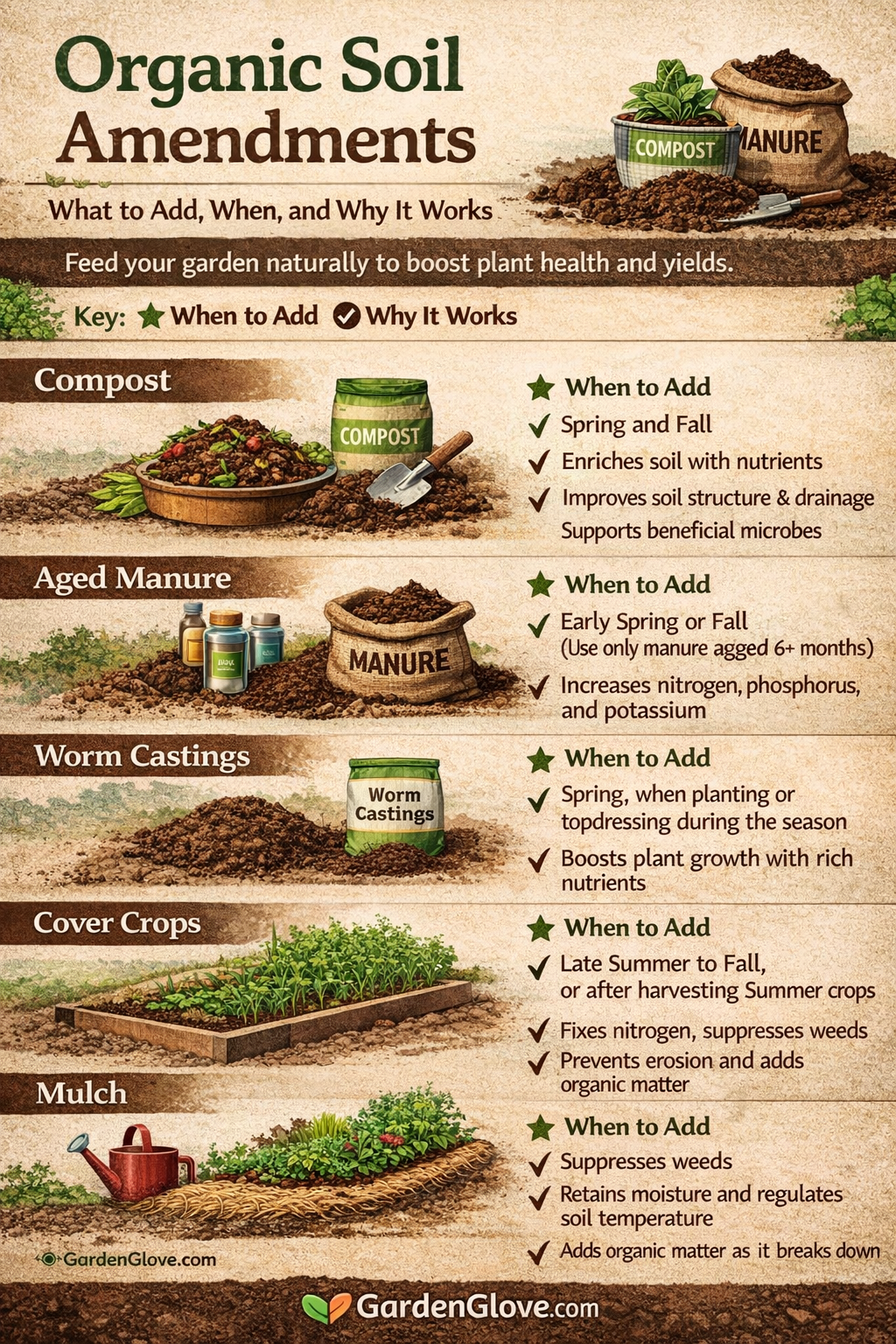
Garden Compost
The most broadly beneficial amendment. Provides organic matter, nutrients, and microbial life (how compost compares to soil: /compost-vs-garden-soil/).
Best use: annual application to all beds.
Well-Rotted Farmyard Manure
High organic matter + nutrient density.
Best use: heavy-feeding crops and pre-season soil building (especially important when preparing vegetable beds: /vegetable-garden-soil-prep/).
Blood Meal
Fast-acting nitrogen source.
Best use: correcting nitrogen deficiency quickly.
Bone Meal
Slow-release phosphorus.
Best use: root crops and long-season plants.
Seaweed
Micronutrient source + soil conditioner.
Best use: supplement, not primary fertility.
Rock Phosphate
Long-term phosphorus source.
Best use: building soil over time rather than immediate correction.
Green Manures
One of the most underused tools in gardening.
Best use: building soil between growing cycles and protecting soil over winter (this also improves long-term soil structure and reduces reliance on external inputs: /best-garden-soil/).
Applying Amendments — Timing and Method
Autumn Application
Best for:
- compost
- manure
- green manures
Allows decomposition before spring planting.
Spring Application
Best for:
- compost
- nitrogen-rich amendments
Aligns nutrient release with plant demand (especially important for timing-sensitive crops: /when-to-plant-vegetables-a-zone-by-zone-guide-to-getting-your-timing-right/).
In-Season Application
Liquid feeds provide fast response when plants need support mid-season (this often ties into watering practices and nutrient availability: /vegetable-garden-watering-guide/).
Summary
Match the amendment to the need:
- compost → general soil building
- manure → nutrient + organic matter boost
- blood meal → fast nitrogen
- bone meal → phosphorus
- seaweed → micronutrients
- green manures → long-term structure
Test first. Apply what the soil actually needs:
→ /soil-testing-guide/
Where to Go Next
If you’re building soil from the ground up:
→ /best-garden-soil/
If you’re deciding between soil inputs:
→ /compost-vs-garden-soil/
If you’re correcting specific soil types:
→ /clay-soil-improvement/
→ /sandy-soil-gardening/
If you’re preparing beds for planting:
→ /vegetable-garden-soil-prep/
If you’re working with raised beds:
→ /raised-bed-soil-mix/