The terms get used interchangeably at garden centres and in gardening content — “use good compost,” “well-amended garden soil,” “mix into your soil.” This conflation creates real confusion and real mistakes. I’ve seen seed trays filled with garden soil that produced patchy germination in compacted, poorly draining medium. I’ve seen raised beds filled with pure compost that grew extraordinary plants for one season before collapsing structurally and requiring rebuilding. Compost vs garden soil is not a question of which is better — it’s a question of what each is, what it does, and when you need which one.
What Garden Soil Is
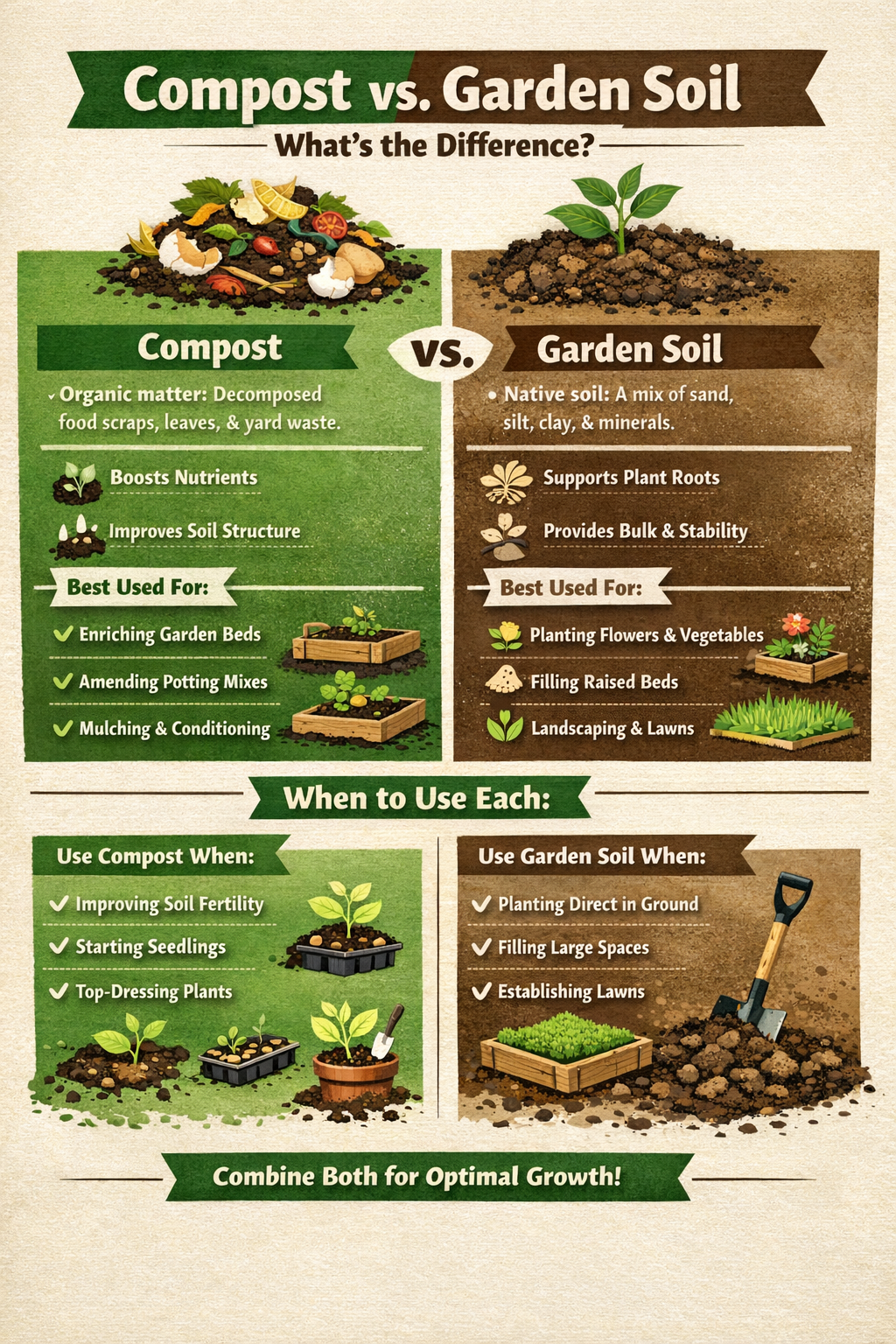
Garden soil is the mineral-dominated growing medium that forms the foundation of outdoor growing. It contains a mixture of sand, silt, and clay particles in proportions that define its texture class — sandy, loamy, or clay. It also contains organic matter, soil organisms, water, and air (for a deeper breakdown of what makes soil productive: /best-garden-soil/).
Importantly, garden soil in bags from a garden centre is a specification — typically a topsoil meeting a quality standard with a defined particle size distribution, pH range, and organic matter minimum.
The mineral particle component of garden soil provides:
- Physical structure — the scaffold that holds everything else in place
- Drainage stability — mineral particles don’t decompose
- Long-term stability — does not shrink significantly over time
What Garden Soil Lacks
Bagged garden topsoil is typically low in organic matter and biologically limited compared to established garden soil.
What Compost Is
Compost is decomposed organic matter — the stable end-product of biological breakdown. It is not a soil — it lacks mineral structure and is not a permanent growing medium.
Compost’s value lies in:
- Biological activity — supports soil life
- Nutrient provision — slow-release feeding
- Soil structure improvement — improves both clay and sandy soils
- Cation exchange capacity — improves nutrient retention
(For how compost fits into a full soil system: /organic-soil-amendments/)
What Compost Lacks
Compost alone works well short-term but compacts, shrinks, and lacks structure over time. It does not replace soil for permanent growing systems.
Multi-Purpose Compost vs Garden Compost vs Well-Rotted Compost
Multi-purpose compost — designed for containers and seed trays
Green waste compost — good bulk amendment
Well-rotted compost — highest biological value
Spent mushroom compost — high organic matter, slightly alkaline
When to Use Garden Soil
Filling raised beds — as part of a mix, not alone (see full mix here: /raised-bed-soil-mix/)
Large containers — provides long-term stability
Levelling ground — foundational layer
Turf establishment — required for root depth
When to Use Compost
Annual soil amendment — maintains fertility and structure
Seed sowing — light, well-draining medium (not garden soil)
Planting backfill — improves root establishment
Mulching — feeds soil over time (this also improves moisture retention and reduces watering needs: /vegetable-garden-watering-guide/)
The Correct Combination
Neither compost nor garden soil alone does everything.
- Soil = structure + permanence
- Compost = biology + fertility
Used together, they create a system that is both productive and stable (this is exactly how vegetable beds are built and maintained: /vegetable-garden-soil-prep/).
For raised beds:
→ /raised-bed-soil-mix/
Summary
Garden soil provides structure, stability, and long-term function. Compost provides biology, organic matter, and nutrient cycling. Use them together — soil as the base, compost as the ongoing input.
Where to Go Next
If you’re building soil from scratch:
→ /best-garden-soil/
If you’re preparing beds for planting:
→ /vegetable-garden-soil-prep/
If you’re working with raised beds:
→ /raised-bed-soil-mix/
If you’re improving soil over time:
→ /organic-soil-amendments/
If you need to test before adjusting:
→ /soil-testing-guide/