
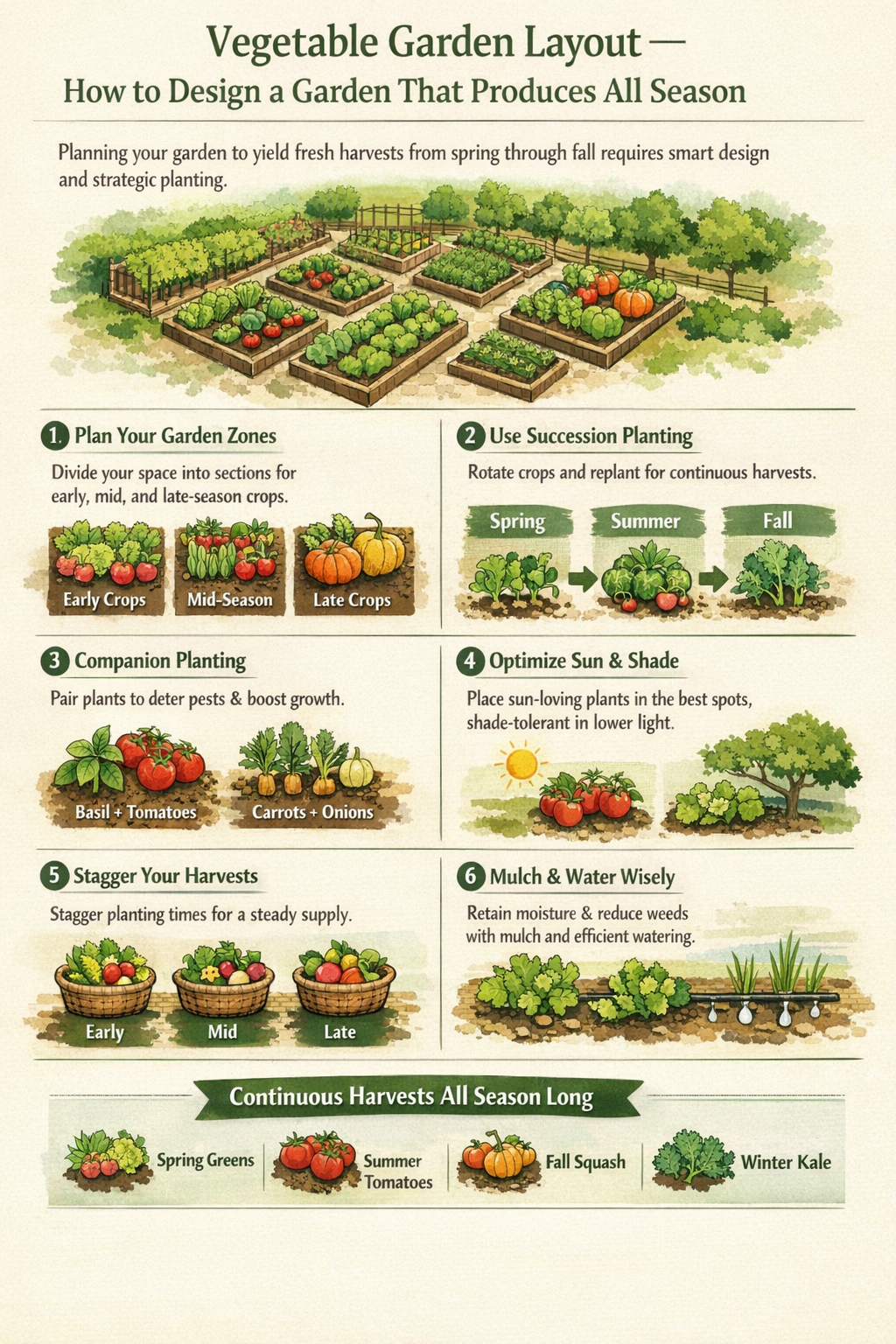
Most vegetable gardens underperform for the same handful of reasons: wrong location, beds that are awkward to work in, crops planted without thinking about height or shade, and no plan for what happens when the first round of harvests is done. The result is a garden that looks great in June, produces reasonably well in July, and by August is half-empty, overgrown, or exhausted.
Designing a productive vegetable garden layout isn’t complicated. It requires thinking through a few decisions before you plant — sun, access, plant height, succession, and rotation — that pay dividends across every season the garden runs. This guide walks through each decision in the order you’d make it, whether you’re starting from scratch or redesigning an existing space.
Step 1 — Site Your Garden Around Sun, Not Convenience
Every other layout decision is shaped by where the garden goes, and where it goes should be determined by sunlight above everything else. Most vegetables need 6 to 8 hours of direct sunlight daily. To maximize sunlight, plant tall varieties along the north side of the garden, medium-high varieties in the middle, and low-growing varieties on the south side.
Before siting any bed or plot, spend a day watching how sun moves across your yard. The spot that looks bright in the morning may be in full shade by early afternoon from a fence, house wall, or tree. Note where continuous sun falls from roughly 9am to 4pm — that’s your productive ground.
A few additional siting factors worth checking:
Water access. You will water this garden regularly in summer. A hose that just barely reaches the sunniest spot becomes a frustration that affects how attentive you are throughout the season (and consistent watering becomes critical later—see /vegetable-garden-watering-guide/).
Tree proximity. Large trees extend their root systems well beyond the visible canopy — often as wide as the tree is tall. Roots from nearby trees compete aggressively for water and nutrients and will undermine a vegetable garden sited within their reach. Keep the garden clear of large tree root zones.
Drainage. Avoid low spots that pool water after rain. Waterlogged soil suffocates roots and invites root disease. If the best sunny location has drainage issues, raised beds filled with the best soil for raised beds (/best-soil-for-raised-beds/) solve the problem without resiting.
Perennials go to the side. Crops that span more than one season — asparagus, strawberries, perennial herbs — should be placed along the perimeter or in a dedicated section so they don’t interfere with bed preparation and crop rotation in annual planting areas.
Step 2 — Choose Your Layout Type
The layout type determines how you organize growing space, manage access, and handle seasonal transitions. A raised bed vegetable garden layout is one of the most popular and versatile ways to grow food at home, working especially well if your native soil is rocky, compacted, or nutrient-poor (our raised bed gardening guide breaks this down further: /raised-bed-gardening-guide/). Square-foot gardening is a highly organized raised bed layout that divides growing area into 1×1-foot squares — ideal for small yards and urban gardens. Each approach suits a different situation.
Raised Bed Layout
The right choice for most home gardeners. A standard 4×8 raised bed, as detailed in our raised bed gardening guide (/raised-bed-gardening-guide/), is manageable for a beginner, highly productive, and teaches you the fundamentals before scaling up.
The 4-foot width rule is essential: never build a bed wider than you can comfortably reach across from either side. At 4 feet, you reach the center from either side without stepping in. Wider than that and you’ll inevitably step into the bed to manage plants in the center — compacting the soil and undoing one of the main advantages of the raised bed system.
Multiple beds in a raised bed layout should have walkways at least 18–24 inches wide between them — enough room for a wheelbarrow, a harvest basket, and comfortable movement without brushing plants.
Traditional Row Layout
Better suited to larger spaces and in-ground planting where you have room to spread out. Rows run north to south for even sun exposure throughout the day. Allow 18–36 inches between rows depending on crop size — wider for large crops like tomatoes and squash, narrower for beans and root vegetables. The main drawback is space inefficiency: row gardens use a large portion of their footprint for pathways rather than production.
Square Foot Gardening
A grid-based raised bed system where each 1×1-foot square holds a specific number of plants determined by size. Removes the guesswork from spacing and supports high-density planting in a small area (you can reference exact spacing needs here: /vegetable-spacing-chart/). This block-style planting method replaces long rows with dense groupings to maximize space, reduces weeding, and supports efficient harvests. Ideal for gardeners who want a structured approach without planning every detail from scratch.
U-Shaped or L-Shaped Layout
Arranging beds in a U or L shape around a central working area creates an efficient gardening station where everything is within arm’s reach without relocating. The open center becomes the work zone — a place to set tools, trays, and harvested produce. Particularly useful for accessibility and for households that want a dedicated garden room rather than beds scattered across the yard.
Container Layout
The right choice for patios, balconies, and small yards where in-ground planting isn’t possible. Containers offer complete flexibility in placement, can be moved to follow sun or protect from frost, and work well for tomatoes, peppers, salad greens, herbs, and compact vegetable varieties. The tradeoff is more frequent watering — containers dry out faster than beds — and limited root volume for large crops.
Step 3 — Plan Plant Height Before You Plant Anything
This is the layout decision most beginners skip, and it’s the one that causes the most visible problems: tomatoes shading peppers that shade lettuce that produces almost nothing.
The principle is straightforward: tall plants at the north end, short plants at the south end, medium plants in between. In a north-south oriented bed, this arrangement means each crop tier gets full sun throughout the day rather than being progressively shaded by taller neighbors.
Tall crops (over 3 feet): Indeterminate tomatoes, pole beans on a trellis, cucumbers on support, corn, sunflowers, peas on stakes, winter squash trained upward. These go at the back (north end) of the bed.
Medium crops (1–3 feet): Peppers, determinate tomatoes, eggplant, broccoli, kale, chard, bush beans, compact herbs. These go in the middle.
Short crops (under 12 inches): Lettuce, spinach, radishes, scallions, beets, herbs like basil and parsley, carrots. These go at the front (south end) where they receive maximum light and remain easy to harvest.
This arrangement also naturally groups plants with similar maintenance schedules together — the harvesting, watering, and pruning needs of each tier align roughly, making the garden easier to manage as a whole.
Step 4 — Plan for the Full Season, Not Just Spring
A garden planned only for spring planting is half the garden it could be. The difference between a bed that produces from April through October and one that exhausts itself by August is succession planning — knowing what goes in when the first round comes out.
Growing vegetables in succession as each parcel of your garden makes sure none of it goes unused during the growing season. As your spring-planted cool-season crops finish, plant a heat-loving crop for summer. Bush beans done? Sow some beets.
The seasonal framework for most of the US:
Spring (cool-season) window (see /when-to-plant-vegetables-a-zone-by-zone-guide-to-getting-your-timing-right/ for exact timing): Lettuce, spinach, arugula, peas, broccoli, kale, radishes, beets, carrots, onions.
Summer (warm-season) window: Tomatoes, peppers, cucumbers, squash, beans, corn.
Fall (cool-season) window: A second planting of lettuce, spinach, kale, beets, carrots, turnips, and radishes started in late summer.
The practical layout implication: don’t treat every square foot of bed as permanently assigned to one crop.
Step 5 — Map the Garden on Paper Before Planting
Mapping your garden also makes it easier to plan for crop rotation, companion planting, and succession sowing. By noting where you plant each family of vegetables, you can reduce pest and disease issues and keep your soil healthy from one season to the next.
You don’t need software or a precise diagram. A rough sketch on graph paper — each square representing one foot — takes 20 minutes and prevents the impulse planting that leads to spacing problems you can’t fix later (this is where spacing becomes critical: /vegetable-spacing-chart/).
Step 6 — Build Crop Rotation Into the Layout
Crop rotation — not planting the same plant family in the same bed two years in a row — is the most effective disease prevention practice in vegetable gardening.
If you’re working with raised beds, this becomes easier to manage when each bed is clearly defined (/raised-bed-crop-rotation/).
Step 7 — Use Vertical Space
Most vegetable garden layouts plan in two dimensions when three are available.
Crops that climb — pole beans, cucumbers, peas, small-fruited squash, and indeterminate tomatoes — produce the same yield in roughly half the horizontal footprint when trellised rather than left to sprawl.
Structures worth incorporating:
A-frame trellis
Cattle panel arch
Tomato cages or stake lines
Proper pruning becomes important as plants grow aggressively (this is where clean cuts matter: /best-pruning-shears/).
Step 8 — Design for Access and Maintenance
The most productive garden is the one you actually use.
Pathways wide enough to work in.
Place frequently harvested crops at the front.
Tools and compost nearby.
Leave space to kneel.
Most long-term issues come down to a few predictable mistakes in layout and maintenance—if something starts going wrong, this is usually where to look: /common-vegetable-garden-mistakes/