Clay soil has a reputation that precedes it. Talk to any gardener who’s tried to work with it and you’ll hear the same complaints: sticky and unworkable when wet, baked into concrete when dry, drainage that turns the garden into a swamp after rain and then cracks apart in a heat wave. Plants that struggle, roots that can’t penetrate, seeds that rot before they germinate.
The frustrating part is that clay soil is actually rich. It holds nutrients exceptionally well, retains moisture through dry spells, and contains the mineral content that lighter soils lack. The problem isn’t what clay has — it’s the physical structure that makes those assets inaccessible. Fix the structure, and clay becomes one of the most productive garden soils available (this ties directly into what makes soil function properly: /best-garden-soil/).
That’s what this guide is about: understanding why clay behaves the way it does, what actually works to improve it, what common “fixes” make things worse, and how to build a realistic multi-season improvement plan.
Why Clay Soil Is Difficult — The Actual Reason
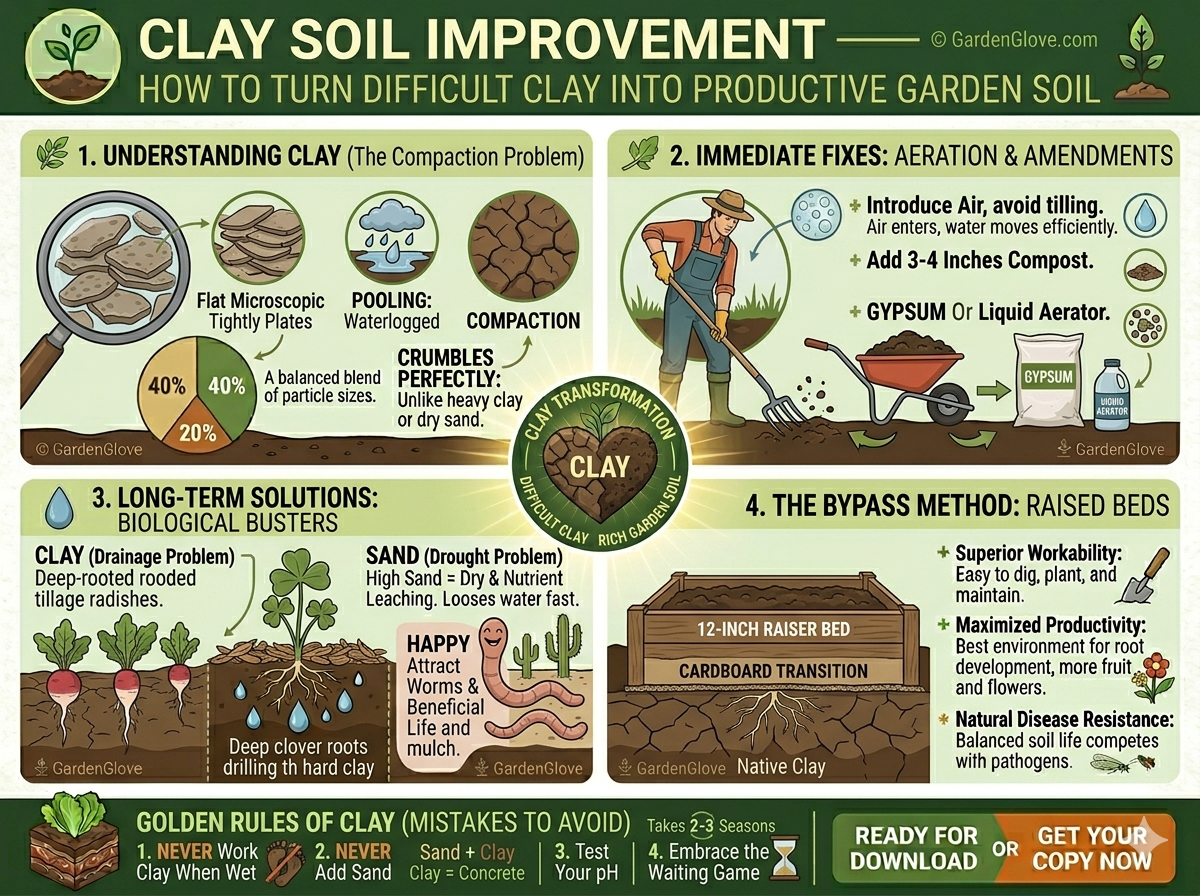
Clay particles are the smallest mineral particles in soil. Because of their size and flat shape, they pack tightly with very little pore space.
That tight packing leads to:
- poor drainage
- low airflow
- compaction
- restricted root growth
Despite this, clay holds nutrients extremely well — the challenge is structural, not chemical.
(This is why testing before correcting matters: /soil-testing-guide/)
The One Rule That Overrides Everything Else: Don’t Add Sand
Adding sand to clay does not improve it — it often makes it worse.
The correct solution is organic matter.
How Organic Matter Actually Fixes Clay
Organic matter improves clay through biology.
Soil organisms:
- break down organic inputs
- create binding compounds
- form aggregates
These aggregates create:
- drainage channels
- air pockets
- root pathways
This is the same process that builds productive soil over time:
→ /organic-soil-amendments/
The Core Amendment: Compost
Compost is the most effective input.
Initial application:
- 3–4 inches worked into topsoil
Maintenance:
- 1–2 inches annually
Using multiple compost sources improves microbial diversity (understanding compost’s role helps here: /compost-vs-garden-soil/).
Other Organic Amendments Worth Using
Aged manure
Leaf mold
Worm castings
Wood chips (surface only)
Biochar
Each contributes differently to structure and biology.
Gypsum: When It Helps and When It Doesn’t
Useful only for:
- sodic clay soils
- sodium imbalance
Otherwise:
- limited effect
Always confirm with a soil test:
→ /soil-testing-guide/
When and How to Work Clay Soil
Timing is critical.
Work soil only when:
- it crumbles
- not when wet
Working wet clay:
- damages structure
- reverses progress
The No-Dig Alternative: Lasagna Mulching
For difficult clay:
- layer organic materials on top
- allow biology to improve soil
This method works especially well when building new growing areas:
→ /raised-bed-gardening-guide/
Cover Crops for Clay Improvement
Deep-rooted crops improve structure naturally:
- daikon radish
- winter rye
- hairy vetch
They:
- break compaction
- add organic matter
- improve drainage
Drainage Improvement for Severely Waterlogged Clay
For extreme cases:
- raised beds (most effective)
- drainage systems
- mounding
Raised beds provide immediate improvement while soil improves underneath:
→ /raised-bed-soil-mix/
Clay Soil pH: The Hidden Problem
Clay soils are often alkaline.
This can:
- lock nutrients
- reduce availability
Test before adjusting:
→ /soil-ph-guide/
A Realistic Multi-Season Improvement Plan
Year 1:
- test soil
- add compost
- correct pH
- mulch
Year 2:
- add compost
- introduce cover crops
- reduce disturbance
Year 3+:
- maintain with compost
- minimal tilling
Over time:
- structure improves
- soil behaves like loam (understanding loam helps here: /loam-soil-explained/)
Where to Go Next
If you’re building soil from scratch:
→ /best-garden-soil/
If you’re comparing soil inputs:
→ /compost-vs-garden-soil/
If you’re improving sandy soil:
→ /sandy-soil-gardening/
If you’re preparing beds for planting:
→ /vegetable-garden-soil-prep/
If you’re working with raised beds:
→ /raised-bed-gardening-guide/