Something looks off in your garden.
Leaves are yellowing. Some plants are wilting. Others have holes, spots, or sticky residue. You know something is wrong—but it’s not obvious what.
This is where most gardeners lose time.
The problem usually isn’t fixing it.
It’s diagnosing it correctly.
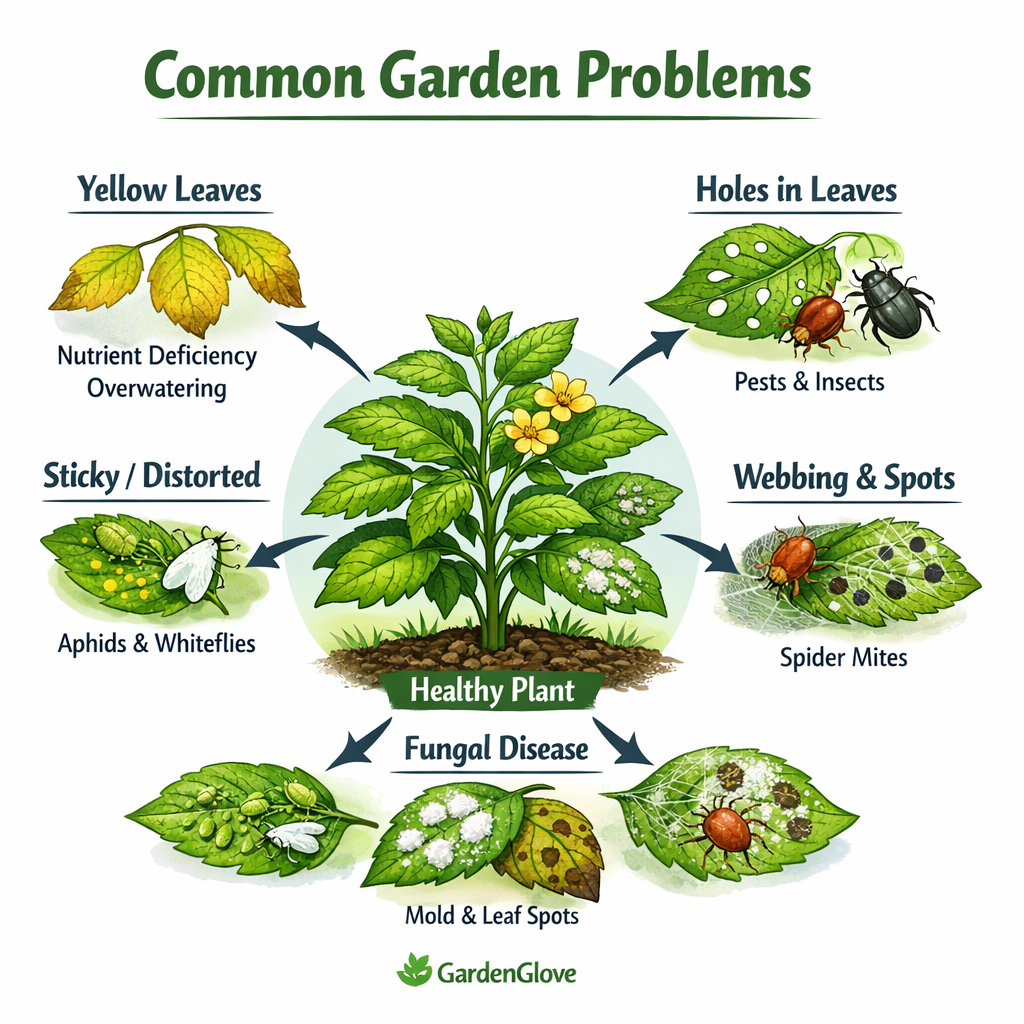
(Place your diagram here — directly under this intro)
Quick Answer
Most common garden problems come from a small number of causes:
- watering issues
- pests
- fungal diseases
- nutrient deficiencies
- environmental stress
If you identify the cause correctly, the solution becomes straightforward.
How to Diagnose Garden Problems (Before You Do Anything)
Before treating anything, look for patterns.
What do the leaves look like?
- yellow → watering or nutrients
- holes → pests
- spots or mold → disease
- distortion or stickiness → sap-feeding insects
Where is the damage happening?
- lower leaves → often normal or nutrient-related
- new growth → pests or deficiency
- entire plant → watering or root issue
How fast is it spreading?
- slow → nutrient or environmental issue
- fast → pests or disease
The 5 Most Common Garden Problems (and What to Do)
Yellow Leaves (Watering or Nutrients)
This is the most common issue—and the most misdiagnosed.
Typical causes:
- overwatering
- underwatering
- nitrogen deficiency
Full diagnosis:
Why Are My Leaves Turning Yellow
Holes in Leaves (Pests)
If leaves are being eaten, something is feeding on them.
Common culprits:
- beetles
- caterpillars
- slugs
Confirm the cause here:
Garden Pest Identification Guide
Then treat using:
Garden Pest Control Guide
Sticky or Distorted Leaves (Sap-Feeding Insects)
If leaves feel sticky or curled, pests are likely draining plant sap.
Common pests:
These pests spread quickly and require repeated treatment.
Spots, Powder, or Mold (Fungal Diseases)
Fungal problems often appear as:
- dark spots
- white powder
- spreading patches
Full guide:
Fungal Diseases in the Garden
Specific example:
Tomato Blight Guide
Wilting Plants (Water or Roots)
Wilting does not always mean lack of water.
Possible causes:
- overwatering (roots suffocating)
- underwatering
- root damage
Check soil moisture before adjusting anything.
What Actually Works (and What Doesn’t)
What works:
- diagnosing before treating
- acting early
- using consistent treatment cycles
What doesn’t:
- guessing and reacting randomly
- treating symptoms instead of causes
- waiting too long
How to Prevent Most Garden Problems
Prevention is more effective than treatment.
- water consistently (not excessively)
- maintain airflow
- inspect plants regularly
- avoid overcrowding
Build a stronger foundation with:
Tools That Make This Easier
Many problems get worse simply because they aren’t handled early.
Use proper tools:
Where to Go Next
If you’ve identified your issue:
- Diagnosis → Garden Pest Identification Guide
- Treatment → Garden Pest Control Guide
- Natural methods → Organic Garden Pest Control
Conclusion
Most garden problems look different on the surface, but they usually come from a small number of causes.
Once you learn to recognize patterns, you stop guessing and start fixing problems quickly and confidently.