
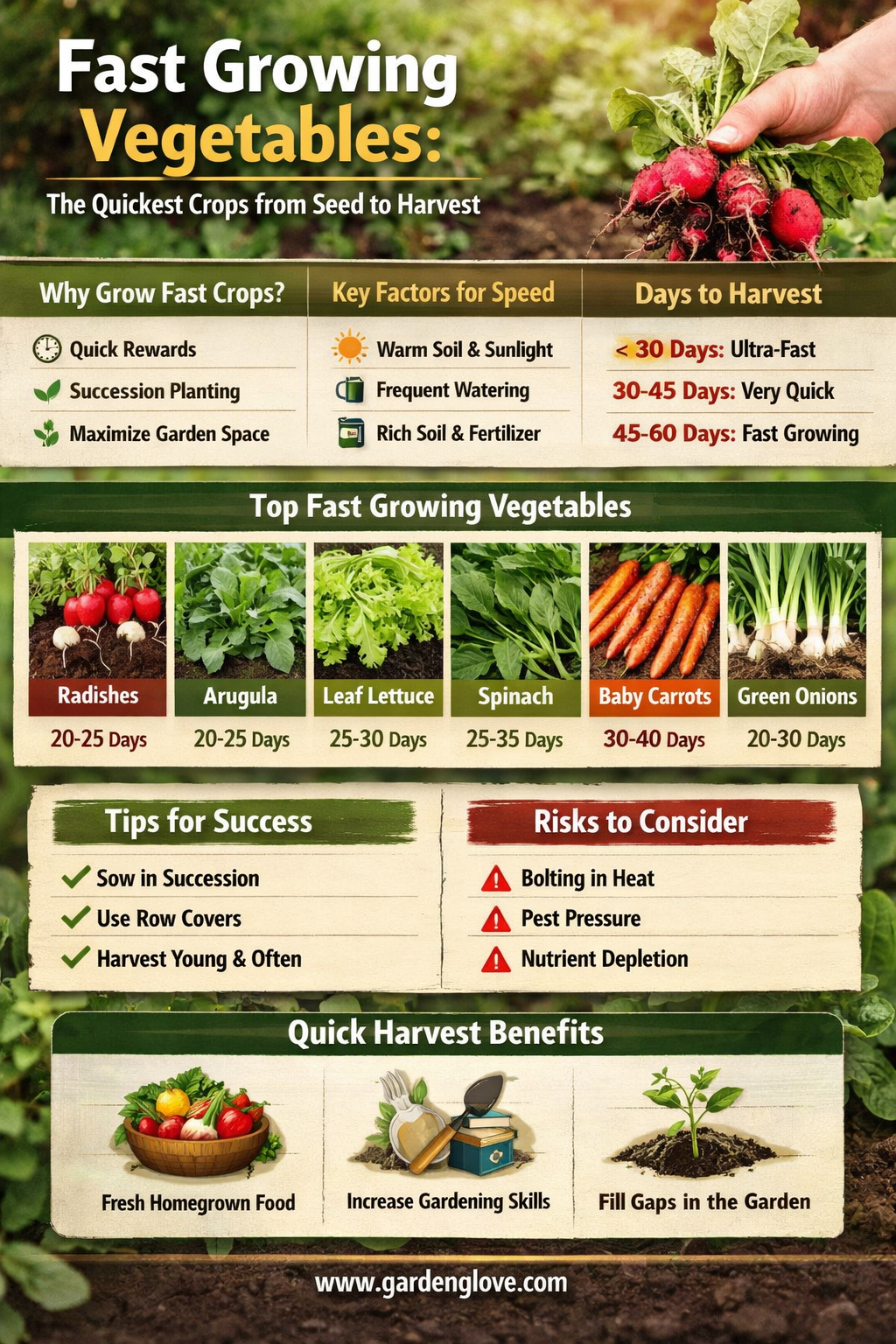
Some gardening satisfaction is worth waiting for. Tomatoes take 70 days. Winter squash takes 90. Melons push 100. But not every crop asks that much of you — and knowing which fast growing vegetables deliver in 20 to 60 days changes how you use your garden space, how you manage gaps in the season, and how quickly a beginner goes from anxious to confident.
Fast crops serve a practical purpose beyond impatience. They fill beds between longer-season plantings. They give you something to harvest while tomatoes are still setting flowers. They make succession planting achievable — sow another row of radishes every two weeks and you’re harvesting continuously rather than all at once. And in short-season climates, fast-maturing varieties are sometimes the only viable option for certain crops at all (this is especially important when planting windows are tight: /when-to-plant-vegetables-a-zone-by-zone-guide-to-getting-your-timing-right/).
This guide covers every genuinely fast vegetable — organized by speed, with the honest days-to-harvest numbers, the best varieties to look for, and the tips that actually move the timeline.
What “Days to Harvest” Actually Means
The number on a seed packet represents days from direct sowing to first harvest under good conditions — adequate soil, correct temperature, consistent moisture. It’s a useful baseline, not a guarantee.
Temperature matters more than calendar date. Cool-season crops grow faster in cool weather and stall or bolt in heat. Warm-season crops stall in cold soil — a zucchini planted in warm May soil will outpace the same variety planted earlier in cold soil (this is one of the most common timing mistakes: /common-vegetable-garden-mistakes/).
You don’t have to wait for full maturity. Most fast crops can be harvested earlier than their packet days suggest.
Transplants shave time. Starting seeds indoors accelerates harvest timelines.
Under 30 Days — The Fastest Crops in the Garden
Radishes — 21 to 30 Days
Mustard Greens — 20 to 30 Days
Arugula — 21 to 40 Days
These crops define what “fast” really means in a vegetable garden. They germinate quickly, establish rapidly, and are ready to harvest while most other plants are still developing.
Because they grow so quickly, spacing and thinning become critical to avoid wasted growth (use exact spacing here: /vegetable-spacing-chart/).
30 to 45 Days — Fast and Reliable
Lettuce — 21 to 50 Days
Spinach — 40 to 50 Days
Beet Greens — 30 Days
Scallions — 20–60 Days
Bok Choy — 30 to 45 Days
These crops balance speed with yield and are ideal for filling gaps in beds or maintaining a steady harvest.
They also respond strongly to soil quality — fast crops slow down immediately in poor soil (this is where preparation matters most: /vegetable-garden-soil-prep/).
45 to 60 Days — Fast Enough to Matter
Peas — 55 to 70 Days
Zucchini — 45 to 55 Days
Bush Beans — 50 to 60 Days
Baby Carrots — 50 to 60 Days
Kale — 25–65 Days
Turnips — 35 to 60 Days
These crops take longer but still fit into succession planting cycles, especially in well-planned gardens (this is where layout determines efficiency: /vegetable-garden-layout/).
Fast Herbs Worth Noting
Cilantro
Dill
Chives
Basil
Herbs are often overlooked in fast-growing lists, but they deliver some of the highest return per square foot and are among the easiest crops to integrate into any garden layout.
The Succession Planting Principle
The most important concept in fast-vegetable growing isn’t any individual crop — it’s succession planting.
Rather than sowing everything at once, plant small amounts every 2–3 weeks. This creates a continuous harvest instead of a single overwhelming one.
This works best when spacing and layout are already dialed in:
→ /vegetable-spacing-chart/
→ /vegetable-garden-layout/
Using Fast Crops to Maximize Bed Productivity
Fast crops solve one of the biggest inefficiencies in gardening: empty space.
Newly planted tomatoes and peppers leave open soil for weeks. Planting fast crops in that space:
- reduces weeds
- improves moisture retention
- produces usable harvest
By the time slower crops take over, the fast crops are already harvested.
This is one of the simplest ways to improve yield without expanding your garden (especially in raised beds: /raised-bed-gardening-guide/).
Where to Go Next
If you’re planning your first garden:
→ /vegetable-gardening-for-beginners/
If you want to maximize production:
→ /vegetable-garden-layout/
If crops are underperforming:
→ /vegetable-garden-soil-prep/
If growth seems inconsistent:
→ /vegetable-garden-watering-guide/
If yields are lower than expected:
→ /vegetable-spacing-chart/