
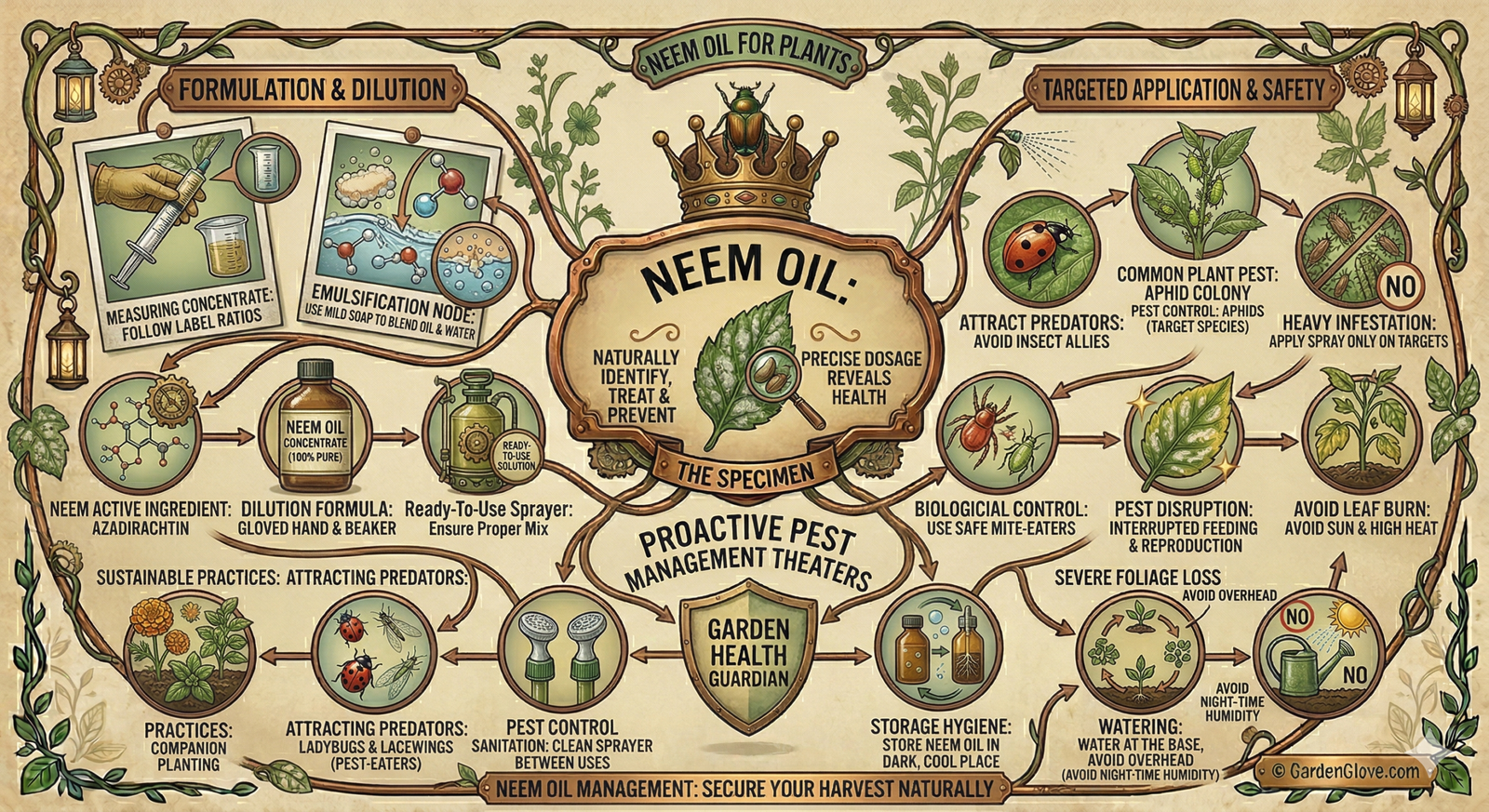
Neem oil comes up in almost every organic pest control conversation, and for good reason. It works on a wide range of common garden pests, doubles as a fungicide, breaks down quickly without leaving heavy residues, and can fit well into a low-toxicity garden strategy when it is used correctly. It is one of the most versatile tools in organic gardening.
But neem oil is also one of the most misused. Gardeners apply it at the wrong time of day and burn their plants. They mix it incorrectly and it separates or loses effectiveness. They expect immediate results that neem does not deliver. They use it as a last resort on heavy infestations when it works best as prevention and early intervention.
Understanding how neem oil actually works — and the practical details that determine whether it succeeds or fails — makes it a genuinely reliable part of any organic pest management program. For the broader framework on diagnosing and treating pest problems naturally, start with Garden Pest Control: Identify, Treat, and Prevent Common Garden Pests Naturally.
What Neem Oil Is
Neem oil is a naturally occurring pesticide extracted from the seeds of the neem tree (Azadirachta indica), a tropical evergreen native to India and parts of Southeast Asia. It has multiple uses in the garden. In addition to helping control a wide range of insect pests, it also serves as a biofungicide.
The oil contains dozens of active compounds. Neem products usually fall into one of two categories.
Cold-pressed neem oil contains azadirachtin naturally along with the other active compounds found in the seed oil. This is the most complete form of neem and usually the version gardeners want when they are looking for broad pest-management value.
Clarified hydrophobic neem oil has had the azadirachtin removed. It still has value because it works by coating insects and fungal spores, but it is less comprehensive than full-spectrum cold-pressed neem oil.
This distinction matters when you shop. Many gardeners buy a neem product expecting one type of performance and get another because they did not check the label closely.
How Neem Oil Works
Neem works through several different mechanisms at the same time, which is one reason it is effective across such a broad range of pests and why resistance tends to be less of a concern than with single-mode pesticides.
The most important active compound is azadirachtin. It can repel feeding, interfere with molting, reduce egg-laying, and disrupt hormonal systems in susceptible insects. Neem oil also works physically by coating certain insects and reducing their ability to function normally. It is usually most effective against immature and soft-bodied insects.
For fungal diseases, neem works differently. It can help slow issues such as powdery mildew by interfering with spore germination and spread across healthy tissue. It does not “cure” heavily infected tissue that is already colonized, but it can help stop a small problem from becoming a large one. That is why it fits especially well into early-stage management for pages like Powdery Mildew Treatment: How to Identify, Treat, and Prevent It Naturally.
The key implication is simple: neem oil usually does not provide instant results. Visible improvement often appears after 7 to 14 days of repeated, thorough applications. Correct application is the difference between success and failure.
What Neem Oil Controls
Insect pests
Neem oil is most reliable against soft-bodied or immature pests such as aphids, mealybugs, scale crawlers, spider mites, and whiteflies. It is also used as part of broader control programs for Japanese beetles, certain lawn grubs, leafhoppers, thrips, and other recurring garden pests.
It is less effective against hard-bodied adult beetles and heavy caterpillar infestations. For example, neem can help deter feeding from Japanese beetles, but on a heavy outbreak it usually works best alongside hand-picking and other control methods. Likewise, neem can reduce pressure from tomato hornworms when used as a deterrent, but it is not the strongest choice once large larvae are already established.
Fungal diseases
Neem is also used to suppress some fungal and bacterial plant problems, including anthracnose, black spot, rust, scab, and blight. In vegetable gardens, one of the most practical uses is early treatment support for powdery mildew on cucurbits and beans.
If mildew is already spreading across the plant, neem can still help protect healthy tissue, but it works best when paired with sanitation, airflow improvements, and early intervention. For the larger decision framework on when sprays make sense versus when cultural controls matter more, see Organic Garden Pest Control: Natural Methods That Actually Work.
Mixing Neem Oil Correctly
This is where many neem failures happen. Neem oil does not mix with water on its own. It needs an emulsifier to stay suspended in solution.
A common mixing ratio for pest control is:
- 2 tablespoons cold-pressed neem oil
- 1 teaspoon mild liquid soap
- 1 gallon warm water
Start with warm water, add the soap, then slowly add the neem oil while stirring or shaking continuously. Mix immediately before use because neem solution does not store well once diluted.
For lighter preventive use, many gardeners work with a lower concentration. For active infestations, a stronger concentration is more common. The safest path is to follow the product label first, then stay conservative until you know how your plants respond.
Preventive spray: Use a lighter solution and apply every 7 to 14 days.
Active infestation: Use a stronger solution and apply every 5 to 7 days until pressure drops.
Dormant spray: For some trees and woody ornamentals, neem can be used during dormancy to target overwintering eggs and larvae, but label instructions matter here because products vary.
When and How to Apply Neem Oil
Apply only in the morning or evening
Timing matters more than most gardeners realize. Neem should be applied in the early morning or evening only. Midday applications raise the risk of leaf burn, especially when oil, sunlight, and heat combine on tender foliage.
Early morning is usually the best window because foliage has time to dry before the hottest part of the day and pollinators are less active. Evening is the second-best option. Never spray neem in full sun or when temperatures are above about 90°F.
Use thorough coverage
Use a pump sprayer or garden sprayer set to a fine mist. Neem works only where it lands, so complete coverage matters. Spray upper and lower leaf surfaces, stems, and the areas where pests are actually feeding.
This is particularly important for pests that hide on leaf undersides, such as colonies described in our Aphids on Plants: How to Identify, Get Rid of Them, and Prevent Infestations, Spider Mites: Identification, Damage Signs, and Control Methods, and Whiteflies on Plants: How to Get Rid of Them and Prevent Infestations guides.
Reapply consistently
Neem breaks down relatively quickly on leaf surfaces, which is part of why it leaves little lasting residue. That is a safety advantage, but it also means one spray is rarely enough. Preventive use usually means reapplying every couple of weeks. Active pest management usually requires weekly treatment.
Spot test first
Neem oil can burn foliage, especially on stressed, recently transplanted, waxy, hairy, or otherwise sensitive plants. Always test it first on a small section of the plant and wait 24 hours before treating the whole thing.
Is Neem Oil Safe?
For humans and pets
Neem oil is generally considered low in toxicity when used as directed. Even so, avoid inhaling the spray, wear gloves for larger applications, and wash produce thoroughly before eating it.
For beneficial insects
Neem is much safer for pollinators and beneficial insects when it is applied at the right time. The key is avoiding direct spray contact while bees and butterflies are active. Once neem has dried, risk is much lower.
This is why application timing is part of the real safety strategy, not just a side note. A badly timed “organic” spray can still create unnecessary collateral damage.
For aquatic life
Neem oil can be harmful to fish and some aquatic organisms. Avoid spraying near ponds, streams, or water features, and prevent runoff into drainage that connects to waterways.
What Neem Oil Will Not Do
Setting expectations correctly matters because neem is often abandoned for the wrong reasons.
It will not provide instant knockdown. Neem changes pest biology over time. You usually will not see dramatic overnight results.
It will not cure established fungal infection. If a plant is already heavily infected, remove the damaged tissue first and use neem to help protect what remains.
It will not replace physical removal for large infestations. A plant covered in large caterpillars or heavily infested with adult beetles usually needs hand removal or another stronger first response.
It will not work well if mixed and stored. Neem breaks down quickly once diluted. Mix fresh each time and use it promptly.
How to Use Neem Oil for Specific Problems
Aphids
Neem is especially useful against aphids because it disrupts both feeding and reproduction. Apply it to new growth and leaf undersides where colonies build fastest. For best results, reduce the colony first with water, then follow with neem. See Aphids on Plants.
Spider mites
Apply neem to the undersides of leaves where mites feed and reproduce. Neem works best here when combined with humidity management and repeated applications. See Spider Mites.
Whiteflies
Neem is useful on whitefly nymphs feeding on the undersides of leaves. Combine it with monitoring tools such as sticky traps for better control. See Whiteflies on Plants.
Japanese beetles
Neem can reduce feeding pressure and act as a deterrent when used early, but it is not usually enough on its own once large aggregations form. See Japanese Beetles.
Powdery mildew
Neem is one of the better organic options for slowing powdery mildew spread when you catch it early. It is more useful as a stop-spread treatment than as a cure for badly infected leaves. See Powdery Mildew Treatment.
Tomato hornworms
Neem works better as a deterrent against egg-laying and on very young larvae than it does on large, established hornworms. For bigger larvae, direct removal usually matters more. See Tomato Hornworms.
Quick Application Reference
| Situation | Concentration | Frequency | Best Time |
|---|---|---|---|
| Prevention | Light solution | Every 14 days | Early morning |
| Active soft-bodied pests | Stronger solution | Every 5–7 days | Early morning or evening |
| Early fungal pressure | Stronger solution | Every 7 days | Early morning |
| Dormant application | Per label | Once in late winter | Morning |
| Repeat support use | Per label | As needed | Morning |
More Garden Pest and Treatment Guides
- Garden Pest Control: Identify, Treat, and Prevent Common Garden Pests Naturally
- Organic Garden Pest Control: Natural Methods That Actually Work
- Aphids on Plants: How to Identify, Get Rid of Them, and Prevent Infestations
- Spider Mites: Identification, Damage Signs, and Control Methods
- Whiteflies on Plants: How to Get Rid of Them and Prevent Infestations
- Japanese Beetles: Identification, Damage, and How to Get Rid of Them
- Powdery Mildew Treatment: How to Identify, Treat, and Prevent It Naturally
- Tomato Hornworms: How to Identify, Control, and Prevent Damage