
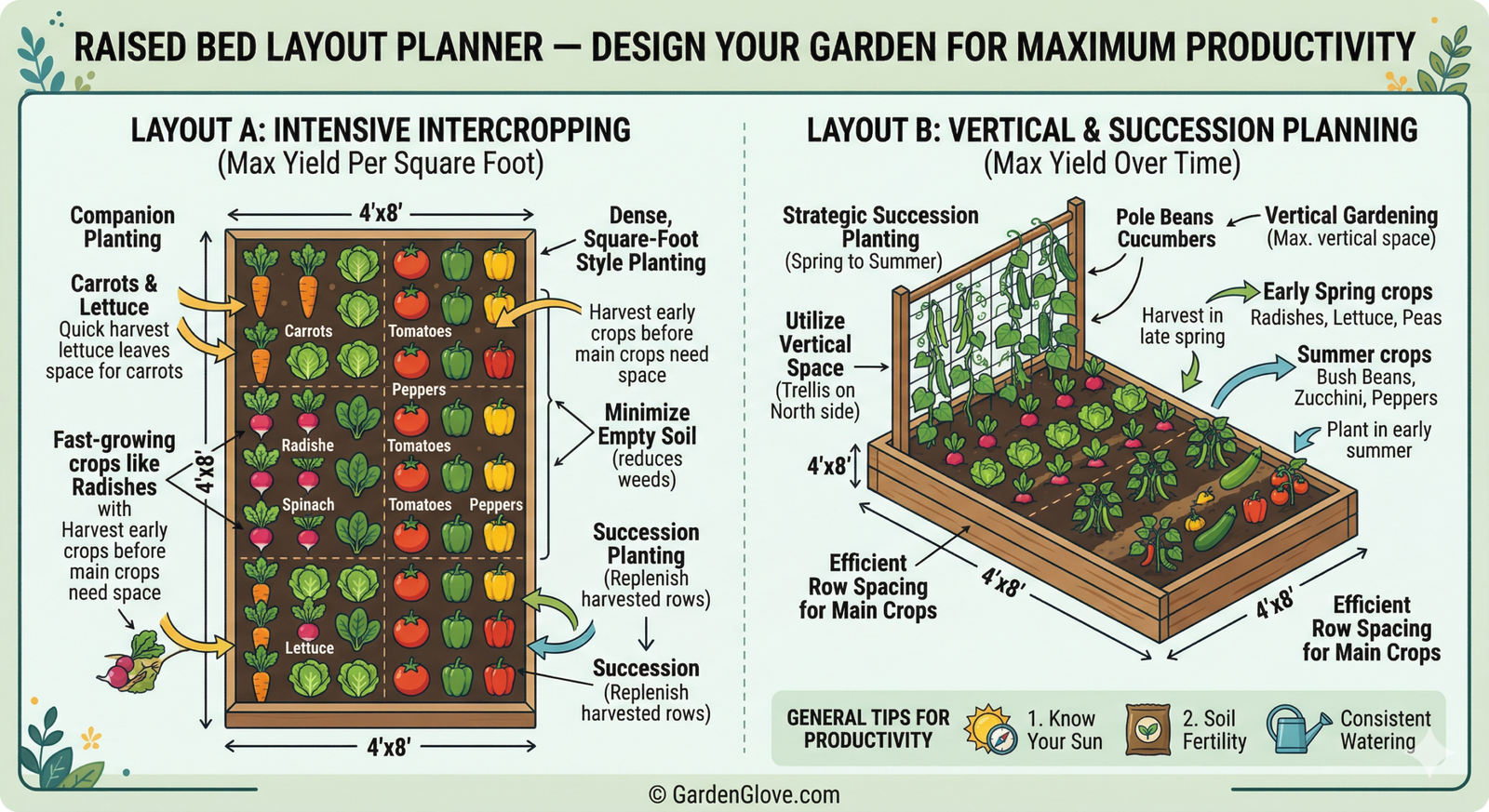
Most raised bed gardens are planted by instinct. You buy seedlings in spring, find spots that seem about right, and push them into the soil. It works well enough — until the zucchini takes over, the tomatoes shade everything behind them, the lettuce bolts in the summer heat before you got to eat it, and somehow the herbs are in the worst possible spot for reaching them from the kitchen.
A little planning before the season starts fixes all of that. Not complicated planning — just thinking through the decisions that actually drive productivity: sunlight, height, access, spacing, what grows well together, and what should never share a bed (this ties directly into overall garden structure: /vegetable-garden-layout/).
This guide walks through each of those decisions in the order you’d make them.
Start With Sun, Not Plants
The single most common layout mistake is choosing bed location before understanding sunlight.
Vegetables need 6 to 8 hours of direct sun per day. That number isn’t flexible.
Before siting beds, observe sun patterns across your yard. Plan beds around the sunniest area available — not what’s left over after other decisions.
Plan for Plant Height Before You Plant Anything
Tall plants cast shade — and that determines everything behind them.
- tall → back (north)
- medium → middle
- short → front (south)
This prevents shading and makes harvesting easier.
(This principle applies across all vegetable layouts: /vegetable-garden-layout/)
The 4-Foot Width Rule and Why It Matters
Beds should not exceed 4 feet in width.
Why:
- reach center from both sides
- no stepping into bed
- preserves soil structure
(This is critical for maintaining soil health over time: /best-garden-soil/)
Spacing: The Number Most Beginners Get Wrong
Spacing determines:
- yield
- airflow
- disease pressure
Raised beds allow tighter spacing — but only when soil is properly built.
Use structured spacing guidelines:
→ /vegetable-spacing-chart/
In poor soil, increase spacing. In rich soil, tighter planting works.
Companion Planting: What Actually Works
Instead of memorizing charts, follow principles:
- pest-repelling herbs at edges
- compatible plant pairings
- avoid known conflicts
Examples:
- tomatoes + basil
- carrots + radishes
Avoid:
- fennel (allelopathic)
- alliums near beans
- tomatoes near potatoes
(Many pairing issues show up as broader garden problems here: /common-vegetable-garden-mistakes/)
Layout Strategies for Common Bed Configurations
Single 4×8 Bed
Divide into:
- back (tall crops)
- middle (medium crops)
- front (short crops)
This allows multiple crops without crowding.
Two Beds
Separate by:
- warm-season crops
- cool-season crops
This simplifies:
- watering
- rotation
- management
Three or More Beds
Now rotation becomes possible.
Group crops by family and rotate each season.
(This is where crop rotation becomes important: /raised-bed-crop-rotation/)
L-Shaped or U-Shaped Layouts
Efficient for:
- accessibility
- workflow
- tool access
Vertical Space: The Missing Dimension
Most layouts ignore vertical growth.
Use:
- trellises
- arches
- supports
This:
- increases yield
- saves space
Place vertical structures on the north side to avoid shading.
Succession Planting: Extending the Season
Beds shouldn’t sit empty.
Replace finished crops with new ones:
- radishes → beans
- lettuce → kale
- beans → fall greens
Timing matters:
→ /when-to-plant-vegetables-a-zone-by-zone-guide-to-getting-your-timing-right/
(This is also where fast crops become useful: /fast-growing-vegetables/)
What to Do When Space Is Limited
Prioritize:
- high-value crops
- compact varieties
- vertical growth
Use:
- cut-and-come-again crops
This maximizes yield per square foot.
A Simple Planning Process Before Each Season
- list crops
- check spacing
- assign positions
- plan succession
- verify compatibility
This prevents:
- crowding
- shading
- wasted space
Where to Go Next
If you’re building your first raised bed:
→ /raised-bed-gardening-guide/
If you need the correct soil mix:
→ /raised-bed-soil-mix/
If you’re preparing beds for planting:
→ /vegetable-garden-soil-prep/
If spacing feels unclear:
→ /vegetable-spacing-chart/
If timing is the issue:
→ /when-to-plant-vegetables-a-zone-by-zone-guide-to-getting-your-timing-right/