
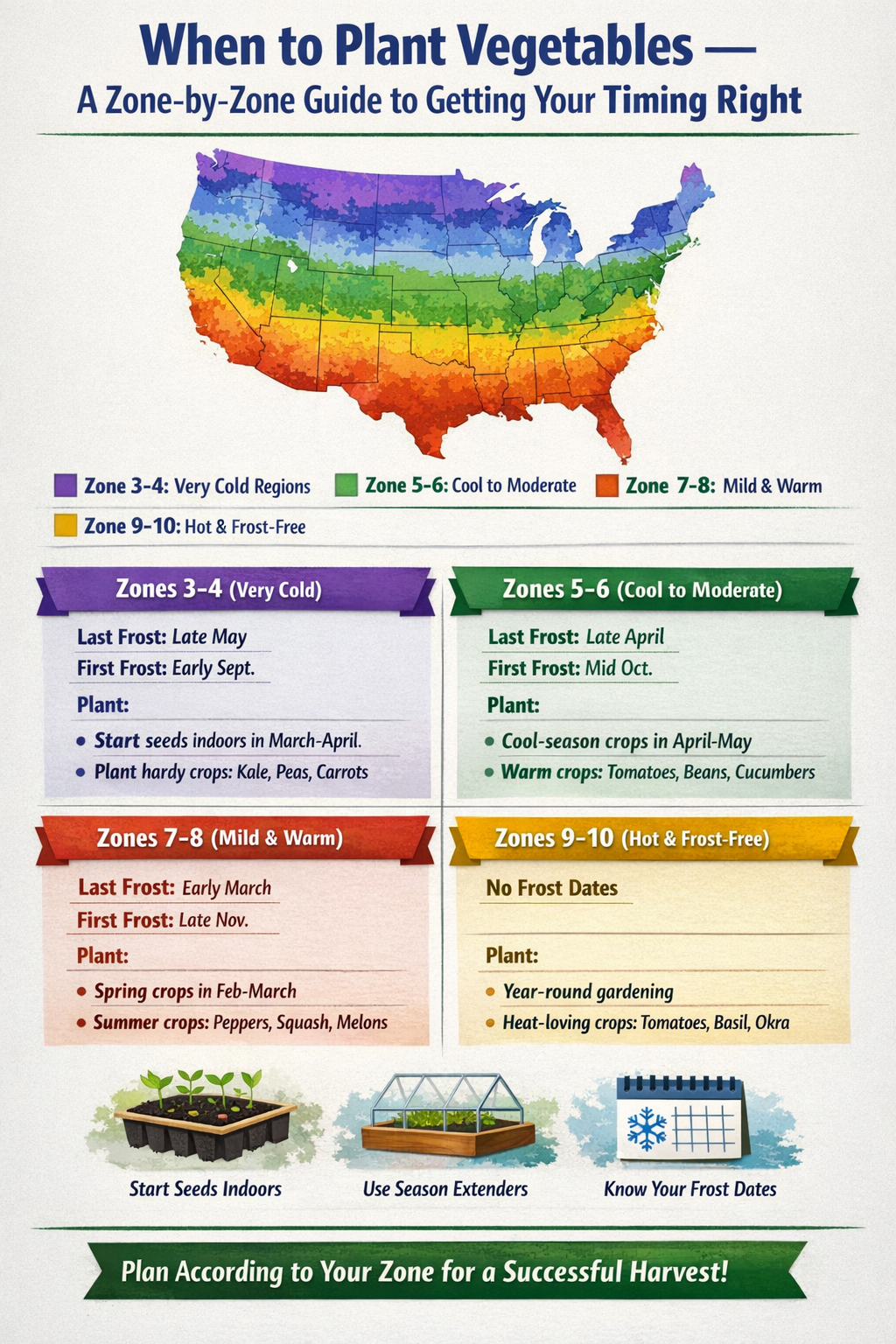
Planting timing is one of the most common sources of garden failure — and one of the easiest to fix once you understand two things: your USDA hardiness zone, and the difference between cool-season (like many fast growing vegetables) and warm-season crops (see which crops grow fastest here: /fast-growing-vegetables/).
Get the timing right and plants establish quickly, produce reliably, and resist disease and pest pressure better. Get it wrong — transplanting tomatoes into cold soil, or planting lettuce when summer heat has already arrived — and you get stunted plants, bolted greens, and fruit that never sets regardless of how well everything else is managed (many of these show up as predictable issues here: /common-vegetable-garden-mistakes/).
Knowing when to plant vegetables in your specific location is important because most states span multiple hardiness zones that can vary drastically in planting schedules. This guide explains the zone system, how frost dates drive every timing decision, and what to plant when across zones 3 through 10.
Understanding USDA Hardiness Zones
The USDA Plant Hardiness Zone Map divides the United States into zones based on average annual minimum winter temperature.
For vegetable gardening, the zone number matters primarily because it determines:
- frost-free growing season length
- timing of last spring frost
- timing of first fall frost
Most vegetables are annuals — what matters is frost timing, not the zone label itself.
How to find your zone: use the USDA map and enter your zip code.
How to find your frost dates: use a frost calculator to determine last and first frost dates — these anchor all planting decisions.
Cool-Season vs. Warm-Season Crops — The Most Important Distinction
Cool-season crops grow best between 40°F and 70°F. They tolerate frost and often improve in flavor after light cold exposure. These go in early and again in late summer for fall harvest (this is where layout planning becomes important for transitions: /vegetable-garden-layout/).
Warm-season crops require warm soil (above 60°F) and are killed by frost. These go in after your last frost date when conditions stabilize.
The practical rule:
- cool-season → before last frost
- warm-season → after last frost
Spacing and arrangement matter once planted:
→ /vegetable-spacing-chart/
Reading the Zone-by-Zone Guides
Each zone guide provides:
- last spring frost / first fall frost
- cool-season planting window
- warm-season planting window
- fall planting window
These dates are averages — always check current forecasts before planting.
Zone 3 — Short Season, High Precision
Last spring frost: Late May to early June
First fall frost: Early to mid-September
Growing season: 90–120 days
Zone 3 requires tight timing and careful crop selection.
Cool-season crops: Start indoors early, transplant into protected beds.
Warm-season crops: Wait until early June and only plant fast-maturing varieties.
Fall planting: Use only the fastest crops.
Season extension becomes essential here — row covers and protected structures dramatically improve success rates (this is where raised bed systems help significantly: /raised-bed-gardening-guide/).
Adjusting for Microclimates
Zone maps describe averages — your garden behaves differently.
South-facing beds warm faster.
Low spots collect cold air.
Raised beds heat earlier than in-ground soil (especially when using the right soil mix: /raised-bed-soil-mix/).
Your own observations over time will outperform any general guide.
Where to Go Next
If you’re building your first planting plan:
→ /vegetable-gardening-for-beginners/
If you want to organize crops efficiently across the season:
→ /vegetable-garden-layout/
If crops are underperforming despite correct timing:
→ /vegetable-garden-soil-prep/
If growth stalls mid-season:
→ /vegetable-garden-watering-guide/
If yields are inconsistent:
→ /vegetable-spacing-chart/