
Most gardeners learn about crop rotation the hard way. Tomatoes go in the same bed three seasons in a row because that’s where the tomatoes go. Then the yields start dropping. Then blight shows up. Then it shows up earlier the following year, and worse. By the time the pattern is clear, the soil has a disease problem that takes years to resolve.
Crop rotation prevents this entirely — not by complicated scheduling, but by following one simple principle: don’t plant the same family in the same bed two years in a row. When the same crops or vegetables within the same family are planted in successive years, the soil may become depleted of critical nutrients, and pests and pathogens that target specific plant families build up in that location.
In a raised bed garden, rotation is more straightforward than most gardeners expect. With three or four beds, a functional system takes about ten minutes to plan and pays dividends every season.
Why Crop Rotation Matters — The Three Problems It Solves
1. Pest and Disease Buildup
This is the most urgent reason to rotate. Many pests and diseases are plant host-specific — plants in the same family tend to be susceptible to many of the same pests and diseases. If tomatoes are infected by anthracnose during one season, tomatoes, peppers, or eggplant planted in the same spot the following year will likely be infected, because anthracnose can overwinter in soil and on infected plant debris for at least one year and sometimes as long as three years.
The same applies to many of the most damaging raised bed problems: fusarium wilt of cucurbits, clubroot in brassicas, early blight in nightshades, and root-rot fungi in legumes. Rotating plant families across three to five years cuts disease incidence by up to 75% and boosts vegetable yields by 28–32% over monoculture by disrupting pest cycles and rebuilding soil fertility naturally.
The mechanism is straightforward: most soil-borne pathogens and many pest insects are host-specific. Move the host plant to a different location and the pathogen or pest population — which overwintered expecting that host — either starves or must restart its colonization cycle from scratch. Do this consistently and populations never establish.
2. Nutrient Depletion
Different plant families draw from the soil in different ways. Heavy feeders like tomatoes, corn, and squash consume large quantities of nitrogen and other nutrients, depleting the soil if grown in the same location repeatedly. Members of the gourd family tend to utilize a lot of nitrogen from the soil, while members of the onion family tend to utilize a greater percentage of potassium than other plants. Alternatively, members of the bean family can help add nitrogen to the soil.
Rotating families moderates this drawdown. A bed that grew heavy-feeding nightshades one season recovers when followed by less demanding crops, and is actively replenished when legumes fix nitrogen into the soil.
3. Soil Structure Improvement
Vegetable crops have varying root structures, which can improve soil aeration and drainage. Crops with penetrating or extensive root systems such as corn, carrots, and tomatoes can help break up compacted soils and bring nutrients to the surface. Fast-growing or shallow-rooted crops such as leafy greens can help protect the soil from erosion. Rotating root depths through the same bed over multiple seasons works the soil at different levels and maintains loose, well-structured growing conditions.
The Foundation: Know Your Plant Families
Crop rotation works by plant family, not by individual crop. Two vegetables that look and taste completely different can belong to the same family, share the same pests and diseases, and need to be treated as one group for rotation purposes.
These are the families that matter most in a home raised bed garden:
Nightshades (Solanaceae): Tomatoes, peppers, eggplant, potatoes, tomatillos. The highest disease-risk family in most home gardens. Rotate these most strictly — four years between nightshades in the same bed is the ideal; three years is the minimum.
Brassicas (Brassicaceae): Broccoli, cabbage, kale, cauliflower, Brussels sprouts, kohlrabi, bok choy, arugula, radishes, turnips. This family is vulnerable to clubroot, cabbage root fly, and imported cabbageworm. Rotate every year without exception.
Cucurbits (Cucurbitaceae): Cucumbers, zucchini, summer squash, winter squash, pumpkins, melons. Susceptible to fusarium wilt, cucumber mosaic virus, and squash vine borer. Heavy nitrogen feeders.
Legumes (Fabaceae): Beans, peas, lentils, fava beans. Nitrogen fixers — they leave the soil more fertile than they found it. The best family to follow heavy feeders in a rotation sequence.
Alliums (Amaryllidaceae): Onions, garlic, leeks, shallots, chives. Relatively low disease pressure; useful as pest deterrents near other crops. Rotate to prevent allium leaf miner and white rot buildup.
Root crops and Umbellifers (Apiaceae): Carrots, parsnips, celery, parsley, dill, cilantro. Share carrot fly susceptibility; rotate accordingly.
Beets and Chenopods (Amaranthaceae): Beets, chard, spinach, amaranth. Light feeders that work well following heavy-feeding families.
Corn and grasses (Poaceae): Corn. Typically treated as its own group.
Alliums can be grouped with root crops in a small garden if bed count is limited. Beets and chard can travel with brassicas or greens depending on your rotation structure.
How Many Beds Do You Need?
In the home garden, it is easiest to implement a crop rotation plan when separate garden beds are utilized. Installing three to four raised beds makes a rotation plan straightforward: identify the garden crops to be grown, identify and group crops according to the plant families, and plant related crops in a bed together.
With one bed: True rotation isn’t possible within a single bed. The practical approach is to divide the bed into sections and rotate families between sections — but if you have a small raised bed, creating sections for crop rotation will not fully prevent weeds and diseases from spreading, since the soil mixes between zones. At minimum, never plant nightshades in the same spot two years running. That single rule prevents the most damaging buildup.
With two beds: A basic alternating rotation is possible. Grow nightshades and heavy feeders in Bed A, grow brassicas and legumes in Bed B. Swap each season. It’s a two-year rotation rather than a three or four-year one, which limits the benefit — but it’s significantly better than no rotation at all.
With three beds: A practical and effective rotation for most home gardens. Three families or family groups move one bed forward each season on a three-year cycle. Each family returns to a bed every third year.
With four beds: The most effective setup for a home garden. Establishing four raised beds allows you to rotate plant families to each bed and only plant the same botanical family in the same raised bed once every four years. Four-year rotation breaks the lifecycle of the most persistent soil-borne pathogens and provides the most complete nutrient cycling.
The Three-Bed Rotation System
For gardens with three beds, this is the most practical framework:
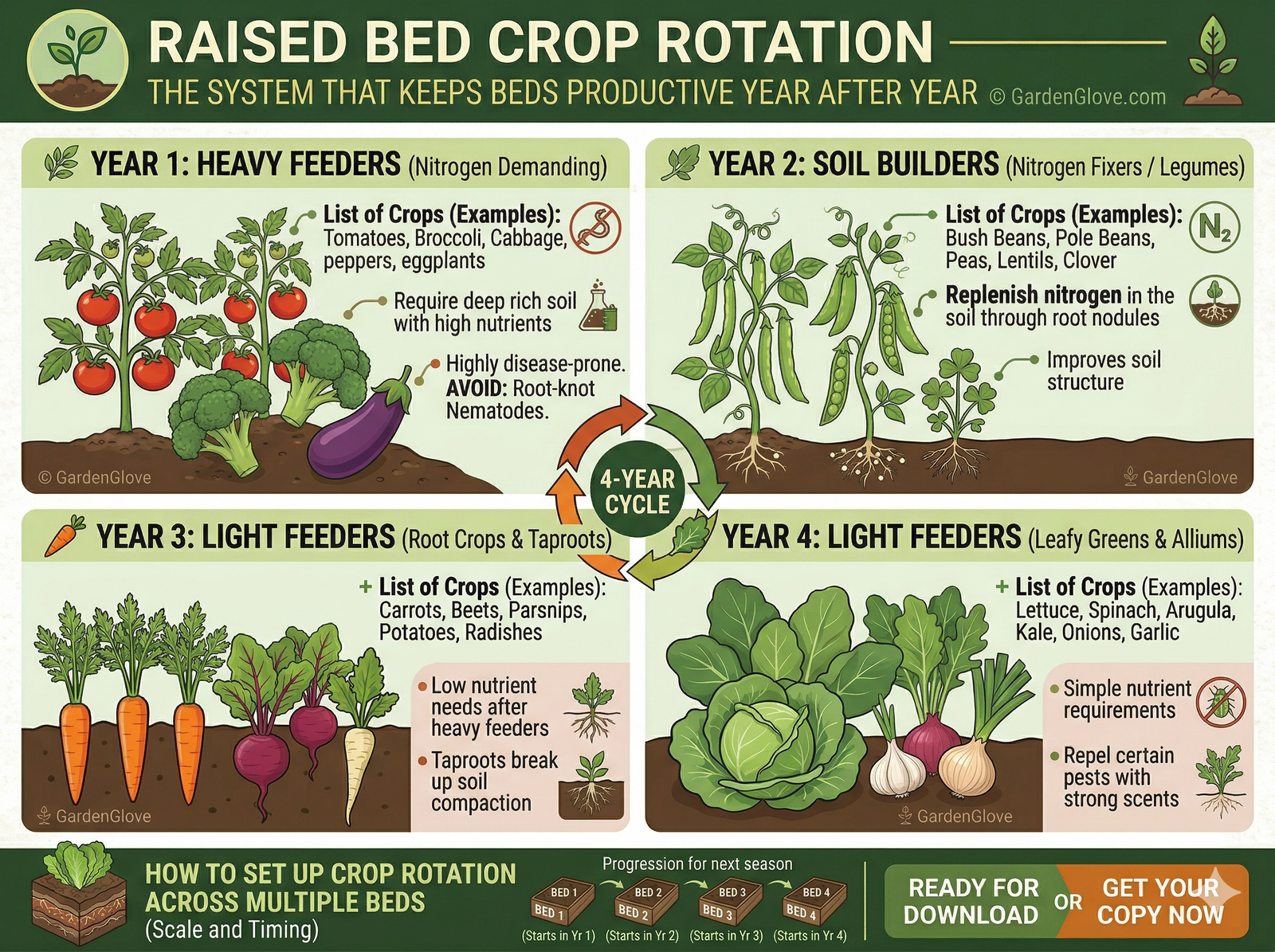
Group 1 — Heavy Feeders (Nightshades + Cucurbits): Tomatoes, peppers, eggplant, potatoes, cucumbers, squash. These crops need the richest soil — amend heavily with compost before planting. They also carry the highest disease risk, making rotation critical.
Group 2 — Brassicas + Root Crops: Broccoli, kale, cabbage, cauliflower, carrots, beets, onions, leeks. Moderate feeders that benefit from the residual fertility left by heavy feeders the previous season. Don’t need as heavy an amendment.
Group 3 — Legumes + Greens: Beans, peas, lettuce, spinach, chard, herbs. Light feeders and nitrogen fixers. This bed gets the least amendment and gives the most back — the nitrogen legumes fix stays in the soil for the following season’s heavy feeders.
The rotation:
| Season | Bed A | Bed B | Bed C |
|---|---|---|---|
| Year 1 | Heavy feeders | Brassicas + roots | Legumes + greens |
| Year 2 | Legumes + greens | Heavy feeders | Brassicas + roots |
| Year 3 | Brassicas + roots | Legumes + greens | Heavy feeders |
| Year 4 | Heavy feeders | Brassicas + roots | Legumes + greens |
Each group moves one bed forward each season. After three years, the cycle repeats.
The logic of the sequence matters. Heavy feeders follow legumes — they get the nitrogen legumes fixed the previous season. Brassicas and roots follow heavy feeders — they do well in soil that’s had the fertility partially drawn down. Legumes follow brassicas — they restore what was used and prepare the bed for heavy feeders again.
The Four-Bed Rotation System
With four beds, add a dedicated fourth group — either alliums and herbs as their own rotation slot, or use the fourth bed as a cover crop or fallow bed that rests and rebuilds each season.
Group 4 — Alliums + Herbs (or Cover Crop): Garlic, onions, leeks, shallots, plus perennial herbs. These crops have relatively low nutrient demand and low disease pressure. Alternatively, plant a nitrogen-fixing cover crop (winter rye, crimson clover, hairy vetch) in the fourth bed each season and turn it in before planting the following year.
| Season | Bed A | Bed B | Bed C | Bed D |
|---|---|---|---|---|
| Year 1 | Heavy feeders | Brassicas + roots | Legumes + greens | Alliums / cover crop |
| Year 2 | Alliums / cover | Heavy feeders | Brassicas + roots | Legumes + greens |
| Year 3 | Legumes + greens | Alliums / cover | Heavy feeders | Brassicas + roots |
| Year 4 | Brassicas + roots | Legumes + greens | Alliums / cover | Heavy feeders |
The four-bed system is the most effective layout for long-term soil health. The cover crop bed in particular contributes significantly — cover crops between main vegetable cycles, especially legumes like hairy vetch, fix up to 105 pounds of nitrogen per acre and slash erosion by over 50%, recouping roughly 61% of their costs through reduced fertilizer needs.
Rotation With Only One or Two Beds — Practical Workarounds
Not every gardener has room for three or four beds. Rotation is still possible with fewer beds — it just requires more planning and realistic expectations.
Divide single beds into quadrants. A bed that is 8 feet long and 4 feet wide can sustain a crop-rotation plan by dividing the space into quadrants and advancing the planting one quadrant in a clockwise direction each season. This isn’t as effective as moving families between physically separate beds — soil mixing at the borders limits the benefit — but it’s measurably better than no rotation.
Prioritize nightshades above everything else. If you can only rotate one family, make it nightshades. Tomato, pepper, and potato diseases are the most persistent and damaging in home garden soil. Even if everything else stays in roughly the same location, moving nightshades is the highest-return single rotation habit.
Use containers for the hardest-to-rotate crops. A tomato grown in a large container or grow bag uses fresh potting mix each season — effectively achieving a complete soil break without needing a second bed. This is a practical workaround for gardeners with limited space who grow tomatoes every year.
Soil Amendment by Rotation Group
Rotation works best when you amend each bed to match the needs of the incoming family rather than treating all beds the same.
Before heavy feeders (nightshades, cucurbits): Add 2–3 inches of rich compost, and consider a balanced organic fertilizer or fish emulsion at planting. This is the bed that gets the most input.
Before brassicas and root crops: Add 1–2 inches of compost. Brassicas benefit from slightly firmer, less fluffy soil than nightshades — don’t over-amend. Lime if pH has dropped below 6.5, as brassicas prefer slightly alkaline conditions and lime also suppresses clubroot.
Before legumes and greens: Add a light top-dressing of compost only. Legumes fix their own nitrogen — over-amending with nitrogen-rich compost actually suppresses nitrogen fixation. Lettuce and salad greens are light feeders; they don’t need heavily amended soil.
Keeping Records: The One Habit That Makes Rotation Work
Crop rotation fails without records. After two or three seasons, it’s genuinely difficult to remember which family was in which bed when — and making assumptions leads to accidentally planting the same family twice in succession.
Keeping a garden log from year to year, including a map, diagram, or photos, helps track garden history and can be used to make informed planting decisions. Note any pest or disease problems associated with the crops in each location — this helps identify patterns and refine future rotation plans.
The simplest system: a notebook with a sketch of your beds at the end of each season, noting which family group occupied each bed. A photo taken at peak summer from the same angle each year is even easier. You don’t need a spreadsheet or an app — you need something you’ll actually look at when planning the next season.
Cover Crops: The Rotation Upgrade
For gardeners with the space and the interest, adding a cover crop to the rotation cycle is the single most impactful soil health upgrade available.
A bed planted to a winter cover crop — crimson clover, winter rye, hairy vetch, or a mix — gains in several ways simultaneously: nitrogen fixation (from legume covers), organic matter addition as the cover is turned in, weed suppression through the off-season, and erosion protection from fall rains and winter freeze-thaw cycles.
Turn the cover crop in three to four weeks before planting, giving it time to begin breaking down. The resulting flush of nutrients and microbial activity gives the following season’s crop an outstanding start — particularly effective before heavy feeders.
For related guides, see our Raised Bed Layout Planner, Raised Bed Companion Planting, and Raised Bed Gardening Guide.