
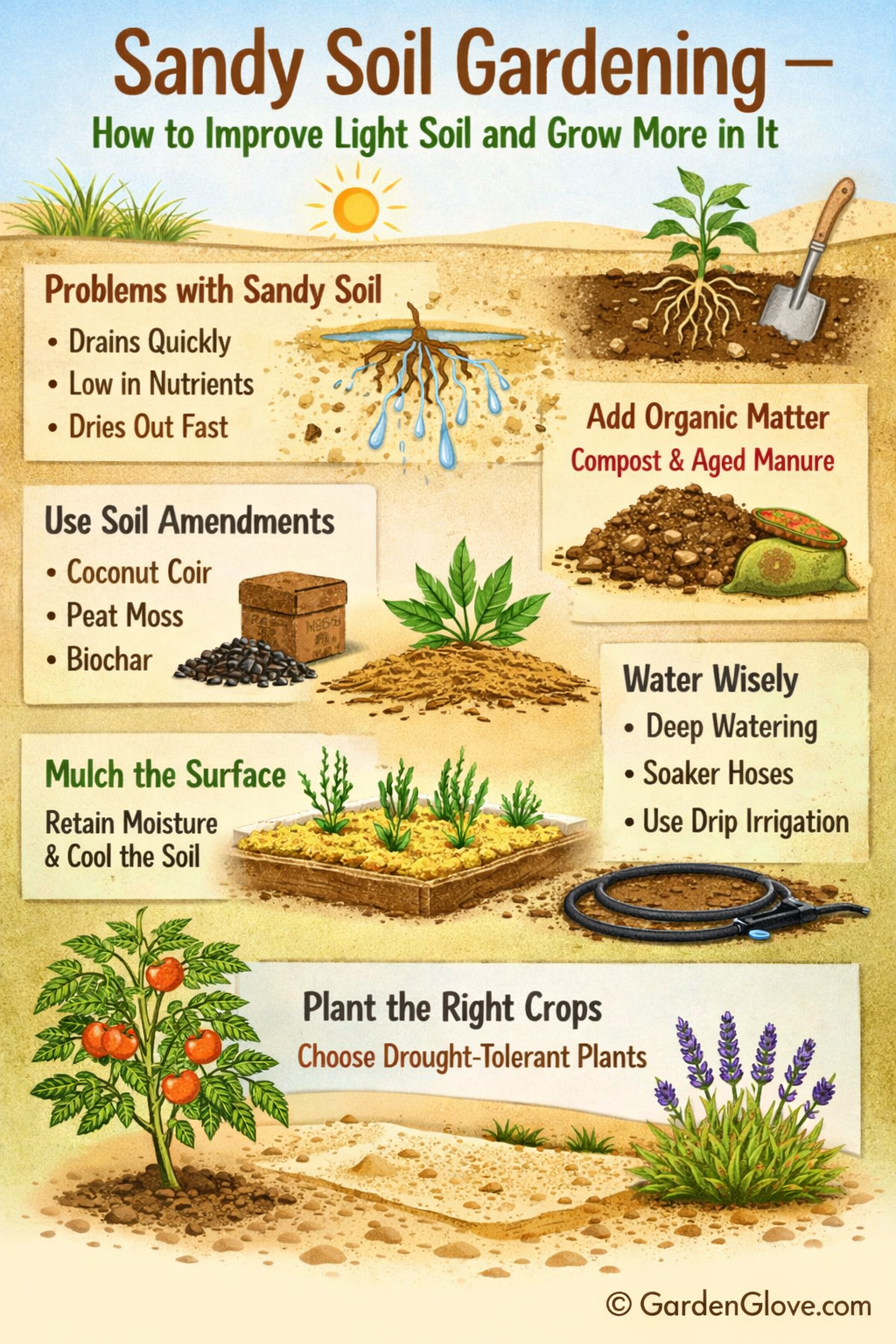
Sandy soil is the opposite of the clay problem. Where clay frustrates with compaction, waterlogging, and difficulty working, sandy soil frustrates with abundance of drainage and absence of everything else. Water runs straight through before plants can use it. Nutrients follow the water. Roots find little to anchor in. You water and fertilize more than your neighbors with heavier soil, and your plants look worse for it anyway.
The gardener’s instinct is often to fight sandy soil — to try to make it into something it isn’t. That usually means expensive amendments applied too heavily, followed by disappointment when the results don’t stick.
A better approach works with sandy soil rather than against it. The improvements are real and permanent when done correctly — but they take consistent effort and the right understanding of what’s actually happening in the soil (this ties directly into how soil functions overall: /best-garden-soil/). This guide covers both.
Why Sandy Soil Behaves the Way It Does
Sand particles are the largest mineral particles in soil. Large particle size creates large pore spaces.
This leads to:
- rapid drainage
- poor water retention
- nutrient leaching
- low cation exchange capacity
Organic matter levels are typically low, which reinforces the problem.
(This is why testing before correcting matters: /soil-testing-guide/)
The Genuine Advantages of Sandy Soil
Sandy soil is not all disadvantage.
Advantages:
- excellent drainage
- easy workability
- faster spring warm-up
- strong root penetration
These advantages shape how it should be managed, not eliminated.
What Sandy Soil Needs — The Core Inputs
Sandy soil improvement is fundamentally about organic matter.
Compost — The Foundation Amendment
Compost fills pore spaces and improves both water retention and nutrient holding capacity.
Application:
- 2–4 inches incorporated initially
- 1–2 inches annually
Compost also improves biological activity (how compost functions in soil: /compost-vs-garden-soil/).
Aged Manure
Adds:
- nutrients
- organic matter
- microbial life
Best applied in fall.
Leaf Mold
Improves:
- moisture retention
- soil structure
Worm Castings
Highly effective:
- improves nutrient availability
- supports microbial activity
Biochar
Long-term amendment:
- improves retention
- supports microbes
Best used with compost.
What About Adding Clay?
Small amounts can help, but:
- difficult to balance
- risk of creating compaction
For most gardeners:
👉 organic matter is the better solution
Mulching Sandy Soil — Non-Negotiable
Mulch is essential.
Benefits:
- reduces evaporation
- stabilizes temperature
- adds organic matter over time
This is one of the highest-impact practices for sandy soil.
Fertilizing Sandy Soil: More Often, Less at Once
Because nutrients leach quickly:
- avoid large single applications
- use split applications
- use liquid or slow-release inputs
This keeps nutrients available in the root zone (this often ties into watering practices: /vegetable-garden-watering-guide/).
Cover Crops for Sandy Soil Improvement
Cover crops:
- build organic matter
- protect soil
- improve structure
Best options:
- buckwheat
- hairy vetch
- crimson clover
- winter rye
- cowpeas
These improve soil over time and reduce erosion.
Watering Sandy Soil Efficiently
Sandy soil needs:
- more frequent watering
- but smaller amounts
Best methods:
- drip irrigation
- soaker hoses
This maintains moisture without waste:
→ /vegetable-garden-watering-guide/
Choosing the Right Plants for Sandy Soil
Some plants thrive in sandy soil:
- root vegetables
- Mediterranean herbs
- asparagus
- strawberries
- potatoes
Others require more support:
- tomatoes
- peppers
- squash
These need improved soil + consistent inputs.
A Practical Improvement Schedule
Year 1:
- test soil
- add compost
- mulch
- adjust fertilization
Year 2:
- add compost
- introduce cover crops
- improved moisture retention
Year 3+:
- maintain organic matter
- stable production
Sandy soil improves faster than clay, but requires continuous input.
pH in Sandy Soil — Often Overlooked
Sandy soils are often acidic.
Low pH:
- locks nutrients
- limits growth
Test before adjusting:
→ /soil-ph-guide/
Adjust with:
- lime (raises pH)
- sulfur (lowers pH)
Where to Go Next
If you’re building soil from scratch:
→ /best-garden-soil/
If you’re improving clay soil:
→ /clay-soil-improvement/
If you want to understand ideal soil structure:
→ /loam-soil-explained/
If you’re preparing beds for planting:
→ /vegetable-garden-soil-prep/
If you’re working with raised beds:
→ /raised-bed-soil-mix/