Ask any experienced gardener what they’d want if they could choose their starting soil, and the answer is almost always the same: loam. Not the richest, heaviest compost mix. Not the fastest-draining sand. Loam — the balanced, workable, forgiving soil that makes everything easier.
Most gardeners have heard the word but aren’t entirely sure what loam means, how to tell if they have it, or whether it’s something they can actually build toward. This guide answers all three questions and explains why loam’s reputation is genuinely earned.
What Loam Soil Actually Is
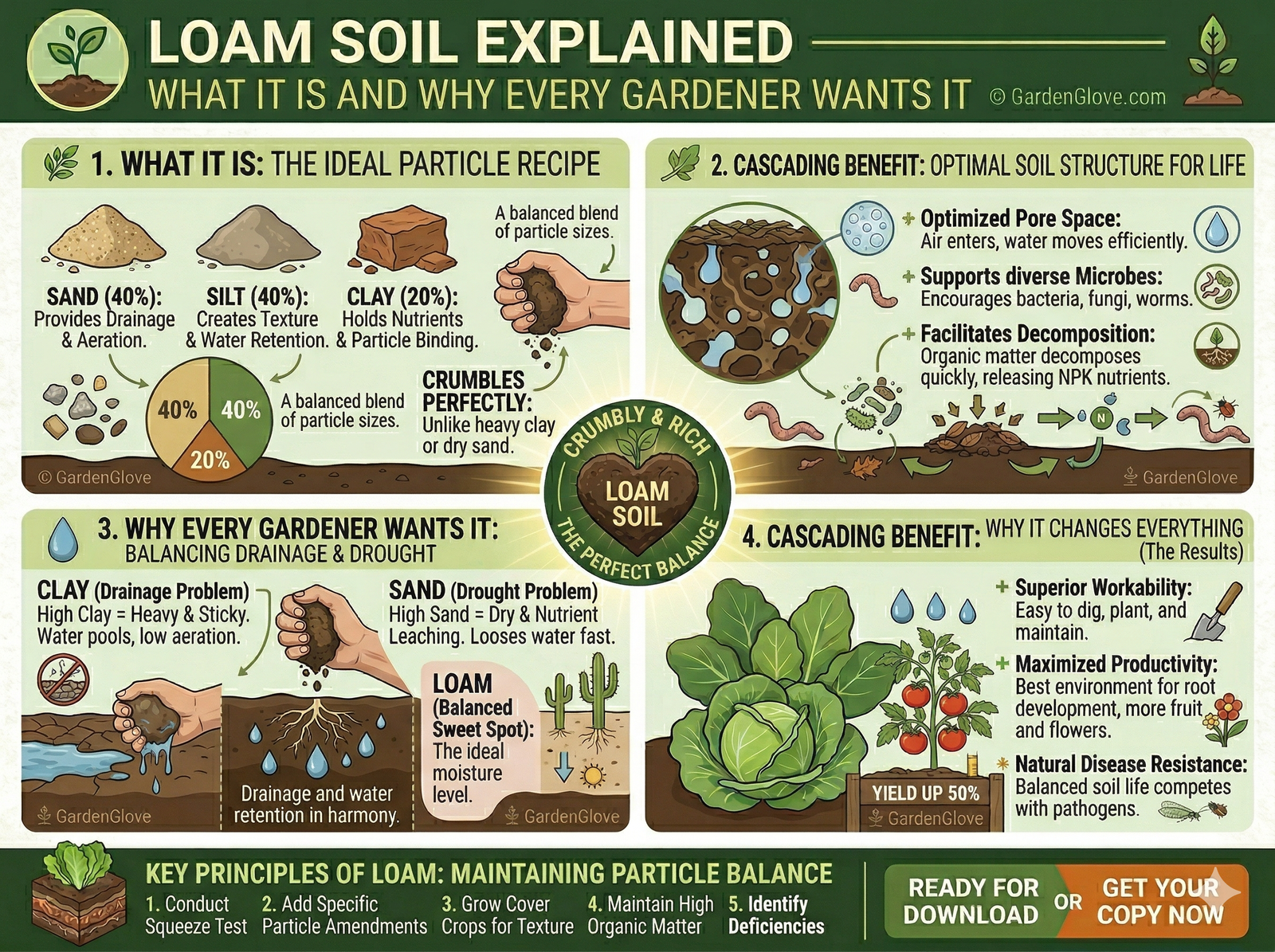
Loam soil is a mixture of sand, silt, and clay particles, with a typical composition of about 40% sand, 40% silt, and 20% clay. That ratio isn’t an exact formula — there’s natural variation, and loam soils can be classified into more specific subtypes including sandy loam, silt loam, clay loam, and silty clay loam depending on which particle type is slightly dominant. But the defining characteristic is balance: no single particle type dominates to the point of causing problems.
A typical loam soil will consist of roughly 50% soil solids — a combination of sand, silt, and clay — and 50% pore spaces and water. That 50/50 split between solid material and open space is what makes loam function so well. The pore structure provides the air roots need to breathe, holds the water plants need between rainfalls, and gives soil organisms room to move and work.
The larger sand grains prevent the soil from compacting, so it drains well and helps oxygen reach plant roots. The silt helps the sand and clay mix together, holds moisture and also makes a good home for microorganisms and decaying organic matter. The clay holds water in the soil and is negatively charged, which attracts positively charged nutrients like calcium, iron, potassium, phosphorus and magnesium.
Each particle type, in other words, contributes something the others can’t provide alone. Sand alone drains too fast and holds nothing. Clay alone holds too much and suffocates roots. Silt alone is slippery and erosion-prone. Together, in the right proportions, they offset each other’s weaknesses while preserving each other’s strengths.
The Three Particle Types — What Each One Does
Understanding the role of each particle type makes the concept of loam much more concrete.
Sand
Sand particles are the largest of the three types — large enough to see individually with the naked eye. Sandy soils do not absorb moisture well, but they do provide great aeration, allowing oxygen to reach plant roots. In a loam mix, sand creates the structural framework that resists compaction. The spaces between sand grains are large enough for water to drain freely and for air to circulate — both essential for root health.
The limitation of sand is retention. On its own, sandy soil drains water and nutrients so quickly that plants can’t access them before they’re gone. Sand needs the other particle types to slow things down.
Silt
Silt particles are medium-sized — smaller than sand but larger than clay. Silt particles absorb moisture better than sand and help the sand and clay mix together effectively. Silt has a smooth, powdery texture when dry and a slightly soapy feel when wet. In a loam mix, silt acts as the mediator — helping sand and clay work together rather than separating, and providing a middle ground for moisture retention that’s better than sand but less extreme than clay.
Pure silt soils are rare but problematic — they compact easily, especially when wet, and can form a hard crust on the surface that sheds water rather than absorbing it. In loam, the sand and clay prevent these problems.
Clay
Clay particles are the smallest of the three types — so small that millions fit in a single gram. Clay is negatively charged, which attracts positively charged nutrients like calcium, iron, potassium, phosphorus and magnesium. This charge characteristic — called cation exchange capacity — is why clay-rich soils are typically nutrient-rich. Clay holds nutrients in a form that plant roots can access, and it holds water tenaciously.
The problem with clay alone is that it holds too much. Waterlogged clay starves roots of oxygen, becomes sticky and unworkable when wet, and bakes into a dense, cracked layer when dry. In loam, sand opens the clay structure, preventing those extremes.
What Makes Loam Different From Other Soil Types
The difference between loam and single-particle soils isn’t just academic — it shows up in how hard you have to work and how well plants perform.
Compared to clay soil: Loam drains where clay waterloggs. Loam warms up in spring where clay stays cold. Loam is workable after rain where clay becomes sticky and then rock-hard. Both hold nutrients well — but loam makes those nutrients accessible while clay sometimes locks them up in anaerobic, waterlogged conditions.
Compared to sandy soil: Loam retains moisture where sand drains it immediately. Loam holds nutrients where sand leaches them. Loam requires far less frequent watering and fertilizing than sandy soil. Both are easy to work and drain adequately — but sand requires constant inputs to stay productive.
Compared to silty soil: Loam resists compaction where silt compacts easily. Loam maintains structure after rain where silt can form a surface crust. Both are reasonably fertile — but loam’s structural stability makes it far more reliably workable across weather conditions.
The practical summary: loam is considered ideal for gardening and agricultural uses because it retains nutrients well and retains water while still allowing excess water to drain away. It doesn’t require the constant intervention that clay and sandy soils demand. It works with you rather than against you.
How to Tell If You Have Loam
You don’t need a lab test to get a reasonable read on whether your soil is loamy. Two simple field tests give you a clear answer.
The Ball Test
Pick up a handful of slightly damp soil — not soaking wet, not bone dry — and squeeze it firmly into a ball. Then open your hand and poke the ball lightly with a finger.
Loamy soil will remain in the shape of a delicate ball but will crumble when you poke it.
- Soil that won’t form a ball at all and falls apart immediately: too sandy
- Soil that forms a tight, slick ball that doesn’t crumble: too much clay
- Soil that forms a loose, slightly rough ball that crumbles under gentle pressure: loam
The Jar Test
Fill a mason jar about halfway with soil, then add water until the jar is about three-quarters full. Cap it, shake thoroughly for a minute or two, then set it somewhere undisturbed.
Over the next few hours, the particles will settle in layers by size — sand settles first (it’s heaviest), silt settles next, and clay settles last (it may take a full day). As the soil settles to the bottom of the jar, distinct layers will form. The bottom layer will be sand, the middle layer will be silt, and the top layer will be clay. When these three layers are approximately the same size, you have good loamy soil.
If the sand layer is dramatically larger than the others, your soil leans sandy. If you can barely distinguish a sand layer but there’s a thick clay band, your soil leans clayey.
The Loam Subtypes — What They Mean for Gardening
Because loam exists on a spectrum rather than at a single fixed composition, there are several recognized subtypes worth understanding.
Sandy loam: Slightly more sand than the standard ratio — typically about 60–70% sand, 20–30% silt, and 10–15% clay. Excellent drainage and aeration, warms quickly in spring, easy to work. Slightly less moisture retention than standard loam. Sandy loam is ideal for growing vegetables, particularly root crops like carrots, potatoes, and onions, since its good drainage and aeration ensure these crops develop strong, healthy roots.
Clay loam: More clay than the standard ratio. Better moisture and nutrient retention than standard loam, but slower draining and heavier to work. Performs well for moisture-demanding crops in drier climates. Can become waterlogged in wet seasons.
Silt loam: Dominated by silt with balanced sand and clay. Very fertile and moisture-retentive, but prone to compaction and surface crusting if not managed carefully. High organic matter content keeps silt loam performing well — without it, it degrades quickly.
Standard loam: The balanced middle ground that most gardeners are aiming for. Works well for almost every crop. The target for most soil improvement programs.
Why Loam Is the Target — Not the Starting Point
Here’s the thing most gardening guides don’t say clearly: very few gardeners start with loam. Native soils across most of the United States lean one direction or another. The South and Pacific Northwest have significant clay-heavy soils. The coastal plain states and many Midwestern areas have sandy or silty soils. Pure loam as a native soil is relatively rare — it’s more often found in prime agricultural regions like parts of the Midwest that were historically grassland.
This doesn’t mean loam is unachievable. Technically speaking, you can’t transform your garden soil into loam by adding sand or clay, because that results in a muddy mess, or worse, almost concrete. But you can create more loamy soil in the common sense of the word by adding organic matter. That improves soil structure, or how well the soil particles are held together in clumps by humus, the glue-like substance formed when organic matter decomposes. A soil with good structure has lots of these clumps, called aggregates, which loosen heavy clay soil and help sandy soils hold moisture and nutrients.
This is the key insight: you don’t balance your soil by adding the missing particle type. You build loam-like behavior — the drainage, retention, workability, and fertility of loam — by building organic matter and soil structure. Organic matter creates aggregates: clusters of soil particles that behave like loam even when the underlying texture is clay-heavy or sandy.
Building Loam-Like Soil: The Practical Path
Whether you’re starting with clay or sand, the process for building better soil is essentially the same. It takes time — typically three to five seasons of consistent effort — but the improvement is measurable and compounding.
Add Organic Matter Every Season
This is the non-negotiable foundation. Compost, aged manure, shredded leaves, worm castings — add 1–2 inches to the soil surface before each planting season and work it lightly into the top few inches. Over time, this organic matter decomposes into humus, which binds soil particles into the aggregates that give loam its characteristic crumbly, workable texture.
For clay soil, organic matter opens the structure and improves drainage. For sandy soil, it fills pore spaces and increases water and nutrient retention. In both cases, the result moves the soil toward loam-like behavior regardless of the underlying particle ratio.
Don’t Add Sand to Clay
You can’t transform your garden soil into loam by adding sand or clay, because that results in a muddy mess, or worse, almost concrete. This is one of the most persistent mistakes in amateur soil improvement. Adding sand to clay in any amount less than a very large quantity (roughly 50% by volume, thoroughly incorporated) makes things worse — small amounts of sand in clay fill the pore spaces that clay already has, creating a denser, harder material.
The fix for clay is always organic matter. Not sand, not grit, not gravel. Organic matter.
Minimize Tillage
Every time you till deeply, you destroy the aggregates that organic matter has spent seasons building. You also kill fungal networks that help bind particles together and disrupt earthworm populations that do the same work. Light surface cultivation to incorporate amendments is fine. Annual deep plowing is counter-productive for long-term loam-building.
Protect the Soil Surface
Bare soil loses organic matter to UV degradation, loses structure to rain impact, and loses moisture to evaporation. Mulch protects all of this simultaneously. A consistent 2–3 inch layer of organic mulch maintains the surface conditions that allow soil biology to thrive and organic matter to build.
Let Earthworms Work
Earthworms are the most effective soil-loamifying agents available to any gardener. Their castings are rich in plant-available nutrients, their tunneling aerates compacted soil, and the mucus they produce as they move binds soil particles into stable aggregates. Earthworms thrive in moist, organically rich, minimally disturbed soil. Everything you do to build loam — compost, mulch, low tillage — makes your soil a better earthworm habitat. And more earthworms make better loam.
What Grows Best in Loam
The short answer is: almost everything. The versatile nature of loam soil, with its balanced texture and nutrient profile, makes it suitable for a wide variety of plants. From vegetables and fruits to ornamental plants and cereals, loam soil can support diverse agricultural activities.
For practical gardening purposes, the crops that benefit most noticeably from loam compared to other soil types are:
Root vegetables: Carrots, parsnips, beets, and potatoes develop clean, straight roots in loose, balanced loam. Clay-heavy soil produces forked, stunted roots; compacted sandy soil provides inadequate anchorage.
Fruiting vegetables: Tomatoes, peppers, cucumbers, and squash are heavy feeders that demand both strong moisture retention (for consistent fruit development) and good drainage (to prevent root disease). Loam delivers both.
Brassicas: Broccoli, kale, cabbage, and cauliflower thrive in the fertile, moisture-retentive conditions loam provides.
Perennial crops: Asparagus, strawberries, fruit trees, and perennial herbs establish stronger root systems in well-structured loam than in compacted clay or nutrient-depleted sand.
Flowers: Annual and perennial flowers generally perform better in loam than any other soil type — it supports both the vigorous root development of the establishment phase and the steady moisture and nutrient supply of the flowering phase.
The few exceptions: crops like lavender, rosemary, and Mediterranean herbs that evolved in poor, fast-draining soils often do better in leaner, sandier conditions than in nutrient-rich loam. Some native wildflowers adapted to specific regional soil types perform best in those conditions rather than amended loam. But for the kitchen garden and general ornamental planting, loam is the target for good reason.
Buying Loam vs. Building It
Bagged and bulk “loam” is widely sold at garden centers and landscape suppliers. The quality varies considerably, and the word “loam” on a label doesn’t guarantee you’re getting a well-balanced product. When buying:
For bulk loam from a landscape supplier: Ask about the composition — what percentage is sand, silt, and clay, and what’s the organic matter content. Good bulk loam should be dark, crumbly, and smell earthy. Avoid anything that smells sour or ammonia-like, or that clumps into wet slabs rather than crumbling.
For bagged “loam” or “topsoil”: Read the ingredient list carefully. Many bagged topsoil products are heavily screened subsoil with minimal organic matter — they’re inexpensive but perform poorly. Look for products that list compost or composted material in the ingredients.
For a raised bed: Building your own growing medium — compost, quality topsoil, and a drainage amendment — produces more reliably loam-like results than most bagged products and gives you control over what goes into the bed. See our Best Soil for Raised Beds guide for specific ratios and materials.
The most reliable path to loam-quality soil in any garden is building it over time from whatever you’re starting with. Buying loam as a supplement or for a new bed is a reasonable starting point — but the soil you build through consistent organic matter addition over several seasons will eventually outperform any purchased product.
For related guides, see our Best Garden Soil Guide, Best Soil for Raised Beds, and Raised Bed Fertilizer Guide.