
Companion planting has more folklore attached to it than almost any other gardening topic. Talk to enough gardeners and you’ll hear confident claims about hundreds of combinations — what helps what, what hurts what, which pairings are sacred. A lot of it is passed-down tradition that’s never been tested carefully.
Here’s the honest version: the science on companion planting is real but narrower than the folklore suggests. There are genuine, well-supported combinations that produce measurable benefits — pest deterrence, pollinator attraction, nitrogen fixation, shade management. There are also combinations that genuinely harm productivity. And there’s a large middle ground of combinations that are neutral — they don’t help or hurt, they just share a bed.
This guide focuses on what actually works: the combinations supported by consistent evidence and real-world gardening experience, the pairings to avoid, and a practical framework for planning a companion-planted raised bed without a complex chart.
Why Companion Planting Matters More in Raised Beds
In a large in-ground garden, plants have room to spread, pest pressure is distributed over a wide area, and monoculture blocks are somewhat diluted by distance. A raised bed concentrates everything — plants are closer together, pest pressure is more focused, and the consequences of poor plant relationships are more immediate.
That concentration works in your favor with good companion planting. A well-placed basil plant next to a tomato in a raised bed is close enough to deliver its pest-repelling benefits effectively. A border of marigolds around the perimeter of a 4×8 bed protects the whole interior. The confined space that creates risk also amplifies the benefit when combinations work.
The other raised bed factor is productivity. A 32-square-foot bed is valuable real estate. Every plant needs to earn its space, which means understanding which combinations improve yields and which undermine them.
How Companion Planting Actually Works
The benefits of companion planting fall into a few clear categories. Understanding the mechanism helps you evaluate whether a claimed combination is likely to be real.
Pest deterrence through scent. Aromatic plants — basil, marigolds, nasturtiums, chives, sage, rosemary — produce volatile compounds that either repel pest insects directly or mask the scent of nearby crops that pests are looking for. This is one of the best-supported mechanisms in companion planting. Insects navigate largely by smell; disrupting or overpowering the scent profile of a target plant reduces pest pressure on it. Herbs and flowers like marigolds and nasturtiums have scents that repel pests or block the scent of plants pests like to attack.
Trap cropping. Some plants attract pests more strongly than their neighbors, drawing them away from crops you’re trying to protect. Nasturtiums are the classic example — aphids and caterpillars prefer nasturtiums to most vegetables. Planted at the bed edge, nasturtiums act as a decoy, concentrating pest pressure where you can manage it.
Beneficial insect attraction. Flowering plants attract pollinators and predatory insects — ladybugs, lacewings, parasitic wasps, and hoverflies — that either pollinate your crops or control pest populations. Dill attracts ladybugs and parasitic wasps. Calendula draws hoverflies that eat aphids. Alyssum brings in lacewings. These aren’t decorative additions; they’re a functional pest management layer.
Nitrogen fixation. Legumes — beans, peas, and clover — fix atmospheric nitrogen into the soil through a symbiosis with soil bacteria. Plants growing alongside nitrogen-fixing crops can benefit from the additional nitrogen, particularly heavy feeders like corn and squash. This is the mechanism behind the Three Sisters combination.
Physical support and shade. Tall crops provide structure for climbers and shade for heat-sensitive crops. Sunflowers support cucumbers and pole beans. Taller brassicas or corn provide afternoon shade for lettuce and spinach, extending their cool-season window into warmer months.
Allelopathy. Some plants release chemicals that suppress the growth of nearby plants — either beneficial (suppressing weeds) or harmful (suppressing neighboring crops). Fennel is the most important example in a kitchen garden: it produces allelopathic compounds that inhibit most vegetables and should never share a raised bed with food crops.
The Best Companion Planting Combinations for Raised Beds
Tomatoes + Basil + Marigolds
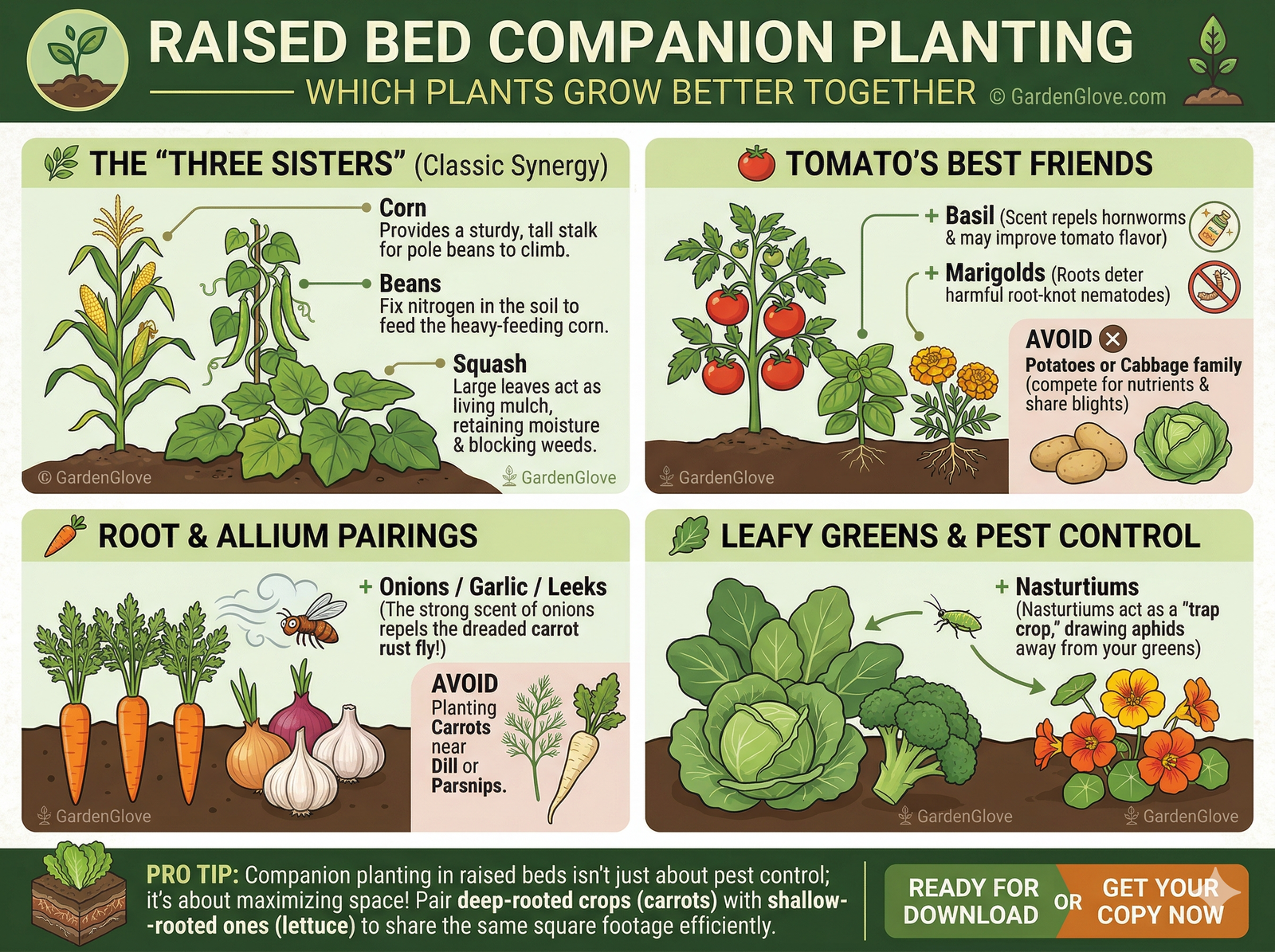
The most reliable companion combination in the kitchen garden, and one of the best-studied. Basil planted at the base of tomatoes repels tomato hornworm moths, which lay eggs that hatch into the caterpillars that devastate tomato plants. Basil also attracts bees, which improves pollination. Marigolds — specifically French marigolds — release compounds through their roots that suppress soil nematodes, which are a significant tomato pest. They also repel aphids and whitefly from above ground.
Plant one basil plant per tomato, nestled at the base where it also benefits from the shade the tomato canopy provides later in summer. Ring the perimeter of the bed with French marigolds. This is a combination you can deploy with confidence every season.
Three Sisters: Corn + Beans + Squash
The classic Native American polyculture, and one of the most ecologically complete companion combinations in vegetable gardening. Corn provides vertical structure for pole beans to climb. Beans fix nitrogen that feeds both corn and squash. Squash spreads across the soil surface, shading it to retain moisture, regulate temperature, and suppress weeds — the large leaves create a living mulch that benefits the whole planting.
This combination requires space — a minimum of 4×4 feet works, and 4×8 or larger is better. It’s most productive in a dedicated bed rather than mixed with other crops. Plant corn first in a block (not a row — corn is wind-pollinated and needs block planting to set ears), then beans at the base of corn stalks once they’re 4–6 inches tall, then squash in the gaps.
Brassicas + Nasturtiums + Sage
Brassicas — broccoli, cabbage, kale, cauliflower — are heavily targeted by cabbage moths, cabbage loopers, and imported cabbageworms. Nasturtiums act as a trap crop, attracting cabbage caterpillars away from the brassicas. Sage produces aromatic compounds that repel cabbage moths and is one of the few herbs with consistent evidence for brassica pest reduction. Plant nasturtiums at the corners and edges of a brassica bed; interplant sage between brassica plants.
Carrots + Chives + Rosemary
Carrot flies locate host plants by scent. Chives and rosemary both produce strong aromatic compounds that interfere with this navigation. Interplanting chives between carrot rows and placing rosemary at the bed edge reduces carrot fly pressure measurably. Chives also have evidence for suppressing aphids on nearby plants. Rosemary and sage are also reputed to deter bean beetles — if your beds include beans, having rosemary nearby serves double duty.
Cucumbers + Dill + Nasturtiums
Dill attracts beneficial insects — ladybugs, lacewings, and parasitic wasps — that control aphids and cucumber beetles. It also improves cucumber flavor according to consistent gardener reports, though the mechanism is less well understood. Nasturtiums planted at the bed edge act as a trap crop for aphids. Keep dill young — once it flowers and sets seed it becomes allelopathic to some plants, including tomatoes. Cut it back regularly or treat it as a cut herb rather than letting it fully mature in the bed.
Beans + Beets + Summer Savory
Bush beans and beets are complementary in space use — beans occupy the above-ground space while beets work below ground, so they’re not competing for the same resource. Summer savory, planted nearby, is one of the most consistent evidence-backed companion herbs for beans: it repels bean beetles and is reported to improve the flavor of both beans and beets. This is a productive combination for a small bed with mixed crops.
Tomatoes + Garlic + Parsley
Garlic repels aphids, spider mites, and several other soft-bodied pests through its sulfurous compounds. Planted between tomato plants, it provides ongoing pest deterrence through the season. Parsley attracts hoverflies and beneficial wasps that prey on common tomato pests. This is a useful variation on the tomato companion trio for gardeners who want culinary herbs over flowers.
Lettuce + Tall Brassicas or Tomatoes
Lettuce is a cool-season crop that bolts (goes to seed) quickly once temperatures rise. Planted beneath or beside taller crops — broccoli, kale, cabbage, or even tomatoes in their early weeks — lettuce benefits from afternoon shade that extends its productive window by two to three weeks into warmer weather. By the time the tall crop fully matures and closes the canopy, the lettuce has usually run its course. This is a shade management combination rather than a pest or fertility combination, but it’s one of the most consistently useful pairings in a small raised bed.
What Not to Plant Together
Most plants are neutral toward each other — they neither help nor harm. The combinations genuinely worth avoiding are fewer than most companion planting charts suggest, but they’re real.
Fennel with almost everything. Fennel produces allelopathic compounds that inhibit the growth of most vegetables, including tomatoes, peppers, beans, and brassicas. Keep fennel in a container or at the far edge of the property, well away from raised bed food crops. This is the one companion planting rule worth treating as absolute.
Onions, garlic, and leeks with peas and beans. Alliums suppress the growth of legumes consistently enough that it’s worth separating them. If you’re growing beans for nitrogen fixation as part of a rotation strategy, this matters even more — alliums near beans reduce the nitrogen benefit. Keep them in separate beds.
Tomatoes and potatoes. Both are nightshades and share disease susceptibility — particularly blight. Growing them together concentrates the risk and accelerates disease spread between plants. Keep them in separate beds and rotate them on a different cycle if possible.
Tomatoes and corn. Both are targets of corn earworm and tomato fruitworm — the same pest. Planting them together creates a concentrated target that amplifies pest pressure on both crops.
Brassicas with each other across seasons. This is a rotation issue more than a companion issue, but it’s worth noting: growing the same brassica family crop in the same bed season after season builds up clubroot, cabbage root fly, and other brassica-specific diseases in the soil. Rotate brassicas to a different bed each season.
Dill (mature) with tomatoes. Young dill is a fine tomato companion — once it flowers and sets seed, the chemistry shifts. Mature dill can inhibit tomato growth. Use dill young and harvested frequently, or keep it out of the tomato bed once it starts to bolt.
A Practical Framework for Planning a Companion-Planted Bed
Rather than memorizing every combination, apply this four-step process to any bed:
1. Anchor with your main crop. Identify the primary vegetable — tomatoes, cucumbers, brassicas, beans. This determines the bed’s character and which companions make sense.
2. Border with aromatic herbs and flowers. Plant marigolds, nasturtiums, basil, chives, or other aromatic plants at the edges and corners of the bed. These provide pest deterrence, trap cropping, and beneficial insect attraction for the whole bed. A companion plant doesn’t need to be immediately adjacent to provide benefit — edge planting protects the interior.
3. Fill gaps with complementary crops. Use the space between main crops for plants that fill a different vertical or root niche — lettuce under tall plants, root crops between above-ground crops, nitrogen-fixing beans alongside heavy feeders.
4. Keep incompatible families apart. Apply the short list of genuine incompatibilities: fennel away from everything, alliums away from legumes, nightshades separate from each other.
That framework handles 95% of companion planting decisions without a chart. The remaining 5% — specific cultivar combinations, microclimate adjustments, regional pest pressures — is best developed through your own seasonal observation.
Companion Flowers Worth Including in Every Raised Bed
These five flowering plants earn their space in or around any raised bed. None of them are edible in the same way vegetables are, but their functional contributions — pest deterrence, pollinator attraction, trap cropping — make them as productive as many vegetables in terms of what they contribute to the system.
French marigolds (Tagetes patula): Suppress soil nematodes, repel aphids and whitefly, attract beneficial insects. Plant freely around and within vegetable beds.
Nasturtiums: Trap crop for aphids, cabbage caterpillars, and whitefly. Edible flowers and leaves are a bonus. Plant at bed edges.
Calendula: Attracts hoverflies, lacewings, and other beneficial insects. Trap crop for aphids. Long blooming season. One of the most consistently useful companion flowers.
Alyssum (sweet alyssum): Low-growing, long-blooming, and a powerful beneficial insect attractor — particularly hoverflies and parasitic wasps. Plant at the front edge of beds where it won’t shade smaller crops.
Borage: Attracts pollinators, particularly bees. Repels tomato hornworm. Accumulates nutrients and returns them to the soil when the leaves break down. Self-seeds freely — manage by deadheading.
For related guides, see our Raised Bed Layout Planner and Raised Bed Gardening Guide.