Every gardener eventually opens the back door to find something has been at the tomatoes overnight, or turns over a leaf to find it lacework — the recognizable destruction of a pest that’s been working quietly while you weren’t looking. The instinct is to reach for a spray.
The problem with chemical dependency in pest control isn’t just environmental — it’s practical. Broad-spectrum insecticides kill beneficial insects alongside harmful ones, eliminating the predators that would naturally regulate pest populations. You spray once, the pest returns without its predators, and the cycle escalates. Chemical control without an underlying system doesn’t solve the pest problem. It replaces it with a more complicated one.
A better approach builds pest resistance from the ground up — healthy soil, diverse plantings, physical barriers, and targeted organic interventions when they’re needed. In a raised bed, you have more tools available than in-ground gardeners do, and more control over the conditions that invite pests in the first place.
Why Raised Beds Have a Natural Advantage Against Pests
Raised garden beds lift your plants above ground level, giving you more control over what’s going on around your plants. That elevation and defined perimeter changes the pest dynamic in several meaningful ways.
Physical barriers are far easier to install on a raised bed than over open ground. A row cover, mesh, or copper tape applied to a defined frame is straightforward; doing the same over a sprawling in-ground plot is impractical. The contained soil also means you can manage soil health precisely — healthy, biologically active soil produces healthier plants, and healthier plants resist pest pressure better than stressed ones. A plant that’s getting adequate water, nutrients, and light is genuinely harder for pests to damage than one that’s already struggling.
The other advantage is observation. A 4×8 bed is small enough to inspect thoroughly in five minutes. Catching a pest infestation early — before it establishes — is the difference between a minor intervention and a major problem. Daily or every-other-day walkthroughs, looking at leaf undersides and stem bases, are the most effective pest management practice available.
The Right Mental Model: Integrated Pest Management
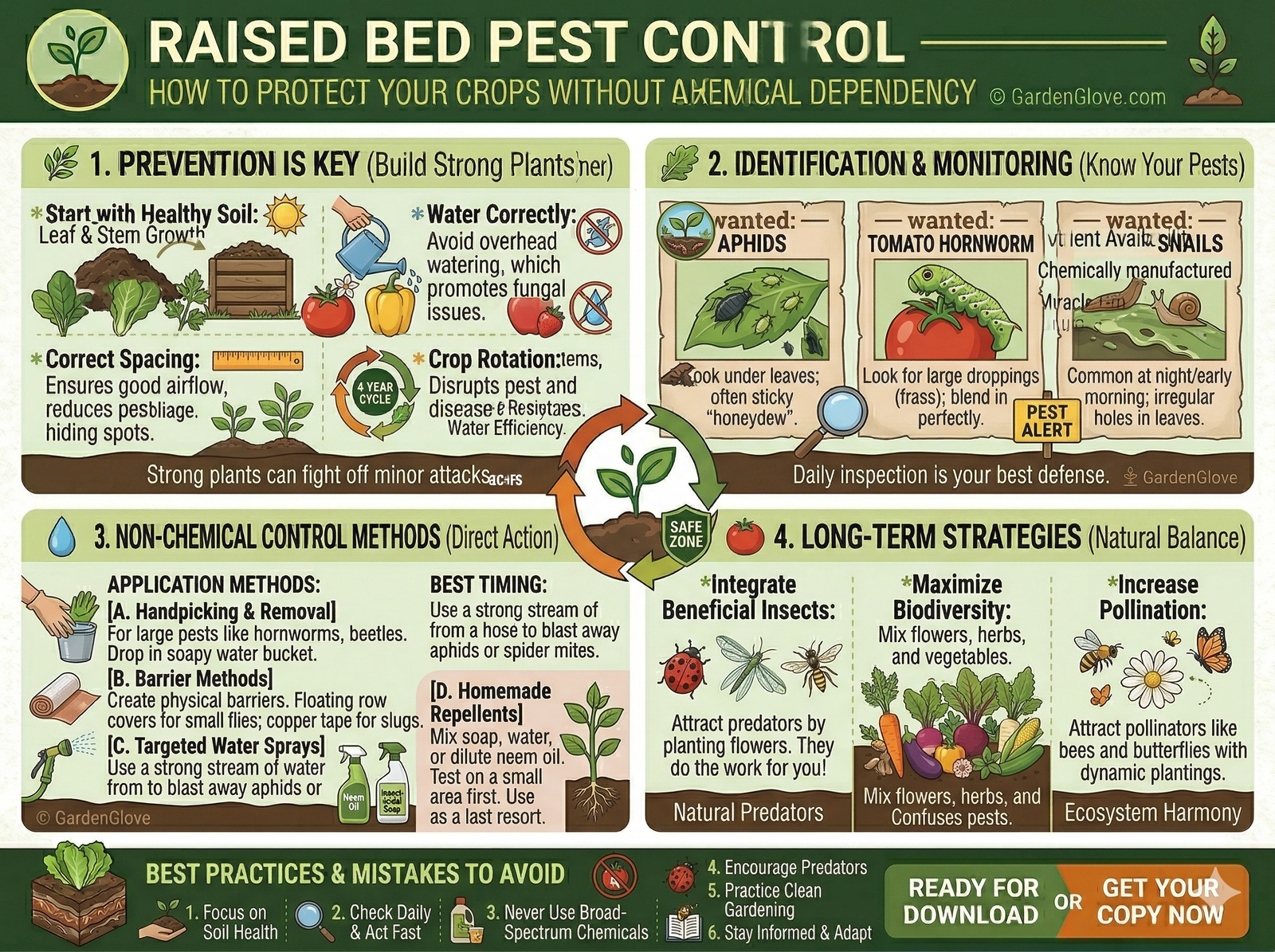
Rather than thinking about pest control as a series of reactive responses, think of it as a layered system — each layer reducing pest pressure before the next one is needed.
Layer 1 — Prevention: Soil health, crop rotation, companion planting, resistant varieties, and sanitation. The goal is a garden environment where pest populations never establish in the first place.
Layer 2 — Physical barriers: Row covers, mesh, copper tape, collars, netting. Keeps pests away from plants mechanically without any chemical input.
Layer 3 — Biological control: Beneficial insects, beneficial nematodes, birds, and other predators that regulate pest populations naturally.
Layer 4 — Manual removal: Hand-picking, blasting with water, removing affected foliage. Direct intervention without residue.
Layer 5 — Organic sprays and treatments: Neem oil, insecticidal soap, Bt, spinosad, diatomaceous earth. Targeted, minimal-residue interventions for established infestations.
Layer 6 — Conventional chemical intervention: A last resort for serious infestations where organic methods have failed and crop loss is imminent.
Most pest problems in a raised bed garden, handled through Layers 1–4, never reach Layer 5. When they do, Layer 5 options are effective, leave minimal residue, and don’t trigger the beneficial-insect collapse that makes chemical dependency a trap.
Layer 1: Prevention
Soil Health
Healthy soil grows healthy plants, and healthy plants are more resistant to pest damage. A plant that’s well-fed, properly watered, and growing in loose, well-aerated soil produces stronger cell walls, more robust immune responses, and better tolerance for partial pest damage than a stressed plant. Every investment in soil quality — compost top-dressing, crop rotation, minimal tillage — pays dividends in pest resistance.
Crop Rotation
90 percent of respondents in a large organic pest control survey reported getting good control of root maggots with crop rotation alone. Rotating plant families between beds breaks the life cycles of host-specific pests that overwinter in the soil expecting the same crop to return. Cabbage root fly, corn rootworm, and tomato-specific soil pathogens are all significantly reduced by consistent rotation. See our Raised Bed Crop Rotation guide for the full system.
Resistant Varieties
This is the most underused prevention tool. Disease-resistant varieties don’t just prevent disease — they reduce the stress that makes plants more susceptible to pest pressure as well. When selecting seeds or transplants, look for varieties bred for disease resistance relevant to your region. A blight-resistant tomato variety, for example, reduces the chronic stress that attracts secondary pests like aphids and spider mites.
Garden Sanitation
Pick up dead leaves, weeds, and debris around the base of your plants. Debris gives pests a convenient place to hide. Remove spent plants promptly at end of season. Don’t leave diseased plant material in the bed or compost pile — bag and bin it. Overwintering pests and disease spores concentrate in plant debris; removing it reduces the starting population for the following season.
Diversity and Companion Planting
One of the worst things you can do in the garden when it comes to pest prevention is plant an entire bed with nothing but cabbages or tomatoes. Planting a mix of plants, or companion planting, is a chemical-free solution to keeping pests at bay. Aromatic herbs, alliums, and flowering plants like marigolds, nasturtiums, and calendula disrupt pest navigation by smell and attract the beneficial insects that control pest populations. See our Raised Bed Companion Planting guide for specific combinations.
Layer 2: Physical Barriers
Row Covers and Insect Mesh
Nothing stops insects like a physical barrier. Floating row cover is lightweight, nonwoven fabric that lets in light, air, and water but stops insects from feeding and laying eggs. Row covers work great on greens, broccoli, root crops, and any crop that doesn’t need pollination by bees.
The key is timing: cover your garden from the moment you first plant your transplants or sow seeds. If you add a cover once pests are already present, you risk trapping the bugs underneath. For crops that need pollination — tomatoes, cucumbers, squash, beans — remove covers when plants begin to flower, or use a coarser mesh that allows pollinator access.
Row covers also provide frost protection, extending the season at both ends. A thicker cover (1.5 oz) protects to around 28°F; lighter covers (0.5–0.9 oz) provide pest protection with minimal heat retention.
Copper Tape for Slugs and Snails
Copper tape comes in a roll and can be applied around raised beds. It forms a protective barrier from slugs by providing a small electric shock when they come into contact with it. Apply a band of copper tape around the exterior of the bed frame, overlapping the ends. Keep it clear of soil and plant material that would create a bridge over the barrier.
Cutworm Collars
Cutworms sever seedlings at the soil line overnight — devastating to transplants. A simple collar made from a toilet paper roll, a 3-inch section of plastic pipe, or a cut-down paper cup pushed an inch into the soil around each transplant prevents cutworms from reaching the stem. The addition of crushed eggshells on top of the ground when transplanting also makes it hard for cutworm’s soft bodies to get around.
Hardware Cloth for Burrowing Pests
In areas with voles, moles, or gophers, line the bottom of raised beds with 1/4-inch hardware cloth before filling. This is the only reliable solution for burrowing pests — they can undermine an entire bed from below, and surface treatments don’t address the problem. Hardware cloth installed at bed construction is a one-time fix.
Layer 3: Biological Control
Attract Beneficial Insects
The most sustainable pest control system is one that runs itself — beneficial insects patrolling your beds, eating pests before populations establish. Several readers noted the ability of sweet alyssum and other flowers to attract hoverflies for organic aphid control. Calendula, borage, dill, fennel (at the garden border), and cosmos all attract ladybugs, lacewings, parasitic wasps, and hoverflies that prey on aphids, caterpillar eggs, and other garden pests.
The key is having these plants flowering throughout the season, not just at one point. Succession-planting alyssum and calendula ensures a continuous food source for beneficials when you need them most.
Beneficial Nematodes
Beneficial nematodes are microscopic organisms effective against over 200 different insects, including cutworms, cabbage maggots, beetles, and root weevil larvae. They are harmless to humans and pets and won’t kill earthworms or harm pollinators. Applied as a soil drench in spring and fall when soil is moist and above 55°F, they work through the soil targeting larvae. Buy the variety appropriate for your target pest — different nematode species target different insects.
Birds and Other Predators
Relying on bigger predators such as chickens, garter snakes, and ducks appears to be the most dependable way to achieve long-term pest control for garden slugs, as well as several types of beetles, cutworms, and many other pests. Even without livestock, installing a bird bath and native plantings near the garden attracts robins, wrens, and other insectivorous birds that actively hunt caterpillars, grubs, and beetles.
Layer 4: Manual Removal
Simple and effective, particularly for larger pests. The best time to hand-pick pests is in the early morning or evening because pests prefer to come out when it’s cooler and dark. Check the stem of the plant, the underside of the remaining leaves, and the surrounding soil — all places that pests like to hide. Remove every pest you can find by hand and toss them into a bowl of soapy water.
For aphid colonies on individual stems: cut off and dispose of heavily infested growth. For larger colonies: blast them off with a strong jet of water, holding leaves in one hand if necessary, to knock the aphids onto the ground where they’ll likely perish. A single strong hosing is often enough to break a manageable aphid infestation — the disrupted colony rarely re-establishes at the same density.
For caterpillars and worms: inspect the undersides of leaves. Tomato hornworms, despite their size, are well camouflaged — look for frass (dark pellet droppings) on leaves as a locator. Pick them off by hand and drop into soapy water.
Layer 5: Organic Sprays and Treatments
Neem Oil
Neem oil is a natural, plant-based, non-toxic, organic product that acts as a pesticide and fungicide in one. It can help control over 200 species of insects including mealybugs, aphids, thrips, whiteflies, mites, and more. Spray in the early morning or around dusk to prevent harm to beneficial insects.
Mix at 2 tablespoons per gallon of water with a small amount of dish soap as an emulsifier. Coat all leaf surfaces including undersides. Neem works best as a preventive or early-intervention treatment — it’s less effective on large established infestations than on emerging ones.
Insecticidal Soap
A diluted solution of pure castile or insecticidal soap (not detergent) kills soft-bodied pests — aphids, whiteflies, spider mites, thrips — on contact by disrupting their cell membranes. This spray works great to kill aphids, spider mites, and whiteflies, but it can also harm beneficial insects. Apply directly to pests and rinse plants after a few hours to prevent leaf burn. Don’t apply in direct sun or high heat. Repeat every few days until the infestation clears.
Bacillus thuringiensis (Bt)
Bt is a naturally occurring bacteria that produces a toxin lethal to the larvae of butterflies and moths, including cabbageworms, tent caterpillars, corn earworms, hornworms, and cutworms. It only attacks caterpillars in the Lepidoptera family and doesn’t harm other insects, bees, pets, or humans.
Apply as a spray to leaf surfaces when caterpillars are actively feeding. Bt degrades quickly in sunlight and rain — reapply after rain or every 5–7 days while larvae are present. It’s the most effective organic control for brassica caterpillars, tomato hornworm, and corn earworm.
Spinosad
Spinosad is a natural substance derived from soil bacteria that is toxic to many types of insects. It works by affecting the nervous system of the pest, leading to paralysis and death. More broad-spectrum than Bt, it’s effective against thrips, leafminers, caterpillars, and Colorado potato beetles. Apply in early morning or evening to minimize contact with pollinators. Rotate with other treatments to prevent resistance buildup.
Diatomaceous Earth
Diatomaceous earth is a non-toxic product made from crushed diatoms whose exoskeletons were made from silica. Its sharp edges prevent soft-bodied pests from entering the bed. Apply to the soil surface around the perimeter of the bed and around the base of affected plants. Effective until rain washes it away — reapply after precipitation. Use food-grade diatomaceous earth; the pool-grade product is processed differently and inappropriate for the garden.
The Most Common Raised Bed Pests — Quick Reference
Aphids: Soft-bodied clusters on new growth and undersides of leaves. Blast with water, apply insecticidal soap, or attract beneficial insects. Rarely require stronger intervention if addressed early.
Cabbage worms and loopers: Holes in brassica leaves, frass present. Row covers prevent; Bt treats existing infestations. Marigolds at bed edges reduce moth egg-laying significantly.
Tomato hornworm: Large green caterpillar on tomato, pepper, eggplant. Look for frass. Hand-pick. Bt works for smaller larvae.
Slugs and snails: Irregular holes in leaves with slime trails, usually worse after rain. Copper tape at bed edge, iron phosphate bait (Sluggo), hand-picking at night. Beer traps work.
Flea beetles: Tiny holes in leaves of brassicas and eggplant, especially seedlings. Row covers protect young plants. Diatomaceous earth around bases. Plants typically outgrow damage once established.
Squash vine borer: Sudden wilting of squash plants; entry holes at stem base. Prevention is critical — row covers until flowering, then remove. Once inside the stem, surgery (slitting the vine and removing larvae) is the only option.
Spider mites: Fine webbing on undersides of leaves, stippled appearance. Worse in hot, dry conditions. Neem oil and insecticidal soap both effective. Increase humidity and air circulation.
Cutworms: Seedlings severed at soil line overnight. Collars prevent. Beneficial nematodes address larvae in soil. Bt kurstaki can be applied as a soil drench.
Japanese beetles: Skeletonized leaves, shiny green beetles present. Hand-pick into soapy water morning and evening. Neem oil deters. Milky spore or beneficial nematodes treat grubs in soil.
Whitefly: Clouds of tiny white insects when disturbed; honeydew on leaves. Yellow sticky traps monitor and catch adults. Insecticidal soap and neem oil treat established populations.
End-of-Season Pest Management
What you do after harvest is as important as what you do during the season. Most soil-dwelling pests and disease spores overwinter in plant debris and the top inch of soil. A thorough end-of-season cleanup — removing all spent plant material, clearing mulch from the bed surface, and lightly turning the top layer of soil to expose overwintering eggs and pupae to cold and birds — reduces the starting pest population for the following spring.
Apply a fresh layer of compost after clearing and before winter. The biological activity it brings to the soil suppresses pest eggs and larvae and builds the beneficial organism populations that work in your favor come spring.
For related guides, see our Raised Bed Companion Planting, Raised Bed Crop Rotation, and Raised Bed Gardening Guide.