
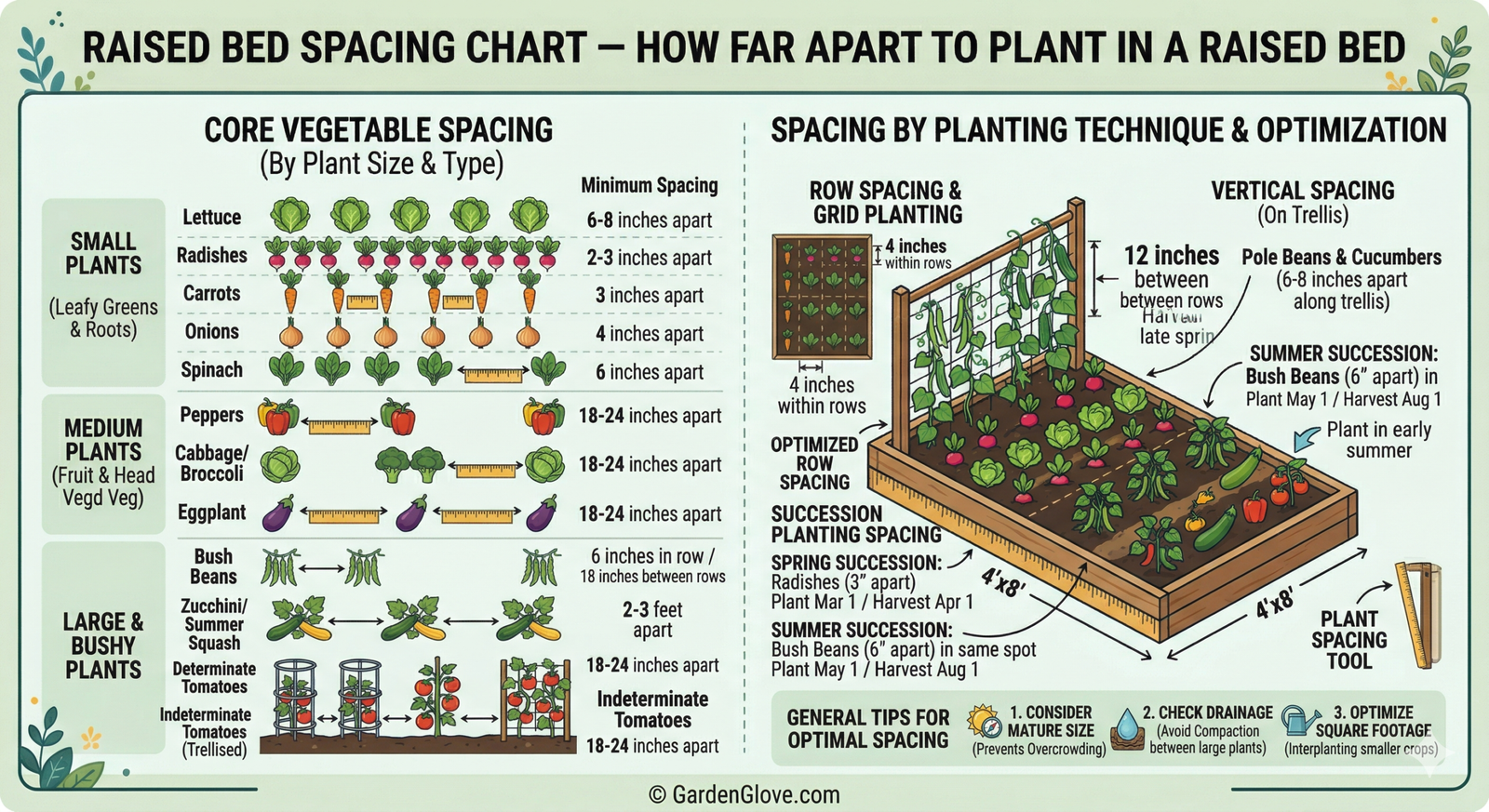
Plant spacing is one of those things that feels like a minor detail until it isn’t. Crowd your plants and they compete for water, light, and nutrients — producing smaller yields and creating the humid, airless conditions that invite disease. Give them too much room and you’ve wasted square footage that could be producing food.
In a raised bed, spacing works differently than in-ground row planting. The soil is loose and rich throughout, there’s no need for walking rows through the bed, and you can reach every plant from the edges. That means you can plant significantly closer than traditional row spacing — but not without limit, and not the same distance for every crop.
This guide gives you the spacing numbers for every common vegetable, herb, and a few fruits, explains the reasoning behind them, and shows you how to apply square foot gardening principles to make the most of whatever bed size you’re working with.
Why Raised Bed Spacing Is Different From Row Gardening
Traditional row spacing was designed for fields — tractors need room to pass, and the soil between rows compacts from foot traffic. In a raised bed, neither of those factors applies. You never walk in the bed, the soil stays loose, and roots can grow in any direction without hitting hardpan or compacted subsoil.
The result is that raised bed spacing is typically 25–50% tighter than conventional row spacing for the same crops. A carrot that needs 3-inch spacing in a traditional row can be spaced at 3 inches in a raised bed too — but you can fill the entire bed at that spacing rather than leaving wide empty aisles between rows. A tomato plant that field growers space at 36 inches apart in a row can go at 18–24 inches in a well-built raised bed.
What hasn’t changed: the plants themselves. They still need room to develop their root systems, access sunlight, and allow airflow through the canopy. The spacing numbers exist to balance those biological requirements against maximum bed productivity.
The Square Foot Gardening Framework
The simplest way to apply spacing in a raised bed is the square foot method: divide the bed into a mental grid of 1-foot squares, and assign each square a plant count based on the crop’s spacing needs.
The square foot garden spacing formula is simple. In one square, you can plant one extra-large plant, 4 large plants, 9 medium plants, or 16 small plants.
Breaking that down:
- 1 per square foot: Large crops that need 12+ inches of space — tomatoes, peppers, eggplant, broccoli, cabbage, kale
- 4 per square foot: Medium crops needing about 6 inches — chard, bush beans, beets, parsley, compact herbs
- 9 per square foot: Smaller crops needing about 4 inches — spinach, bush beans (closer spacing), turnips
- 16 per square foot: Fine crops needing about 3 inches — carrots, radishes, onions, small herbs
Some large crops need more than one square foot per plant — tomatoes ideally get 2–4 square feet, winter squash can need 9 or more. These are the crops that determine your overall bed layout rather than the other way around.
The Full Raised Bed Spacing Chart
Vegetables — Fruiting Crops
| Crop | Spacing (inches) | Plants per sq ft | Notes |
|---|---|---|---|
| Tomato (indeterminate) | 24–36 in. | 1 per 4–9 sq ft | Needs cage or stake; keep 24 in. minimum |
| Tomato (determinate/bush) | 18–24 in. | 1 per 2–4 sq ft | More compact; still needs support |
| Pepper | 12–18 in. | 1 per sq ft | Bush habit; benefits from close neighbors |
| Eggplant | 18 in. | 1 per 2 sq ft | Warm-season; space for airflow |
| Cucumber (bush) | 12 in. | 1 per sq ft | Trellised: can go tighter at 8–10 in. |
| Cucumber (vining) | 12–18 in. | 1 per 2 sq ft | Train vertically on north edge of bed |
| Summer squash/zucchini | 24–36 in. | 1 per 4–9 sq ft | Very large; one plant per corner or own bed |
| Winter squash | 36 in.+ | 1 per 9+ sq ft | Train over bed edge to save space |
| Corn | 12 in. | 4 per sq ft | Needs block planting for pollination (min. 3×3) |
| Peas (bush) | 4–6 in. | 4–9 per sq ft | Excellent for dense planting |
| Peas (climbing) | 4–6 in. | 4–9 per sq ft | Trellis on north side of bed |
Vegetables — Root Crops
| Crop | Spacing (inches) | Plants per sq ft | Notes |
|---|---|---|---|
| Carrot | 3–4 in. | 9–16 per sq ft | Thin to final spacing after germination |
| Radish | 3 in. | 16 per sq ft | Fast-growing; succession plant every 2 weeks |
| Beet | 4–6 in. | 4–9 per sq ft | Thin beet seedlings — each seed is a cluster |
| Turnip | 4–6 in. | 4–9 per sq ft | Can harvest greens; thin for root development |
| Parsnip | 4–6 in. | 4–9 per sq ft | Slow to germinate; needs deep soil |
| Potato | 12 in. | 1 per sq ft | Needs 12–18 in. depth; hilling required |
| Onion (bulb) | 4–6 in. | 4–9 per sq ft | Reduce to 6 in. for large bulbs |
| Onion (green/scallion) | 2–3 in. | 16 per sq ft | Can plant very densely |
| Garlic | 6 in. | 4 per sq ft | Plant in fall for summer harvest |
| Leek | 6 in. | 4 per sq ft | Needs 12–16 in. soil depth |
Vegetables — Brassicas and Leafy Crops
| Crop | Spacing (inches) | Plants per sq ft | Notes |
|---|---|---|---|
| Broccoli | 12–18 in. | 1 per 1–2 sq ft | Large plant; full 18 in. for side shoot production |
| Cabbage | 12–18 in. | 1 per 1–2 sq ft | Reduce spacing for smaller heads |
| Cauliflower | 18 in. | 1 per 2 sq ft | Needs full spacing for head development |
| Brussels sprouts | 18–24 in. | 1 per 2–4 sq ft | Tall plant; goes at back of bed |
| Kale | 12–18 in. | 1 per 1–2 sq ft | Cut-and-come-again; tighter for baby kale |
| Kohlrabi | 6–9 in. | 1–4 per sq ft | Compact; good for intensive planting |
| Bok choy | 6–9 in. | 1–4 per sq ft | Cool-season; bolt-resistant varieties available |
Vegetables — Salad and Greens
| Crop | Spacing (inches) | Plants per sq ft | Notes |
|---|---|---|---|
| Lettuce (head) | 8–12 in. | 1–4 per sq ft | Smaller varieties at 8 in.; butterhead at 10–12 |
| Lettuce (leaf/loose) | 4–6 in. | 4–9 per sq ft | Harvest outer leaves; don’t pull whole plant |
| Spinach | 4–6 in. | 4–9 per sq ft | Cool-season; succession plant every 2 weeks |
| Arugula | 4–6 in. | 4–9 per sq ft | Bolt-prone in heat; early spring or fall |
| Swiss chard | 6–9 in. | 1–4 per sq ft | Cut-and-come-again over a long season |
| Mâche/corn salad | 4 in. | 9 per sq ft | Cold-hardy; great for winter beds |
| Mizuna/Asian greens | 6 in. | 4 per sq ft | Fast-growing; use as cut-and-come-again |
Herbs
| Crop | Spacing (inches) | Plants per sq ft | Notes |
|---|---|---|---|
| Basil | 12 in. | 1 per sq ft | Pinch flowers to extend harvest |
| Parsley | 8–10 in. | 1–2 per sq ft | Biennial; slow to germinate |
| Cilantro | 4–6 in. | 4–9 per sq ft | Succession plant; bolts in heat |
| Dill | 9–12 in. | 1 per sq ft | Tall; goes at back of bed |
| Chives | 6 in. | 4 per sq ft | Perennial in most climates |
| Thyme | 8–10 in. | 1–2 per sq ft | Perennial; woody base needs room |
| Oregano | 10–12 in. | 1 per sq ft | Spreads; keep trimmed |
| Mint | 12 in. | 1 per sq ft | Contain in a pot sunk into bed — spreads aggressively |
| Rosemary | 18–24 in. | 1 per 2–4 sq ft | Perennial shrub; consider a dedicated bed |
| Sage | 18–24 in. | 1 per 2–4 sq ft | Perennial; woody at maturity |
Beans
| Crop | Spacing (inches) | Plants per sq ft | Notes |
|---|---|---|---|
| Bush bean | 4–6 in. | 4–9 per sq ft | Direct sow; harvest triggers more production |
| Pole bean | 4–6 in. | 4–9 per sq ft | Trellis required; very productive per sq ft |
| Lima bean (bush) | 6 in. | 4 per sq ft | Warm-season; don’t rush planting |
| Fava bean | 6 in. | 4 per sq ft | Cool-season; great nitrogen fixer |
Spacing Adjustments for Raised Bed Conditions
The numbers in the chart above are reliable starting points, but two conditions can shift them in either direction.
Soil quality affects how close you can go. The square foot densities assume a well-built, nutrient-rich raised bed mix — compost-heavy, loose, and well-draining. In a bed that’s mostly native soil or low-quality fill, use standard row spacing rather than raised bed spacing. Dense soil limits root development and nutrient availability, and crowded plants in poor soil underperform worse than spaced plants do.
Trellised crops can go tighter than ground-grown ones. A cucumber trained vertically on a trellis takes up less horizontal space than one sprawling across a bed. Bush cucumbers at 12 inches on the ground can be spaced at 8–10 inches when trellised, because the canopy grows upward rather than outward. The same applies to pole beans, peas, and indeterminate tomatoes with strong caging.
How to Use This Chart for a 4×8 Bed
A 4×8 bed has 32 square feet. Here’s how to think through planting it using the spacing chart:
Step 1 — Start with your large crops. A single indeterminate tomato plant needs 4 square feet. Two tomatoes take 8 square feet — a quarter of the bed. Plant them at the north end so they don’t shade what’s in front.
Step 2 — Add medium crops. Two pepper plants at 1 per square foot take 2 square feet. A 2×2 block of bush beans (4 square feet, 16–36 plants) fills another section.
Step 3 — Fill with short crops. One square foot of radishes gives you 16 plants. Two square feet of lettuce at 4 per square foot gives you 8 heads. One square foot of carrots gives you 9–16 roots. Three to four square feet of basil and parsley finishes the front row.
At this point you’ve used roughly 20 of 32 square feet with intentional spacing. The remaining 12 square feet can go to a second round of fast crops for succession planting — more beans, a spinach block, additional herbs — or be reserved for mid-season transplants once early crops finish.
The Most Common Spacing Mistakes
Trusting the pot tag spacing. Nursery tags list standard field spacing — the distance that works in rows with walking paths between them. In a raised bed, you can typically go tighter. A pepper tag that says “space 18 inches apart” in a field row can go 12 inches in a raised bed without crowding.
Not thinning. Direct-sown crops like carrots, beets, and lettuce need to be thinned to their final spacing after germination. It feels wasteful to pull healthy seedlings, but leaving them crowded produces poor results. Thin carrots to 3–4 inches and beets to 4–6 inches once they reach 2 inches tall.
Planting large sprawlers without accounting for their spread. A zucchini plant listed at “24-inch spacing” will spread 3–4 feet in every direction at maturity. One plant per 4×4 section is about right. Two plants in a 4×8 bed leaves almost no room for anything else. If zucchini is important to you, give it its own bed or train it to sprawl over the edge.
Ignoring vertical space. Crops that are trellised produce the same yield in roughly half the ground footprint of ground-grown plants. Pole beans, cucumbers, and peas on a north-side trellis free up the majority of the bed for other crops while still producing a full harvest.
Crowding herbs with vegetables. Perennial herbs like rosemary, sage, thyme, and oregano grow into substantial plants over multiple seasons. Planting them between annual vegetables creates a problem by the second year — the herbs have taken over and there’s no room to rotate crops. Dedicate one bed or section to perennial herbs and keep annual herbs with the vegetables.
A Note on Succession Spacing
Spacing works differently for crops you’ll succession plant — sowing a new batch every two to three weeks to extend harvest. For these crops (radishes, salad greens, cilantro, bush beans, spinach), don’t plant the whole designated area at once. Plant half the allocated space, wait two weeks, plant the other half. Both sowings will be at proper spacing, and you’ll harvest continuously rather than getting everything at once.
For a bed producing salad greens through spring and fall, succession planting at correct spacing is more important than the exact number of plants per square foot. Eight well-spaced lettuce plants sown two weeks apart produces more usable salad over more time than sixteen crowded plants sown all at once.
For more on planning your beds, see our Raised Bed Layout Planner and Raised Bed Gardening Guide.