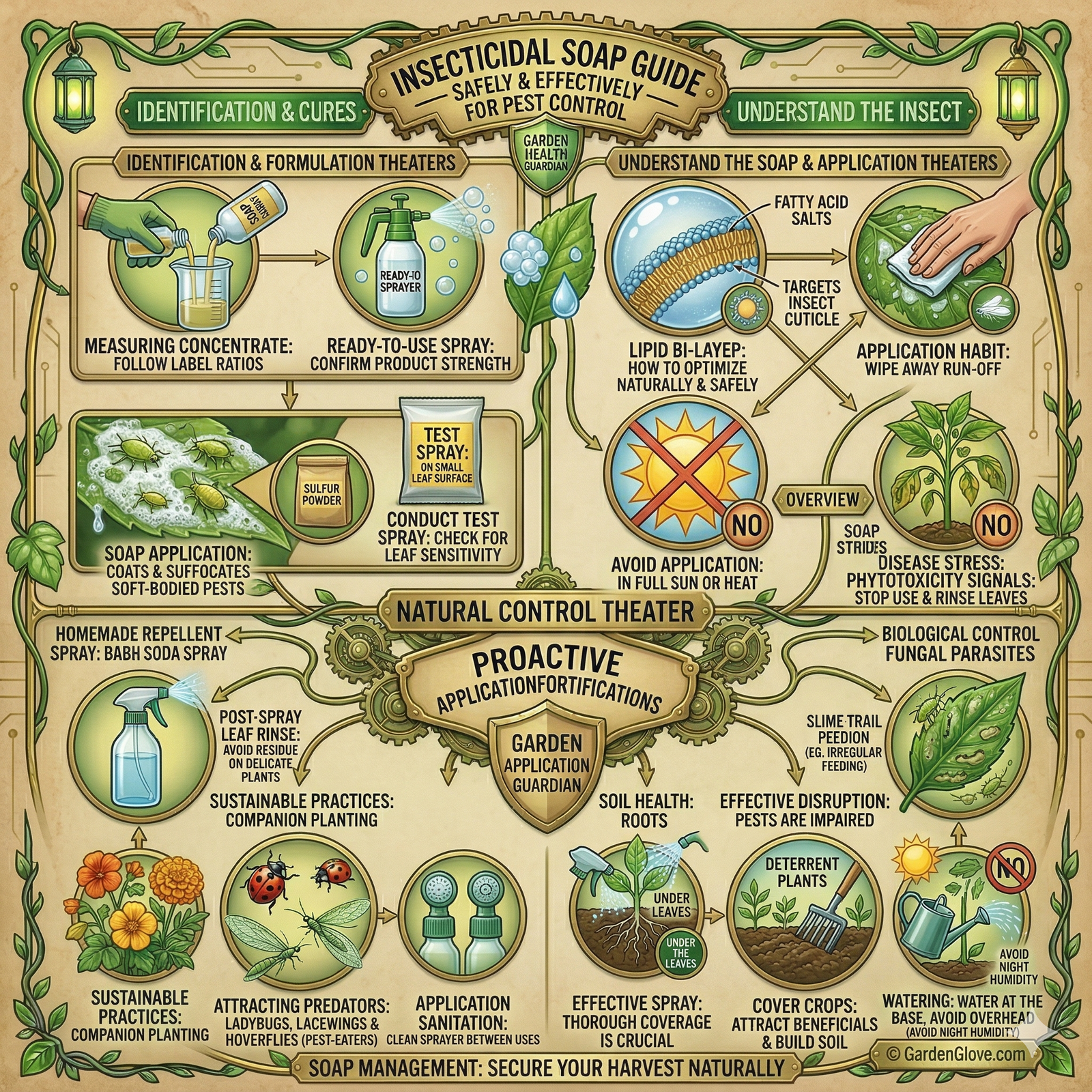
Insecticidal soap is one of the oldest pest control tools in gardening — it has been used for more than 200 years to manage soft-bodied garden pests. It’s inexpensive, biodegradable, low in toxicity to mammals, and effective against a wide range of the pests that gardeners deal with most: aphids, whiteflies, spider mites, mealybugs, and thrips.
It’s also one of the most misused products in the organic gardening toolkit. Gardeners apply it at the wrong concentration and burn their plants. They spray it in full sun and get the same result. They use dish soap instead of proper insecticidal soap and damage their vegetables. They spray once and expect lasting results from a product that works only on contact and has no residual effect.
This insecticidal soap guide covers what the product actually is, how it works, which pests it controls, how to apply it correctly, what to watch for, and what common substitutes to avoid. If you are not sure which pest you are dealing with, start with our Garden Pest Identification Guide — What’s Eating Your Plants and How to Tell before treating.
What Insecticidal Soap Actually Is
Insecticidal soap is not dish soap, hand soap, or laundry detergent. It is a specific formulation — potassium salts of fatty acids derived from natural animal fats and plant oils — made and tested to be effective against pests while remaining reasonably safe for plants.
Modern insecticidal soaps, or soap salts, are potassium salts of fatty acids — molecules containing potassium attached to long carbon chains. The key word is potassium. Most household soaps use sodium salts, which are harsher and far more likely to damage plant tissue. Dishwashing soaps and detergents are designed to remove grease from dishes and may cause plant damage by dissolving the waxy cuticle on plant leaf surfaces.
Commercial insecticidal soaps are purpose-formulated to be effective at the concentrations that are safe for plants. That balance is difficult to replicate at home with general-purpose soap products, which is why commercial formulations are significantly more reliable than homemade alternatives.
Available formats:
- Concentrate: The most economical option. Dilute per label directions — typically 2.5 to 5 tablespoons per gallon of water.
- Ready-to-use (RTU): Pre-mixed spray. Convenient but more expensive per application.
- Combination products: Some formulations add neem oil, pyrethrin, sulfur, or spinosad. These extend the pest range but also broaden the impact on non-target insects. Plain insecticidal soap is the most selective option.
How Insecticidal Soap Works
Because insecticidal soap works on direct contact with pests via the disruption of cell membranes when the insect is penetrated with fatty acids, the insect’s cells leak their contents causing the insect to dehydrate and die.
The mechanism is purely physical, not chemical. The fatty acids penetrate the pest’s soft outer cuticle, disrupt cellular integrity, and cause rapid dehydration. For this reason:
It has no residual effect. As mentioned earlier, once an insecticidal soap spray has dried, there is no residual activity because insecticidal soaps work only on contact. A pest that arrives after the spray has dried is completely unaffected. This is both a limitation — requiring repeated applications — and an advantage: beneficial insects that land on the plant after the soap dries are safe.
It must coat the pest to work. If you can’t see the pest — don’t bother spraying. A pest that flies away will not be harmed. Spraying leaf surfaces when no pests are present accomplishes nothing. The soap only affects insects it directly contacts while still wet.
It works best on soft-bodied, immature pests. Insecticidal soap works best to control soft-bodied pests such as aphids, whiteflies, spider mites, mealybugs, and scale. It is most deadly to insects in their young life cycle, especially the nymph stage. Large-bodied adults with tough exoskeletons — beetles, caterpillars, stink bugs — are largely unaffected by soap sprays.
What Insecticidal Soap Controls
Effective Against
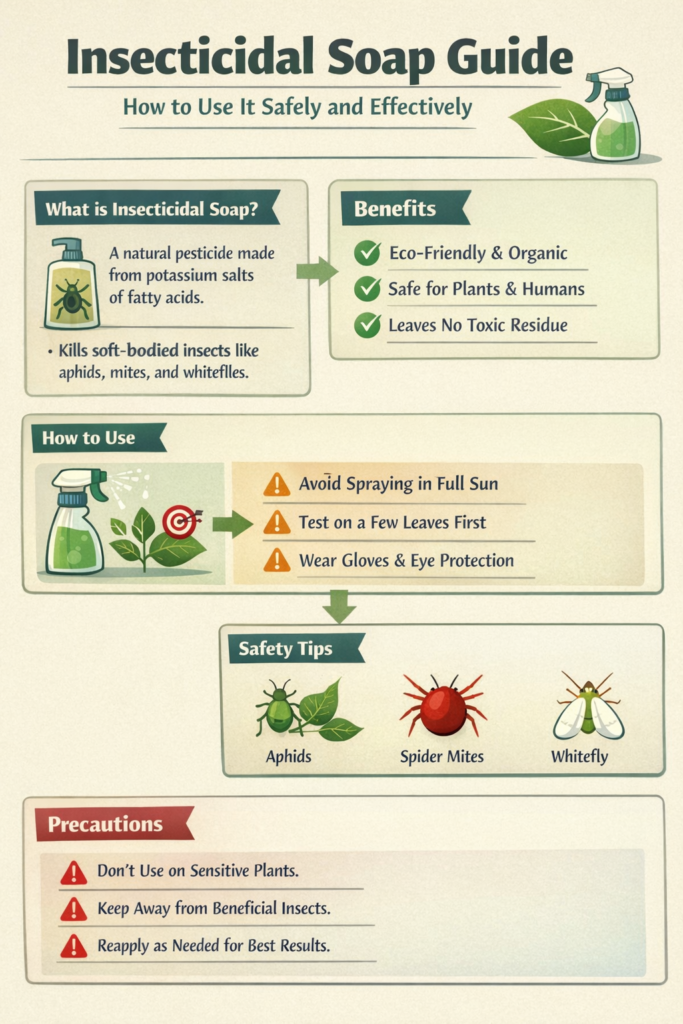
Insecticidal soaps are most effective on soft-bodied pests such as aphids, adelgids, lacebugs, leafhoppers, mealybugs, thrips, sawfly larvae, scale insects (especially scale crawlers), plant bugs, psyllids, spider mites and whiteflies.
For vegetable gardeners, the most useful applications are:
- Aphids — direct contact with colonies; coat shoot tips and leaf undersides where colonies cluster
- Whitefly nymphs — spray leaf undersides where nymphs feed; adults will fly off but nymphs are eliminated
- Spider mites — most effective when directed at leaf undersides where mites feed and reproduce
- Mealybugs — direct contact required; their waxy coating makes thorough penetration difficult
- Thrips — useful at nymph stage; adults are more mobile and harder to contact
Less Effective Against
Larger insects, such as caterpillars, sawflies, and beetle larvae, are generally immune to soap sprays. Large, adult flying insects with stronger exoskeletons are generally not affected, but larval stages may be susceptible.
For caterpillars use Bt instead. For Japanese beetles and other hard-shelled beetles, use hand-picking or neem oil. Don’t reach for soap spray when facing pests it won’t affect.
That matters with pests like Tomato Hornworms — How to Find, Remove, and Prevent Them, Cabbage Worms and Cabbage Loopers — How to Protect Your Brassicas, and Squash Vine Borers — How to Protect Your Squash Before It’s Too Late. These are not the situations where insecticidal soap is usually your main fix.
Impact on Beneficial Insects
This is a nuance most guides skip. Many pollinators and predatory insects such as lady beetles, bumblebees, and hoverflies are relatively unaffected. However, soap will kill predatory mites that may help control spider mites. Also, the soft-bodied aphid-eating larvae of lady beetles, lacewing, and hoverflies may be affected negatively. According to one study a single soap application killed about 15% of lacewing and lady-beetle larvae, and about 65% of predatory mites.
The practical implication: check for beneficial insect larvae before spraying. If ladybug larvae, lacewing larvae, or predatory mites are present and working on the pest population, give them a week before intervening. Don’t spray if lady beetles or other friendly insects are on the plant. Wait a couple of hours and check again. Adult ladybugs and bees that land on dried soap are unaffected — it’s the larval stages and predatory mites that are vulnerable to wet spray.
How to Mix Insecticidal Soap
Insecticidal soaps are usually used as a 1 to 2% solution (2½ to 5 tablespoons per gallon). Always follow the label for the product you are using. Do not attempt to use in higher concentration, as this may be very harmful.
Standard mixing ratio:
- 2.5 tablespoons concentrate per gallon of water (1% solution) — for most applications
- 5 tablespoons per gallon (2% solution) — for heavy infestations or hard-to-control pests
Always start at the lower concentration and increase only if needed. Higher concentrations increase effectiveness marginally but increase plant damage risk substantially.
Water quality matters. Insecticidal soap mixed in hard water with a high mineral content may be less effective and more toxic to the treated plants. A precipitate may be formed when the metal ions found in hard water bind to the fatty acids in the soap. If your tap water is noticeably hard, use distilled or softened water for mixing.
Mix fresh each time. For best results use freshly mixed solution. Don’t store mixed soap spray — the potassium fatty acid salts degrade in water. A concentrate stores well; the diluted solution does not.
How to Apply Insecticidal Soap
Timing
Do not apply the soap in full sun or at temperatures above 90°F as this may damage the plants. It is best to treat your plants in the early morning or late in the day. Since the soap spray is only effective as long as it is wet, the slower drying conditions favor better insect or mite control.
Early morning is the preferred window — cooler temperatures slow drying (maximizing contact time with pests), foliage dries through the day (reducing phytotoxicity risk), and pollinators are less active. Avoid treating with soaps on hot sunny afternoons which promote rapid drying.
Coverage
The soapy water needs to not just touch the insect but also coat the insect’s body in order to be effective. This means turning over leaves to reach insects on the underside of leaves or spraying from the bottom up.
Thorough coverage is vital for the soap to be effective: spray thoroughly, but not beyond the point of runoff. Dripping excess soap off leaves doesn’t improve results and wastes product. The goal is full, even coverage — particularly on leaf undersides where most target pests live.
Frequency
To be most effective, you must apply insecticidal soaps vigilantly and thoroughly. You may need to reapply weekly until the pests are under control.
For most active infestations, apply every 5–7 days. The soap kills only what it contacts on the day of application — new nymphs hatching from untouched eggs will resume the population unless subsequent applications reach them. Three to four consecutive weekly applications typically work through the pest lifecycle.
One manufacturer recommends a maximum of three sequential applications over a two-week period — spacing them out and monitoring between applications rather than spraying continuously.
Water In Before Spraying
Apply insecticidal soap spray only when the plant has been watered and is well-hydrated. Wilted plants are more susceptible to damage. Stressed, drought-stressed plants are significantly more prone to soap burn. Water the night before or the morning of application.
Plant Sensitivity — The Spot Test
Not all plants tolerate insecticidal soap equally. Soap spray may damage plants, especially at higher concentrations or at temperatures above 32°C (90°F). Plant injury may not be apparent until two days after application.
Insecticidal soaps may cause phytotoxicity symptoms such as yellow or brown spotting on the leaves, burned tips or leaf scorch on certain sensitive plants.
Plants known to be more sensitive include: sweet peas, portulaca, hawthorn, cherries, plum, some tomato varieties, nasturtiums, bleeding heart, maidenhair fern, Easter lily, and crown of thorns.
When in doubt, test soap-detergent sprays for phytotoxicity problems on a small area a day or two before an extensive area is treated. Apply to one or two leaves, wait 24–48 hours, and check for spotting, browning, or tip burn before treating the whole plant.
If the damage you are seeing may be disease rather than insect feeding, see Fungal Diseases in the Garden — How to Identify and Manage the Most Common Ones before spraying.
What Not to Use — The Dish Soap Problem
This comes up in every organic gardening forum, and the answer is consistent: commercial insecticidal soap is significantly safer and more effective than dish soap.
Dish soaps contain powerful detergents that can injure plants, damage soil, and contaminate waterways. Many household soap components are not biodegradable. Furthermore, household soaps used as pesticides are of questionable legality.
Dish soaps are detergents, not soaps in the chemical sense. They’re formulated to remove grease from dishes — aggressively — and that action extends to the waxy cuticle on plant leaves. Dish soap is not even a soap — it is a detergent. You can’t make insecticidal soap using a detergent because they are very toxic to plants.
Some gardeners use pure castile soap (like Dr. Bronner’s unscented) as a lower-risk DIY alternative. Castile soaps are genuine potassium-based soaps rather than detergents and are less likely to damage plants than dish soap. However, they’re not formulated or tested as pesticides, may contain additives, and aren’t labeled for this use. For reliable results with minimal plant risk, commercial insecticidal soap is the better choice.
Safety
Soaps have low mammalian toxicity. However, they can be mildly irritating to the skin or eyes. Insecticidal soaps are biodegradable, do not persist in the environment, and they do not contain any organic solvents. Many formulations of insecticidal soap can be used on various food crops up to the day of harvest.
Insecticidal soap breaks down rapidly in the environment — it leaves no persistent residue. Wash produce before eating. Wear gloves if applying large quantities to minimize skin irritation.
Because insecticidal soaps are toxic to fish and aquatic organisms, do not use near bodies of water. Don’t spray near ponds, streams, or drainage that runs to water features.
Quick Application Reference
| Situation | Concentration | Timing | Frequency |
|---|---|---|---|
| Light aphid, mite infestation | 1% (2.5 tbsp/gal) | Early morning | Every 7 days |
| Heavy soft-bodied pest infestation | 2% (5 tbsp/gal) | Early morning or evening | Every 5–7 days |
| Whitefly nymphs (leaf undersides) | 1–2% | Early morning | Every 5–7 days |
| Sensitive plant species | 1% or less | Cool morning | Test first; max 3 applications |
| Spider mites (leaf undersides) | 2% | Early morning | Every 5 days |
Related Guides
For pest-specific guidance on where insecticidal soap is most useful, see our Aphids on Plants, Spider Mites, and Whiteflies on Plants guides.
If you are still trying to identify the problem, go to Garden Pest Identification Guide — What’s Eating Your Plants and How to Tell.
If you need broader prevention and treatment strategies across the cluster, return to the Garden Pest Control pillar.